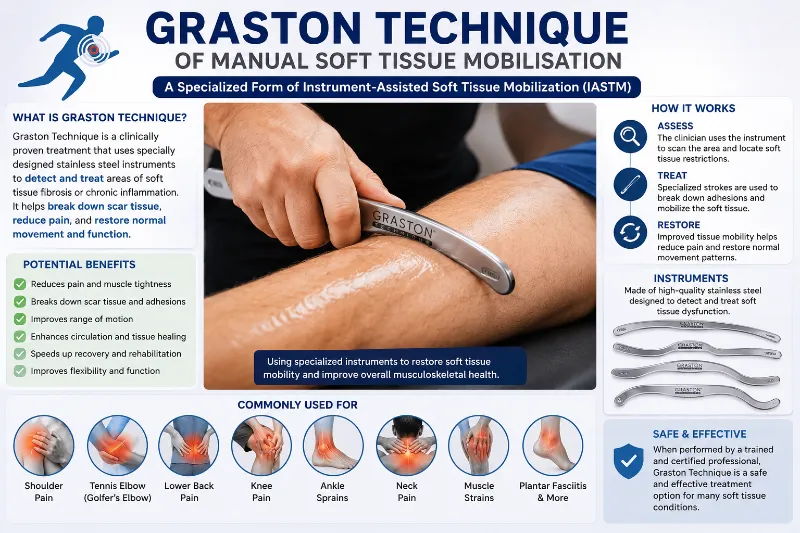
Graston Technique of Manual Soft Tissue Mobilisation
Table of Contents
Introduction
Graston Technique is a type of instrument-assisted soft tissue mobilisation (IASTM) that is performed by qualified practitioners who use specially designed stainless steel instruments to glide over the skin, facilitating the recognition and release of restricted soft tissue. The treatment is typically indicated in the context of rehabilitating tissue pain, stiffness, or dysfunction.
To an untrained eye, the very idea of using metal instruments to scrape the skin sounds intimidating. The reason why Graston Therapy is performed with these particular tools rather than hands is that they allow the therapist to have better control over the pressure applied. Graston Technique’s official website notes that the instruments are used for a specific type of IASTM that enables clinicians to treat pain, range of motion, and soft tissue injuries by enhancing their sense of touch.
What Is Graston Technique?
Graston Technique is one of the forms of IASTM that can be used by clinicians to manually treat soft tissue. Simply put, it is a type of soft tissue mobilisation therapy that uses specially designed stainless steel instruments rather than the therapist’s hands. The instruments are available in several shapes and sizes to allow the therapist to access all the body’s parts and provide the necessary treatment angle and pressure.
In the context of Graston, the term soft tissue refers to muscles, tendons, ligaments, fascia, and post-surgical scars that can become inflamed or restricted in their natural range of motion. The Graston Technique’s website notes that the therapy is used by clinicians to treat chronic, acute, and post-surgical soft tissue conditions.
How Does It Work?
The therapist typically begins the treatment by using the instruments to examine the soft tissue. The examination helps the therapist determine the appropriate treatment to be administered. Once the affected tissue is localised, the therapist begins mobilisation with either a specific type of movement or pressure. Graston Technique’s training website notes that the therapy is characterised by clinical indications, physiological effects, and treatment parameters. The latter refers to the unique angles of the instruments, variations of stroke, and body position used during the treatment.
The exact mechanism of action of Graston Technique is unknown. However, it is typically used to reduce pain and increase tissue extensibility and mobility in the affected area. According to a published review on the effectiveness of IASTM, the technique can be beneficial in improving the range of motion in asymptomatic participants and reducing pain and patient-reported disability in some injured patients. The same review notes that the effectiveness of the technique is inconsistent in the literature and that the evidence is inconclusive.
One of the ways to interpret the benefits of Graston Technique is to consider it a part of a rehabilitation programme that facilitates the restoration of tissue mobility, extensibility, and movement potential. In this regard, the technique can be considered a tool that allows the therapist to provide a specific type of movement to the targeted area. This perspective aligns with the published reviews and training materials on IASTM and Graston Technique.
What Conditions Is It Used For?
Graston Technique is typically used for a variety of soft tissue conditions that cause pain and limited range of motion. According to the patient FAQ section on Graston’s website, the technique can be used for chronic, acute, and post-surgical soft tissue conditions.
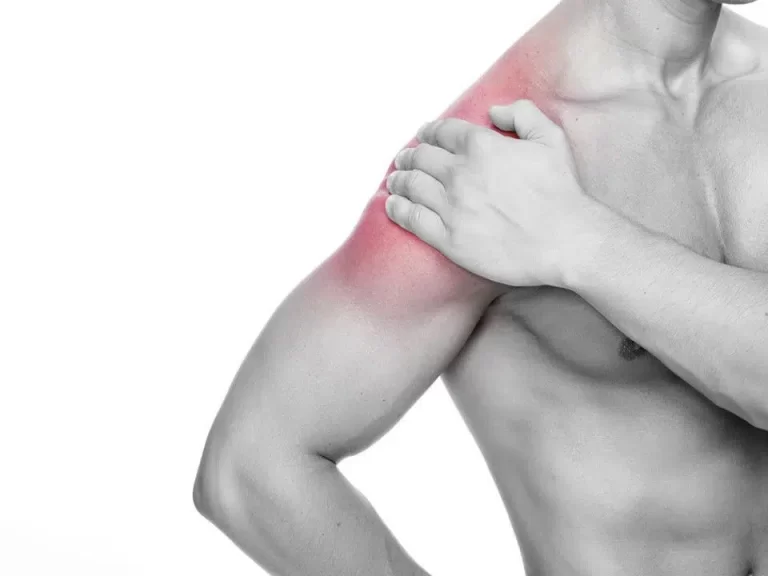
As a soft tissue mobilisation therapy, Graston Technique can be indicated for a variety of soft tissue conditions and injuries. In practice, the therapist would use the technique to treat tendon irritation, muscle stiffness, post-surgical tissue restriction, or any other condition that causes limited range of motion or pain.
It is important to note that Graston Technique is not a universal solution. In other words, the technique is used as a part of the rehabilitation programme that is specifically tailored to the patient’s needs and condition. That perspective aligns with the published literature on IASTM and Graston Technique, as well as the official training of the technique.
What Does the Treatment Feel Like?
A typical Graston session can begin with the therapist examining the affected tissue with the instruments. The therapist then proceeds to loosen the restricted tissue using various strokes and pressure, depending on the patient’s needs and the area being treated. The patient can feel a range of sensations during the treatment, from light pressure to scraping and rubbing, depending on the location and the pressure used by the therapist. The therapist can also use the instruments to compare the mobility of different areas of the body or track the progress of the treatment.
Most patients report that Graston Therapy can cause bruising, redness, and soreness after the treatment. According to the patient FAQ, these side effects are common and should subside within a few days. In addition, the therapist can incorporate a variety of other treatment modalities into the session, depending on the patient’s needs and the therapist’s treatment plan. The same FAQ section notes that the therapist would use movement, stretching, and strengthening as a part of the rehabilitation programme.
What Are the Benefits?
The benefits of Graston Technique are largely related to the potential improvements in range of motion and reduction in pain and tissue restriction. As previously mentioned, the systematic review on the effectiveness of IASTM found that the techniques can be beneficial in improving the range of motion in asymptomatic participants and reducing pain and patient-reported disability in some injured patients. The same review notes that the effectiveness of the technique is inconsistent in the literature and that the evidence is inconclusive.
Another benefit of Graston Technique is that it provides the therapist with a tool to enhance their sense of touch during the treatment. The therapist can use the instruments to identify the restricted tissue and loosen it with a specific type of pressure and movement. Graston’s patient FAQ section notes that the instruments are designed to amplify the therapist’s tactile response during the examination and treatment.
Some patients may also appreciate the fact that Graston Technique can be a part of their structured rehabilitation programme. In other words, the technique can be used to track the progress of the treatment based on the specific changes in the mobility of the targeted tissue. That benefit is related to the ability of the therapist to examine the tissue using the instruments and measure the range of motion before and after the treatment. This perspective aligns with the published literature on Graston Technique, IASTM, and patient rehabilitation.
What Does the Research Say?
The published literature on the effectiveness of Graston Technique and IASTM is mixed. According to a 2016 review, at the time of publication, there were no systematic reviews or randomised controlled trials examining the effects of IASTM as a treatment intervention or its effects on range of motion. The same review notes that the evidence on the effectiveness of IASTM is inconsistent.
A 2019 systematic review and meta-analysis of the effects of IASTM found that it could be considered an effective treatment option for improving the range of motion in asymptomatic participants and reducing pain and patient-reported disability in the injured population. The review also notes that the effectiveness of the technique varies depending on the targeted condition and that the evidence should be interpreted with caution.
The most recent research on IASTM and Graston Technique is a 2025 consensus statement that describes the intervention as a myofascial release technique used by clinicians. This information suggests that the evidence on the effectiveness of Graston Technique and IASTM is growing, albeit slowly. In addition, a 2026 meta-analysis of the effects of IASTM found that it could be an effective treatment option for managing musculoskeletal disorders. This analysis also notes that the findings should be interpreted in the context of the study’s limitations and the characteristics of the population included.
The bottom line is that Graston Technique has its place in the rehabilitation setting and that the majority of clinicians have a positive outlook on its effectiveness. At the same time, it is important to understand the limitations of the available evidence. As the most recent review and meta-analysis suggest, IASTM can be beneficial in treating some musculoskeletal conditions but is far from being universally effective.
Are There Any Risks or Side Effects?
Graston Technique is generally considered a safe treatment option because it is a type of manual therapy. However, it can cause a number of side effects, such as bruising, redness, and soreness after the treatment. According to the patient FAQ, these side effects are normal and should be short-term.
The reason why Graston Technique can cause these side effects is that it involves the use of pressure on the skin and soft tissue. This aspect of the treatment makes Graston Technique a type of physical therapy that should only be performed by trained professionals. The same FAQ section notes that Graston Technique should only be performed by qualified clinicians who have received proper training and have a good understanding of the technique.
The patient should also know that not all soft tissue conditions are suitable for Graston Technique. In other words, the patient should not attempt to use the instruments at home without the advice of a therapist. The treatment of acute inflammation, abnormal swelling, bruising, skin rash, or other conditions should be avoided by the general population and only attempted by a therapist in a controlled setting. This information aligns with the published information on the Graston Technique and the principles of clinical rehabilitation.
Who Can Perform It?
Graston Technique is typically performed by physical therapists, chiropractors, athletic trainers, and other healthcare professionals with a solid understanding of the technique. Graston’s official website notes that the technique is used by healthcare professionals and that they can receive training and become certified practitioners.
The reason why training is necessary is that the Graston Technique is a complex intervention that requires the therapist to have a solid understanding of the indications, contraindications, and principles of the treatment. Graston’s training website notes that the technique is a comprehensive therapy algorithm that is taught to the clinicians.
In other words, Graston Technique is not a simple type of massage that can be learned in a short time. Graston’s official university and training section describes in detail what the certified practitioners need to learn before they can perform the technique.
Graston Technique vs. Massage
Graston Technique is often compared to a regular massage, but it is actually a type of physical therapy. Both treatments can be used to reduce pain and stiffness in the soft tissue, but they are used in different contexts and have different purposes.
Graston Technique is typically indicated for soft tissue injuries and dysfunction and is aimed at restoring the range of motion in the affected area. On the other hand, a regular massage is more focused on the relaxation of the patient and is used to reduce muscle tension. This perspective aligns with the published information on Graston Technique and massage therapy.
Conclusion
Graston Technique is a type of manual soft tissue mobilisation that can be used by qualified practitioners to treat restricted tissue and restore the range of motion in the affected area. The technique can be beneficial for the patient because it is aimed at reducing pain and increasing tissue extensibility and mobility. At the same time, it is important to be aware of the limitations of the technique and the potential risks associated with it.
The bottom line is that Graston Technique has its place in the modern physiotherapy practice. The evidence on the effectiveness of the treatment is mixed, but the majority of clinicians have a positive outlook on its potential benefits. Patients should also be aware that Graston Technique is a type of manual therapy that can cause bruising and soreness after the treatment.
FAQs
Is the Graston Technique painful?
No. It is a non-invasive procedure that is not meant to be uncomfortable or result in severe bruises. You can sustain some small bruises or soreness.
How many sessions of the Graston Technique?
Your unique condition and how well you respond to therapy will determine how often you receive Graston treatments. Treatments start off with one or two sessions each week, but they can be changed depending on how well the patient is doing.
References:
- Shivangi Chauhan. (2022). The Graston Technique Of Soft Tissue Mobilization: – Mobile Physio Clinic. Mobility Physiotherapy Clinic. https://mobilephysiotherapyclinic.net/the-graston-technique-of-soft-tissue-mobilization/
- (n.d.). ?srsltid=AfmBOopDT62aV4MclqyZgfWBiU1L5-M3LiytVyEQl9ixge9NNDLObfQ1. grastontechnique.com. https://grastontechnique.com/?srsltid=AfmBOopDT62aV4MclqyZgfWBiU1L5-M3LiytVyEQl9ixge9NNDLObfQ1
- Thomas Hyde DC. (2026). The Graston Technique: An Instrument-Assisted Soft Tissue Manual Therapy for Back Pain. Spine-health. https://www.spine-health.com/treatment/chiropractic/graston-technique-instrument-assisted-soft-tissue-manual-therapy-back-pain