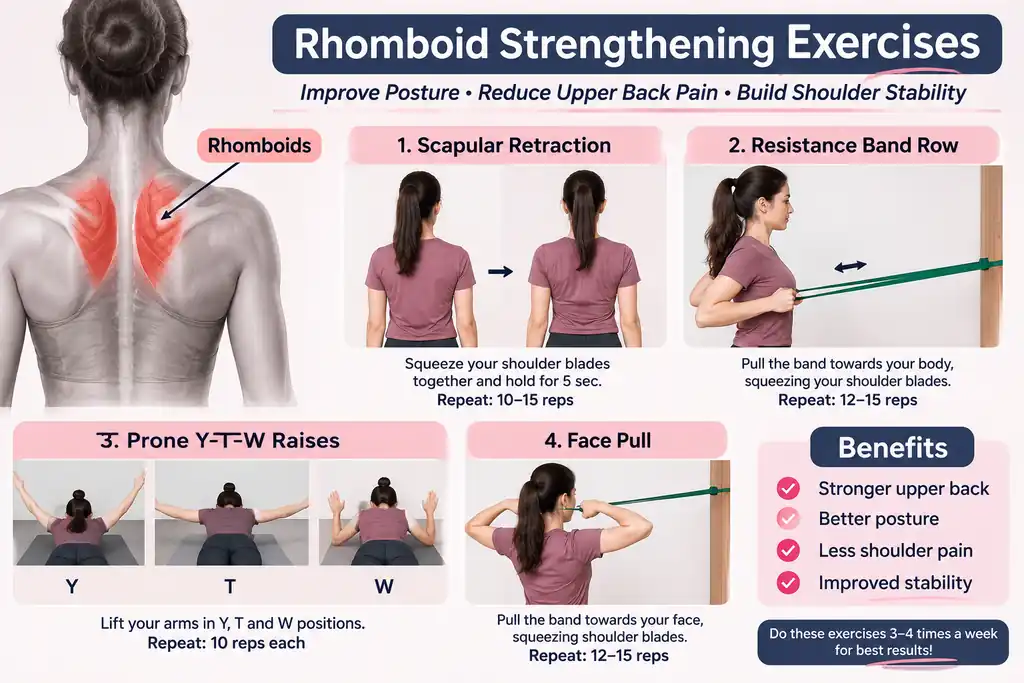
10 Best Rhomboid Strengthening Exercises
Table of Contents
Introduction
Rhomboid muscles help us maintain good posture, keep our shoulder blades stable, and allow movement of our shoulder joint.
- Rhomboid Major – The bigger muscle sits below the rhomboid minor.
- Rhomboid Minor – The smaller muscle sits on top of the rhomboid major.
Weak rhomboid muscles can lead to poor posture, rounded shoulders, unstable shoulder blades, and pain in the upper back, especially for those who sit for long periods of time.
Strengthening the rhomboid muscles will help improve the stability of the scapulae, make the upper back stronger, help promote healthy movement of the shoulder joint, and help improve postural control. These exercises would be beneficial for anyone experiencing weakness in the upper back.
Below, we will look at the best rhomboid strengthening exercises, benefits of doing them, how to perform them, and important considerations.
What are the Rhomboid Muscles?
There are 2 muscles:
- Rhomboid Major – The larger muscle sits below the rhomboid minor.
- Rhomboid Minor – The smaller muscle sits above the rhomboid major.
What do the Rhomboid Muscles do?
The rhomboid muscles help:
- Retract the shoulder blades towards the spine.
- Help stabilise the shoulder blades during arm movement.
- Help with downward rotation of the scapula.
- Allow efficient movement of the shoulders and upper back.
Best Rhomboid Strengthening Exercises
1. Scapula Retraction
This is one of the easiest ways to activate the rhomboid muscles.

Instructions:
- Maintain a neutral spine and relaxed shoulders.
- Maintain an upright posture while standing or sitting, with your arms relaxed naturally beside your body.
- Gently squeeze your shoulder blades together as if you are trying to hold something small between them.
- Don’t shrug your shoulders all the way up to your ears.
- Hold for 5 seconds.
- Gently return to the starting position.
- Repeat 10-15 times.
2. Resistance Band Rows
The rhomboids and other upper back muscles may be strengthened with this fantastic workout.
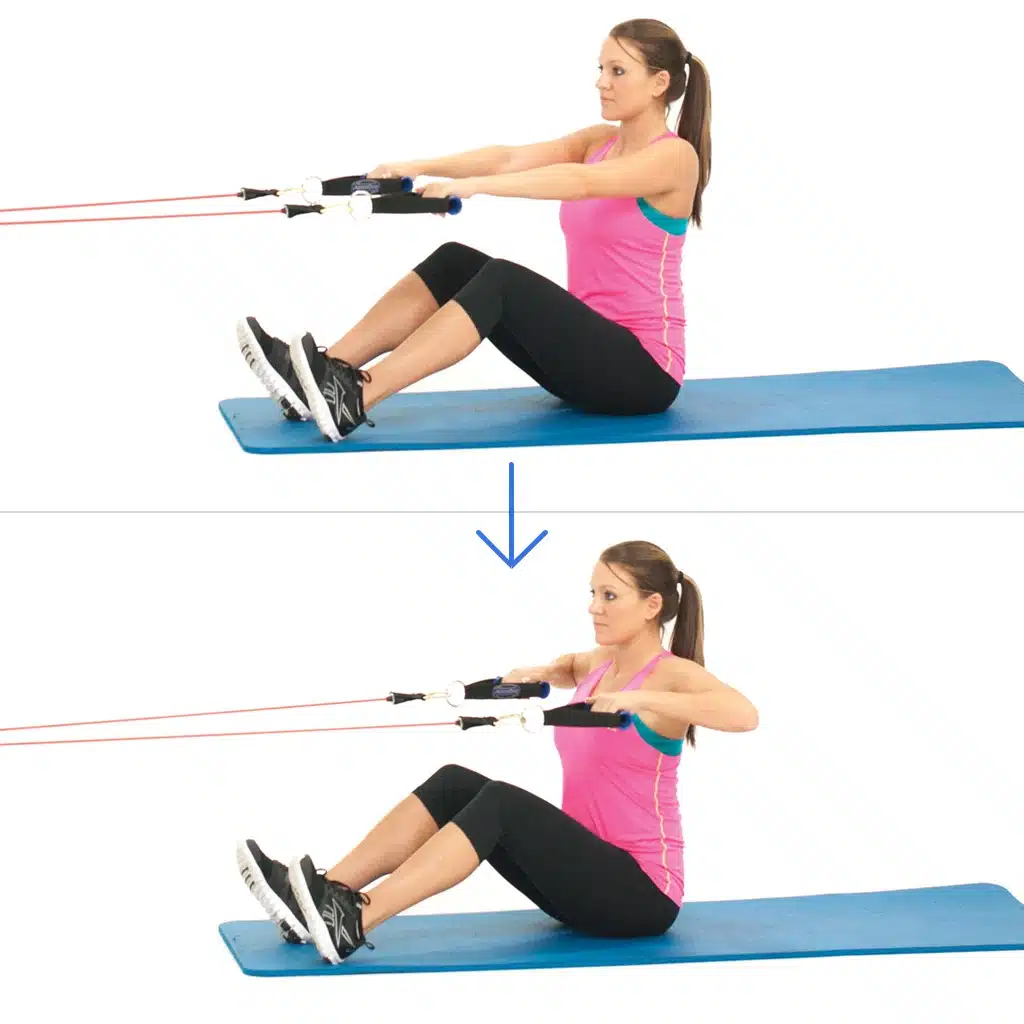
Instructions:
- Sit on the floor with legs straight.
- Hold both ends of the resistance band as you loop it around your feet.
- Keep your back straight and shoulders relaxed.
- Bend your elbows and pull the band in the direction of your stomach.
- Squeeze your shoulder blades together.
- Return your arms to the starting position slowly.
- Repeat 10-15 times.
3. Prone T Raise
This helps strengthen the rhomboids, middle trapezius, and other muscles responsible for stabilising the scapula.
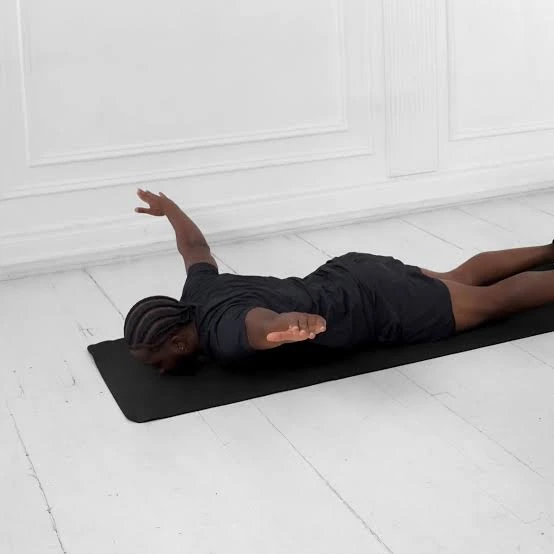
Instructions:
- Lie face down on an exercise mat with your forehead supported.
- Extend both arms outward at shoulder height, positioning them horizontally to form a T with your body.
- Thumbs facing upwards.
- Squeeze your shoulder blades together to slowly raise your arms off the ground.
- Hold for 2-3 seconds.
- Slowly lower back to the start position.
- Repeat 10-12 times.
4. Prone Y Raise
This enhances shoulder blade control and strengthens the upper back.
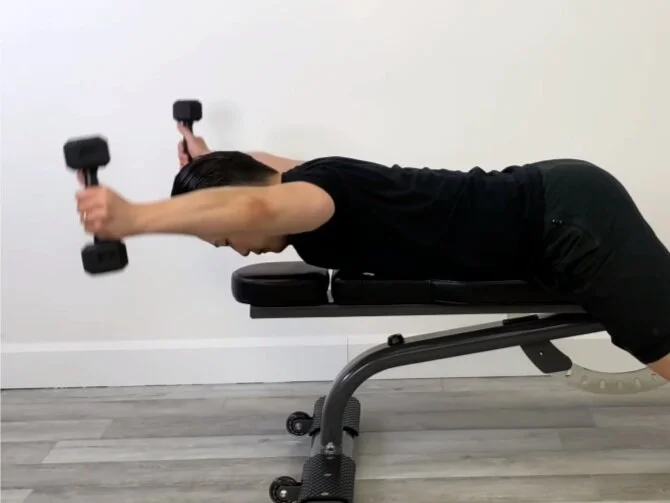
Instructions:
- Lie face down on an exercise mat.
- Raise your arms to form a Y.
- Thumbs facing upwards.
- Gently engage your upper back muscles.
- Lift both arms slightly off the floor. Don’t shrug your shoulders.
- Hold for 2-3 seconds.
- Lower arms back to the starting position.
- Repeat 10-12 times.
5. Bent-Over Dumbbell Row
The latissimus dorsi, trapezius, and rhomboids are strengthened as a result.

Instructions:
- Stand with feet shoulder-width apart.
- Facing one another, grasp a dumbbell in each hand.
- Slightly flex both knees and gently hinge your upper body forward at the hips while keeping your back straight.
- Engage your abdominal muscles while maintaining a neutral spine.
- To bring the dumbbells closer to your waist, bend your elbows.
- Squeeze your shoulder blades together.
- Repeat 10-12 times.
6. Seated Cable Row
This is a great exercise to build upper back strength and improve scapula stability.
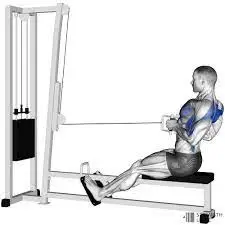
Instructions:
- Sit on the cable rowing machine. Feet supported.
- Hold the handle in both hands.
- Sit up tall with your spine in neutral.
- Pull the handle towards your stomach by bending your elbows.
- Squeeze your shoulder blades together. Don’t overarch your back.
- Return your arms to their initial position by straightening them.
- Repeat 10-12 times.
7. Wall Angels
This helps improve shoulder mobility and control in the upper back.

Instructions:
- Stand against a wall.
- Feet slightly away from the wall.
- Arms in a goalpost position with elbows bent.
- Shoulders relaxed; gently engage your shoulder blades.
- Slowly push your arms up the wall.
- Return your dumbbells to the starting position gradually.
- Slowly return to the start position.
- Repeat 10-12 times.
8. Resistance Band Pull Apart
This targets the rhomboids, middle trapezius, and posterior shoulder muscles.

Instructions:
- Stand tall with feet shoulder-width apart.
- Using both hands, hold a resistance band in front of your chest.
- Arms straight. Don’t lock your elbows.
- Gently pull your hands apart by moving your arms outwards.
- Squeeze your shoulder blades together.
- Hold for 2 seconds.
- Return to the start position.
- Repeat 10-15 times.
9. Face Pulls
This is a great exercise to strengthen the rhomboids, posterior deltoids, and middle trapezius.
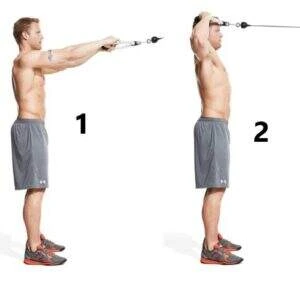
Instructions:
- Attach the resistance band or cable to a stable anchor positioned approximately level with your face.
- Hold the band or rope in both hands.
- Pull the band towards your face.
- Pull your shoulder blades together and extend your elbows.
- Keep your shoulders away from your ears.
- Return to the start position.
- Repeat 10-12 times.
10. Bird Dog
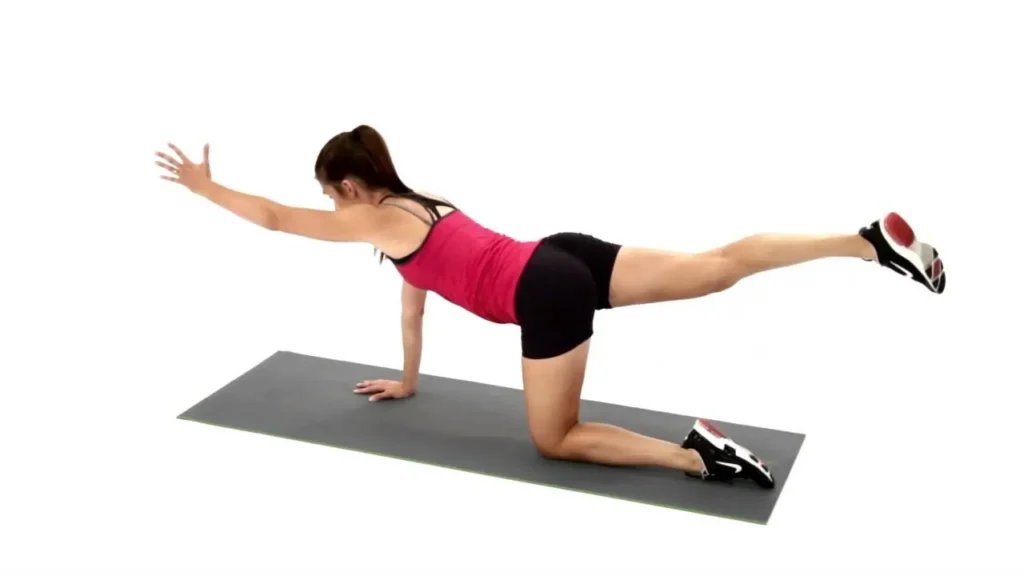
Instructions:
- On a workout mat, start on your palms and knees.
- Get onto all fours, placing your palms under your shoulder joints and your knees in line with your hip joints.
- Engage your abdominal muscles while maintaining a neutral spine.
- Gently stretch your left leg backward and your right arm forward.
- Keep your hips and shoulders stable.
- Hold for 3-5 seconds.
- Repeat on the opposite side after returning to the starting position.
- Repeat 8-10 times on each side.
Benefits of Rhomboid Strengthening Exercises
Doing rhomboid strengthening exercises regularly can help improve:
Posture
Having strong rhomboids will help pull the shoulder blades towards the spine and help keep your upper back in good alignment. This can help reduce rounding of the shoulders.
Upper Back Strength
These exercises target the rhomboids and other supportive muscles in the upper back. This helps improve overall strength and endurance.
Scapula Stability
The rhomboid muscles help keep your shoulder blades stable during arm movement. Strengthening them will help improve scapula control during daily activity and exercise.
Shoulder Function
Keeping your scapula in the correct position will help improve efficient movement of your shoulder joint. Rhomboid strengthening will help improve shoulder movement.
Reduce Postural Pain
Those who spend long periods of time sitting or working on a computer may experience fatigue in their upper back. Strengthening your upper back and improving your posture may help reduce any pain experienced.
Improve Exercise Performance
Having strong scapula stabilisers will help improve pulling exercises, weight training, swimming, and other upper body exercises.
How often should I do them?
If you are new to upper back strengthening exercises, you can perform these exercises 2-3 times per week. This will allow enough time to recover between challenging exercises.
- Beginners: 1-2 sets of 8-12 reps.
- Intermediate: 2-3 sets of 10-15 reps.
- 2-3 times per week.
- Around 30-60 seconds of rest between sets.
- Start using light resistance and progress as your strength and exercise technique improve.
Tips for doing Rhomboid Strengthening Exercises
To get the most out of these exercises, make sure to:
- Keep your spine neutral.
- Don’t shrug your shoulders.
- Focus on controlled movement of your shoulder blades.
- Use light resistance and progress.
- Don’t use momentum to pull weights or resistance bands.
- Breathe naturally.
- Practice good posture in daily activities.
Who should do them?
- Those with weak upper back muscles.
- Rounded shoulders.
- Those looking to improve scapula stability.
- Athletes involved in swimming, rowing, and weight training.
- Those looking to improve upper back strength and postural control.
- If you have had a recent shoulder injury, severe neck/upper back pain, or have been diagnosed with a spinal condition, please speak to a physiotherapist.
Common Mistakes
Avoid the following mistakes:
- Shoulder Shrugging.
- Too much resistance. Using heavy weights can cause poor technique.
- Overarching the lower back.
- Too fast. Perform slow, controlled repetitions.
- Overtraining. Make sure you are getting enough recovery between strengthening exercises.
- Not targeting other muscles. Include exercises to strengthen your rotator cuff, serratus anterior, and other scapula stabilisers.
Conclusion
Rhomboid strengthening exercises are a great way to improve upper back strength, scapula stability, and postural control. Scapula retraction, resistance band rows, prone T raises, bent-over dumbbell rows, wall angels, and face pulls can all help strengthen your rhomboids and other upper back muscles.
Perform these exercises regularly using correct technique. Progress resistance as your strength improves. Pairing these with chest stretches, thoracic mobilisations, and good sitting posture will help improve healthy shoulder joint mechanics.
If you are experiencing consistent upper back pain or pain in your shoulder blades, please see a qualified physiotherapist.
FAQs
What exercises can I do to strengthen my rhomboids?
Scapular retraction, resistance band rows, prone T raises, dumbbell bent-over rows, face pulls, and resistance band pull-aparts are good exercises.
How will I know if I have weak rhomboids?
You may find you struggle to keep your posture upright, lack upper back strength, lack control of your scapulae, or get tired during pulling movements. This can be caused by other factors, so it may be worth having an assessment.
Can I improve my rounded shoulders with rhomboid exercises?
Yes, your rhomboids and other scapula stabilizers may get stronger as a result. Often, alongside stretching the chest and being conscious of your posture, it can help.
How often should I train my rhomboids?
Most beginners will be able to train their rhomboids 2-3 times a week.
Can weak rhomboids cause upper back pain?
It can cause you to feel fatigued due to weakness or lack of strength. Upper back pain can be caused by various factors.
Will resistance bands help strengthen my rhomboids?
Yes! Resistance band rows and pull-aparts can be great exercises.
Will rhomboid exercises help me as an office worker?
Yes! They can assist you in getting better control over your scapulae and strengthen your upper back. If you also take regular breaks to move and ensure your workstation is ergonomically set up, then it can help.
References
- Cpt, K. M. (2026, April 30). 5 easy rhomboid exercises to define your back. Healthline. https://www.healthline.com/health/fitness-exercise/rhomboid-exercises
- CNC, T. B. P. D. C. C. (2026, May 12). Strengthening exercises for rhomboid pain. Prehab. https://theprehabguys.com/blog/strengthening-exercises-for-rhomboid-pain/
- Mazzo, L. (1970, January 1). 8 rhomboid exercises that activate your back muscles in a whole new way. The Output. https://www.onepeloton.com/blog/rhomboid-exercises
- Rhomboid — Exercise Library & Database — Rehab Hero. (2025, March 28). Rehab Hero. https://www.rehabhero.ca/exercise/tag/Rhomboid