Walking Lunges Exercise
Table of Contents
Introduction
Walking lunges are a powerful lower-body exercise that strengthens your quadriceps, hamstrings, and glutes, improves balance and coordination, and improves functional mobility.
The walking lunge is a version of the static lunge exercise. This exercise strengthens the Back, hips, core, and glutes, along with the leg muscles. Adding weights or rotating your torso throughout the workout can also make walking lunges more difficult.
A useful weight-bearing exercise that could improve lower-body strength and range of motion and simplify daily tasks is the walking lunge. You will be using your core muscles to help with stability and balance throughout the walking lunge, even if your strong lower body muscles are the main movers.
The muscles used in walking lunges
- Glutes
- Hamstring Muscle
- Quadricep Muscle
- Calves
- Hip Muscles
Benefits
Improve your range of motion
By improving flexibility and relaxing your hips and hamstrings, walking lunges can help you extend your range of motion. This can help athletes, casual exercisers, and fitness beginners alike by improving posture and balance.
Improved outcomes
One type of functional exercise is the walking lunge. Walking lunges could get easier in real life with consistent practice.
Improves Balance and Core Stability
The walking lunge is particularly dynamic since it takes place unilaterally while standing and involves your lower body and core muscles.
Encourages One-Stop Learning
Any muscle imbalance between the left and right legs can be found and fixed using unilateral workouts.
You can do it anywhere
Walking lunges are the perfect portable workout, whether you’re at home, the gym, on a business call, in a hotel, or pretty much wherever else.
Walking Lunge Exercise Video
How to perform walking lunges?
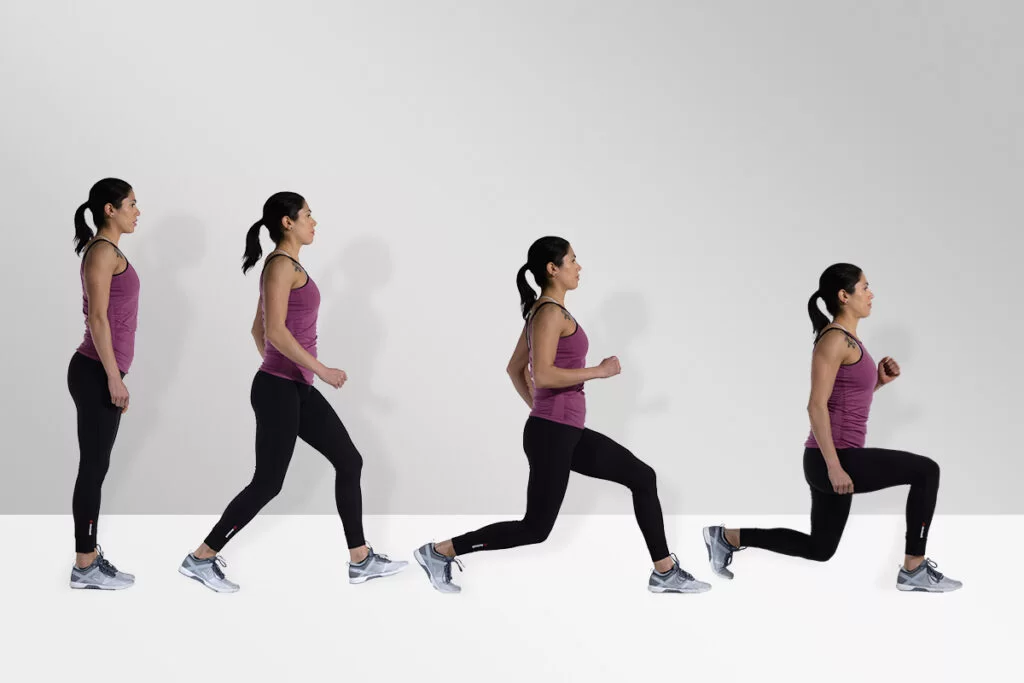
- Put your feet hip-width apart to begin. Keep your shoulders back and your core active. You can clasp your arms behind your head or keep them at your sides.
- As you drop your body to the floor and take a step forward with your right foot, take a deep breath. As you lower your torso, take a long enough stride to ensure that both knees are bent at a 90-degree angle.
- Let your left back knee come closer and touch the ground. Keep your front knee just above your ankle rather than pushing it too far forward. Either slowly lower your body or maintain an upright stance while looking directly ahead.
- Keep your bottom lunge position for some counts
- Breathe out as you use your left foot to step into the next lunge, then use your right foot to move it forward.
- Continue walking while alternating legs with each step. Aim for flexible, controlled movement and put quality before quantity.
Variations
Walking lunge with torso twist
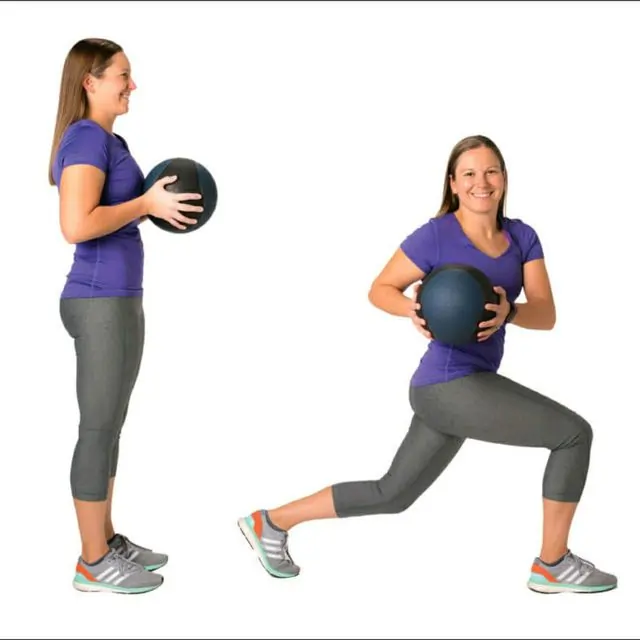
- Maintain a straight posture and place your feet hip-width apart. Contract your abdominal muscles while holding a weight or medicine ball in front of your abdomen with both hands and your elbows bent at a 90-degree angle.
- Step forward with your right leg, placing your weight on your heel.
- While your right foot touches the ground and stabilizes, bend your right knee and drop it until it is parallel to the floor in a lunge position. Hold on.
- Holding the weight with both hands, rotate your upper body to the right once you’re comfortable in the lunge position. Movement should originate from your torso.
Walking lunge with weights
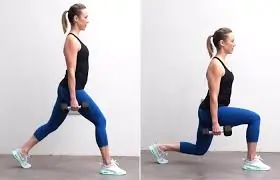
- Maintain a straight stance with your shoulders back. Keep your arms by your sides and grasp one dumbbell in each hand while maintaining a straight posture.
- Keep your arms loose and at your sides during the workout. Step forward with your right leg, placing your weight on your heel.
- As your right foot falls and stabilizes, bend your right knee to lower yourself into a lunge stance.
- Without shifting your right leg, repeat the motion with your left leg, bringing your left foot forward. With your left leg parallel to the floor, pause in a lunge position.
- Repeat the lunge while changing legs and “walking” ahead.
Overhead walking lunges
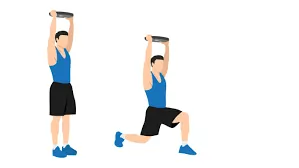
Raise a weight plate or medicine ball above your head while you lunge.
Hill walking lunges
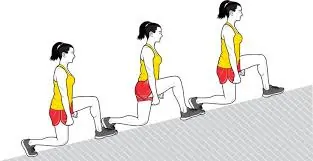
As you climb a hill, perform walking lunges.
Sideway walking lunges
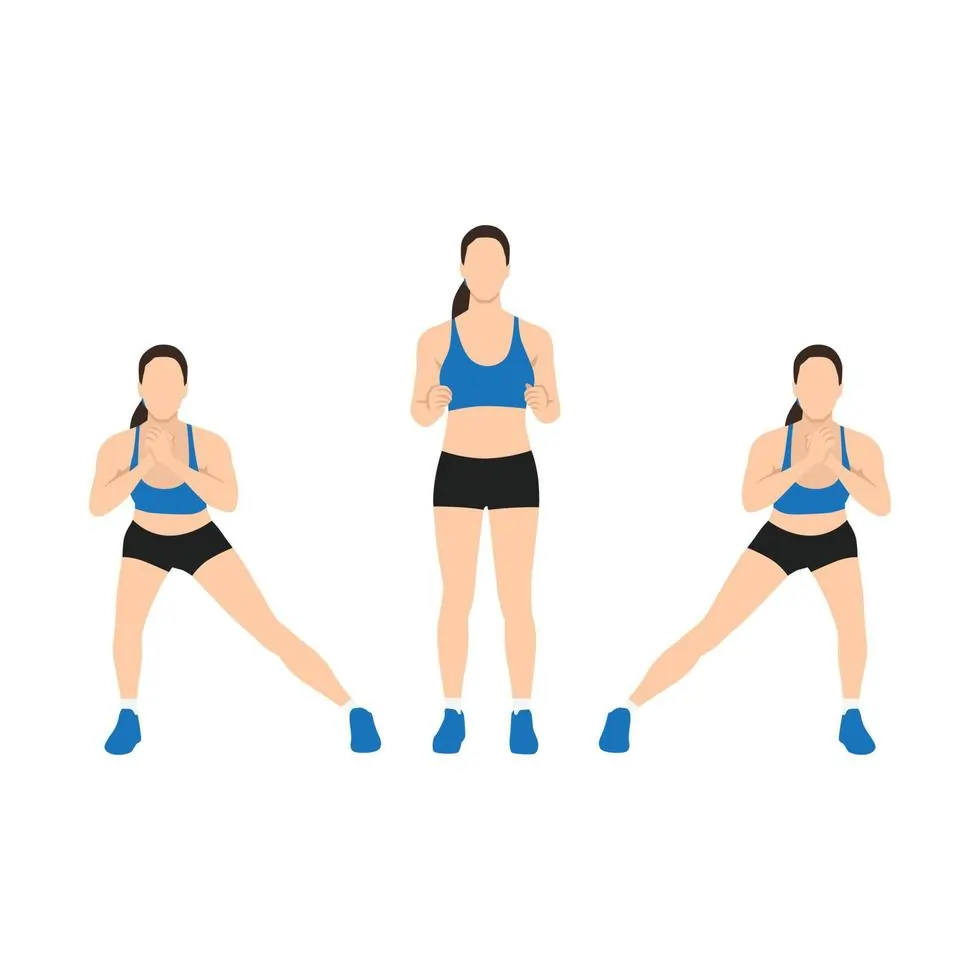
- Keep your feet shoulder-width apart and breathe through your nose into your abdomen.
- Start by using your weak leg to step to your side.
- Keep your chest up and your shoulders back.
- Your direction leg should be exactly straight.
- You can keep your trail foot flat or turn your toes up for pulling deeper.
- As you raise yourself and complete the rep, release your breath.
Precautions
- To position properly, you may prefer to start with a static lunge if you are a complete beginner.
- Throughout the exercise, maintain a straight stance rather than bending forward.
- Contract your muscles as you progress.
- If you take too long a stride, you run the risk of arching your back.
Common mistakes
The foundation of performing a walking lunge is proper technique. Learning this technique, from alignment and posture to concentrating on the appropriate muscles, may require some trial and error. You can avoid harm and get off to a solid start by being aware of the usual mistakes in preparation.
Modify your footing
Most walking lunges are carried out incorrectly, especially when it comes to the feet. Throughout the set, you must keep your feet hip-width apart for a safe walking lunge. Putting one foot in front of the other at this point could make you look silly.
Make the Correct Move.
Your hips and groin may hurt if you push too hard or take too many steps. Start small and work your way up to greater strength and agility.
Do not place your back knee on the floor.
Allowing the hind leg to come into contact with the floor is another frequent technical mistake. Avoid being able to lower the leg to the ground; keep your back knee hovering over the floor when you take a step.
Conclusion
Walking lunges are a fun and efficient way to strengthen a variety of muscle groups and improve balance and flexibility. Whether done as a stand-alone exercise, as part of a leg day workout, as part of your current full-body regimen, or as part of a dynamic warm-up, walking lunges are a flexible exercise for all fitness levels.
FAQS
Who should stay away from lunges?
Before starting a lunge-based exercise program, anyone with significant knee, hip, or back problems should consult their physician, physical therapist, or personal trainer. Don’t let your weak legs stop you from doing the lunge.
What are the benefits of walking lunges?
Walking lunges work many muscle groups, including the quadriceps, hamstrings, glutes, and core, to improve lower body strength, stability, and overall functional fitness. The activity’s dynamic nature improves joint mobility and flexibility.
What risks come with lunging?
“When doing a lunge, you shouldn’t strain.” The healing process for a strained tendon or muscle may take several weeks. Before starting a lunge-based exercise program, anyone with significant knee, hip, or back problems should consult their physician, physical therapist, or personal trainer.
Walking lunges or squats: which is better?
Squats improve strength, power, longevity, and joint-friendly movement. Lunges enhance performance, balance, coordination, and flexibility in actual life.
What would happen if I did walking lunges every day?
Lunges are an easy yet powerful way to strengthen your core, tone your legs, and enhance your balance. Depending on whether you’re an athlete, go to the gym, or work out at home, daily lunges can help shape your lower body, increase flexibility, and improve stability.
What is the recommended duration for walking lunges?
In a lunge posture, pause with your left leg parallel to the ground. Repeat this exercise, lunge with different legs while “walking” ahead. For each leg, perform ten to twelve repetitions. Do two or three sets.
Which is better, static lunges or walking lunges?
Static lunges allow most people to lift more, which makes them better for strength and hypertrophy, but walking lunges may be better for developing balance, stability, and core strength because they push these areas more. Select the lunge that most closely follows your objectives, or include both in your routine.
References
- Bodyweight lateral walking lunge – Simple Solutions fitness. (n.d.). https://www.simplesolutionsfitness.com/exercise-library/bodyweight-lateral-walking-lunge
- Lindberg, S. (2024, November 25). Walking lunges are a staple Functional Fitness Move—Here’s How to Master them. https://www.onepeloton.com/blog/how-to-do-walking-lunge
- Chertoff, J. (2019, June 24). How to Step Up Your Workout with Walking Lunges. Healthline. https://www.healthline.com/health/exercise-fitness/walking-lunges
- Fit, C. (2022, August 8). Walking Lunges: How-To, Variations, Benefits, Precautions & More. blog.cult.fit. https://blog.cult.fit/articles/walking-lunges-variations-benefits-precaution-and-more