
Box Jump Exercise
Table of Contents
Introduction
The Box Jump Exercise is a powerful plyometric movement designed to improve explosive strength, speed, and overall athletic performance.
They are an excellent way to improve your vertical jump, explosive power, lower body strength, and overall athletic performance.
Box jumps are a more challenging exercise that should be performed with caution. Once you have a strong foundation of leg strength and have trained more beginner-friendly jumping routines, you should be able to carry out box jumps with a low step or box.
Box jumps are a type of strength- or power-focused exercise that should be used at the beginning of the routine after a thorough warm-up. This keeps the targeted muscles from being too fatigued, making the exercise safer to perform.
Box Jump Exercise Video
The box jump activated the muscle
- Quadriceps
- Gluteal Muscles
- Hamstring Muscles
- Calf Muscles
Benefits
Boosts the Power of Explosives
The primary objective of box jumps is to target the fast-twitch muscle fibers that generate explosive motions. For athletes or anyone looking to improve their strength and speed, they are an excellent workout.
Improves Heart Health
Box jumps are a high-intensity workout that raises your heart rate and strengthens your lower body.
Improves Balance and Coordination
The precision and control required to jump onto a box eventually help to improve balance and coordination.
Burns Calories and Fat
Box jumps are an excellent method of weight loss since they are a calorie-burning exercise that activates multiple muscle groups simultaneously.
Improves Athletic Performance
By simulating the explosive movements required in a range of sports, such as basketball, soccer, and track and field, this plyometric workout improves overall athletic performance.
Minimum necessary equipment
Because all you need is a strong container or platform, box jumps are an easy addition to any workout regimen, whether at home or at the gym.
How to Do Box Jumps?
All you need to perform box jumps is a commercial plyo box, a strong bench, a chair, or a similar sturdy elevated platform. If you’re just beginning, become comfortable with a smaller box or surface before trying to go on to taller ones. Make sure the stability, support, and cushioning in your shoes are appropriate.
It’s crucial to start with a low box so you can get used to the activity. Select a box that is between 12 and 24 inches tall, depending on your level of strength and confidence.
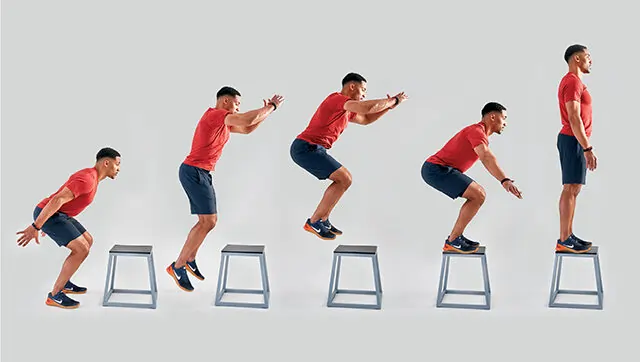
The task itself is simple in theory. All you have to do is stand facing the box, jump cleanly from the ground to the top of the box, and land both feet at the same time. The short jump may appear simple, but as you learn the exercise, it’s important to develop the proper technique since it will help you perform the exercise safely and successfully as your box jump height grows.
The lower body and core must be fully processed, along with coordination and concentration, for box leaps to be performed successfully.
How to do:
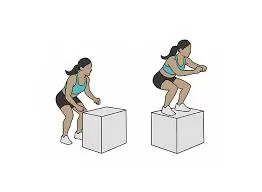
- As you face the box, place your feet six inches away from its side. Your feet should be around hip-distance apart, and your knees and hips should be slightly bent in an athletic position.
- Bend your knees and thrust your hips back as you easily move your arms behind you.
- Jump into the balls of your feet, push yourself straight into the air, swing your arms forward and upward, and fully stretch your knees and hips to jump as high as you can.
- To land on top of the box, bend your knees and hips to bring them forward at the top of your jump.
- Starting with your heels and finishing with your heels, place both feet on top of the box at the same time. To reduce the impact of the landing, try to do this “softly,” allowing your hips and knees to naturally bow.
- Check that your feet are about hip-distance apart when standing on the box.
- To begin the next cycle, carefully exit the box without jumping.
Is it possible to add weight?
Adding weight will make a box jump, which is already a challenging maneuver, much more challenging. If you feel confident performing a normal box jump, consider adding:
Ankle weights or a weighted vest: If you secure weight to yourself, the box jump action’s mechanics won’t change, making it an appropriate progression from a regular box jump.
Holding a dumbbell in each hand: Start this method with a dumbbell in each hand.
A kettlebell: Hold a kettlebell at chest level with both hands and perform the box jump after using dumbbells.
Variations:
Lateral Box Jumps:
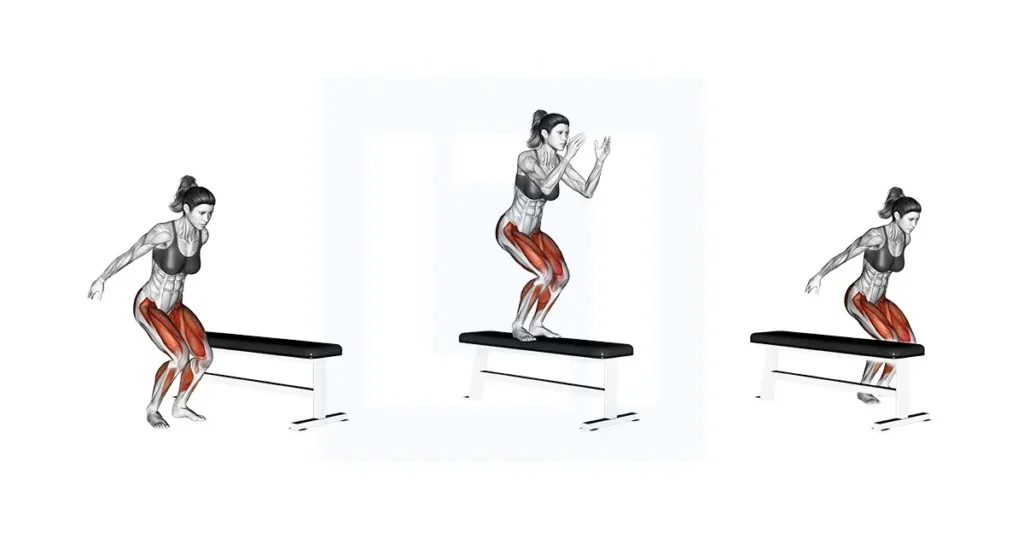
Jump onto the box sideways rather than directly. This variation uses your oblique muscles to increase lateral stability.
Single-Leg Box Jumps:
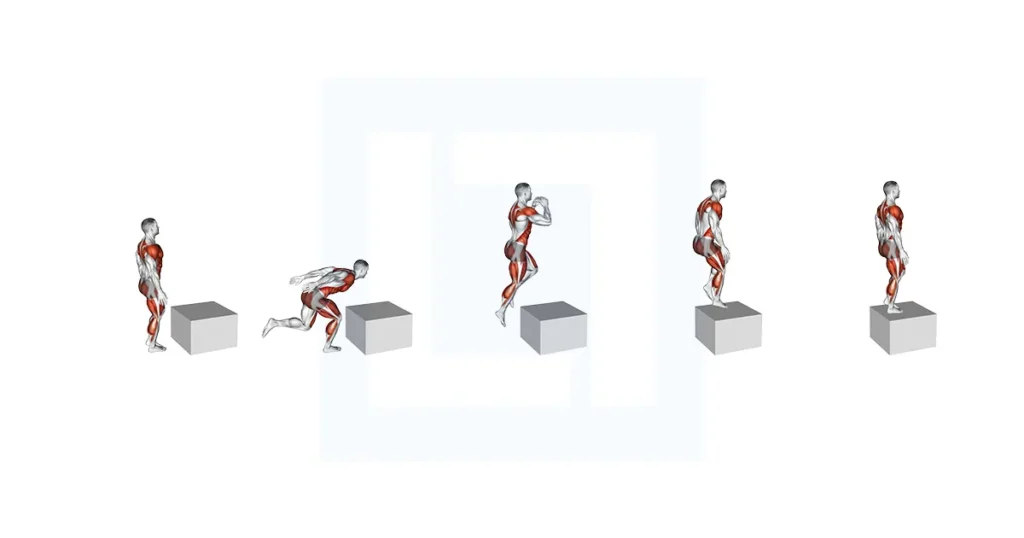
To perform the jump, jump on opposite sides while using one leg. This raises the risks while also enhancing unilateral strength and balance.
Box Jumps with Weights:
Use a weighted vest or light dumbbells to increase difficulty and build strength.
Jumps in Depth:
Start on the box, leap to the ground, and immediately back to the box. This variation may significantly boost reactive strength.
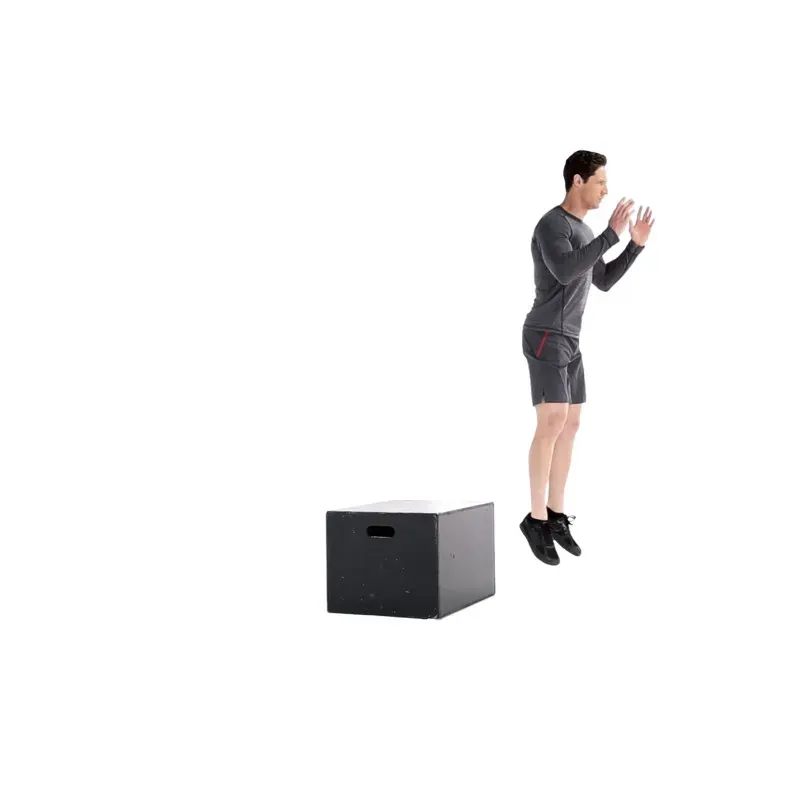
High Box Jumps:
Take on the challenge of a taller box. Make sure your form stays the same to prevent injuries.
Common Mistakes
Choosing an Excessively High Box
Starting with a box that is too high is one of the most common mistakes. First of all, it’s a great way to lose confidence if you can’t finish the exercise. You also incur the risk of falling, scraping your shins, falling, or kicking the box.
If you have never done the exercise before, start with a small platform, like 12 to 24 inches, to feel comfortable and make sure you are doing it correctly. You can just level up to the next box height if you feel that the jumps are too easy.
Jumping Out of the Box
It’s quite common for them to jump off the box to reset or rebound for their subsequent repetition. But it’s important to understand that, even though it might seem easier than jumping up onto a high platform, jumping off an elevated surface actually puts a lot of strain on your joints, and if you’re not careful, this is when injuries are most likely to occur.
Even if you’ve done a lot of plyometric training and feel comfortable doing “depth jumps” (jumping from an elevated surface), it’s still a good idea to be cautious and walk off the box slowly rather than jump off. This applies to everyone, but it’s especially true for beginners and those advancing to higher levels.
Improper Alignment of the Landing Foot or Knee
Correctly landing the box leap is essential to preventing injuries, particularly to the knee. Landing with one foot ahead of the other, landing with both feet together, or landing with knee valgus—the “caving in” of the knees toward one another—are common mistakes. Do the exercise in front of a mirror or have a person observe you to look for excessive knee movement.
Jumping Without Fully Extending Your Hips
Two of the primary goals of box jumps are to increase vertical jumping height and explosive strength. To properly achieve these two goals, though, you must jump with full hip extension, sending yourself as high as you can before bending your hips and pushing your knees forward to make the landing.
As opposed to making the vertical jump with full hip extension, people often make the mistake of “hopping” from point A to point B, only getting enough air to pull the knees forward in time for landing. Try doing the exercise in front of a mirror to see if you’re experiencing full hip extension when you jump.
Box Jumps Following a Workout
You need new legs to perform box jumps as effectively as possible. If you wait until the end of your workout, you will be too tired to perform box jumps to the best of your abilities. You won’t get the kind of constant progress you’re expecting.
Safety and Precautions
- Before you start, incorporate lower-key plyometric exercises, like jumping rope or skipping, into your warm-up for a few weeks.
- As with most high-impact exercises, it’s crucial to wear proper equipment, like a sports bra for large breasts, to help reduce bounce.
- As previously mentioned, start with a low box as well. It reduces the risk of developing several potential diseases, including ACL tears, falls, and shin scrapes, and is a safer option for beginners.
- For athletes in good shape, box jumps are usually safe, but don’t try them until your lower-extremity problems or back pain have resolved.
- Before attempting box jumps, pregnant women should consult a physician. Your doctor may give you the all-clear to continue exercising and performing box jumps in the early weeks of your pregnancy, but they will probably advise you to stop as the pregnancy progresses.
- You should absolutely wait till after the baby is delivered and your body has had some time to heal before performing box jumps if you haven’t been exercising during your pregnancy.
- Reduce the number of repetitions to two or three sets of three to five reps if your focus is on form and the highest level of efficiency.
Conclusion:
Increasing explosive power and burning calories are just two benefits of box jumps, an intense full-body workout. If you use the proper form, incorporate it into your routine, and change it up to keep things interesting, you will be well on your way to achieving your fitness and health goals.
Don’t hesitate; start incorporating box jumps into your training routine immediately to increase your level of fitness and benefit from its full-body benefits.
FAQs
What advantages do box jumps offer?
While swinging your arms for velocity can work some upper-body muscles, box jumps also train your core muscles since they require balance, stability, and control to ensure a safe and proper landing.
Which exercises improve box jumps?
Strengthening your legs, particularly your glutes, will help you perform better box jumps. Hip jerks and other hip flexion workouts, like deadlifts, can help you improve your jump strength. Squats are also great. Perform calf-strengthening exercises like calf lifts and jump rope.
In box jumps, which muscles are used?
Box jumps are basically a lower-body exercise that works your quadriceps, calves, hamstrings, and glutes as you bend into a squat, jump high into the air, land gently on the box in a squat, and then step down one foot at a time.
Do box jumps aid in leg strengthening?
The box jump strengthens the biggest muscle groups in the legs, such as the quadriceps and glutes, while also improving balance and core strength. To make sure you land gently after completing the jump-up, you will need to rely on strong core abdominal muscular activation.
How long should box jumps continue?
When practicing box jumps, you should often use a box that is 24 to 30 inches high. Three to five sets of three to five repetitions is good general advice for power gains, but you should stop each set as soon as you start to slow down or lose control of your landing.
Exactly how much can a person box jump?
Box Height: 24 to 32 inches. One or two times a week, each jump should be performed at high intensity and close to maximal effort. The reps are lowered to emphasize the power generated for each jump.
Do box jumps increase your speed?
A plyometric exercise with several benefits is the box jump. As a result, your client’s lower body strength increases. They have more explosive power and speed, as well as an improved vertical jump. Box jumping can also be a part of an aerobic exercise program that burns calories if you do enough repetitions.
References:
- Davis, N. (2020, July 24). How to do box jumps the right way — and why you should. Healthline. https://www.healthline.com/health/fitness-exercise/box-jump#takeaway
- Ascm-Cep, L. W. M. (2023, June 16). How to do box jumps: proper form, variations, and common mistakes. Verywell Fit. https://www.verywellfit.com/how-to-do-box-jumps-4588131
- https://www.netmeds.com/c/health-library/post/box-jumps-full-body-workout-benefits-variations-and-step-by-step-guide-to-mastering-them?srsltid=AfmBOorFXmVZEagQUWGsltLcE5-LOuG4rMMsfan6XOTgkrSelhC5OHqW






One Comment