
Sulcus Sign
Table of Contents
Objectives:
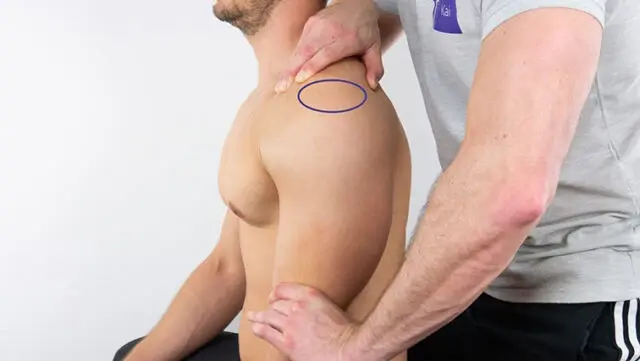
The Sulcus Sign is an examination test used to check shoulder instability, mainly inferior instability. It involves the clinician applying a downward force on the humerus while stabilizing the scapula.
A positive Sulcus Sign is indicated by the presence of a visible sulcus or groove beneath the acromion, suggesting that the humeral head has shifted downward away from the glenoid cavity.
Still used to evaluate inferior laxity, the sulcus test was initially introduced by Neer and Foster in 1980 as a component of a multidirectional instability investigation. It assesses the superior glenohumeral ligament, as evidenced by subsequent biomechanical research. The patient may be examined while sitting, standing, or lying down.
Purpose:
The superior glenohumeral ligament and coracoid-humeral ligament’s laxity can cause inferior instability in the glenohumeral joint, which can be evaluated using the sulcus test.
Technique:
The patient can undergo this test while sitting, standing, or lying down with their shoulder in the neutral position (0 degrees rotation). The examiner then pulls the distal end of the humerus causally. On the other hand, it is believed that McFarland et al.’s recommendation to sit with arms by your sides will produce more reliable outcomes. The test is considered positive if the sulcus moves more than 1 cm inferiorly and appears in the subacromial space.
To increase the diagnostic accuracy, the test should be performed twice, first with the arm in neutral rotation and again with the arm in external rotation.
The poor translation should be the same in both situations. A larger degree of inferior translation during external rotation of the arm suggests the potential for a rotator interval injury.
Centimeters can be used to express the displacement amount. Grade I usually indicates a displacement of less than 1.5 cm, Grade II indicates a displacement of 1.5–2 cm, and Grade III indicates a displacement of more than 2 cm. McFarland has proposed dividing these values into two categories: low (grade I) and high (grades II and III).
Positive Sign:
According to Tzannes and Murrell, a positive sulcus sign that measured more than two millimeters had a sensitivity of 28% and a specificity of 97%.
Others have reported a wide range of inferior laxity in asymptomatic patients, suggesting that there may not be a single degree of inferior translation that defines inferior instability.
Evidence:
It is crucial to remember that asymptomatic people can exhibit a broad range of inferior laxity, indicating that inferior instability cannot be precisely defined by a single degree of inferior translation. Therefore, it’s crucial to carefully interpret the test results in light of other clinical findings. Research has demonstrated that the sulcus test exhibits moderate reliability (κ 0.43), with significant differences observed between test takers.
FAQs
What is the sulcus sign test?
The superior glenohumeral ligament and coracoid-humeral ligament’s laxity can cause inferior instability in the glenohumeral joint, which can be evaluated with the sulcus test. Neer and Foster first described it in 1980 to investigate multidirectional instability.
How to perform a sulcus sign?
The sulcus sign is used to evaluate inferior glenohumeral instability. Taking the patient by the arm, the examiner pulls inferiorly while the patient is sitting or standing. The test is deemed successful if the humeral head moves inferiorly and causes a dimple or sulcus to form behind the acromion.
What is the sulcus sign at rest?
Joint when the patient is seated. One hand is used to stabilize the opposing shoulder while the other is resting on the thigh. Insert your second hand, holding the elbow, into the cubital fossa.
References:
- Physiotutors. (2024c, May 20). Sulcus Sign | Inferior Shoulder Instability Assessment. https://www.physiotutors.com/wiki/sulcus-sign/
- Inferior Sulcus Test | ShoulderDoc. (n.d.). https://www.shoulderdoc.co.uk/article/752
- Wikipedia contributors. (2024, May 25). Sulcus sign. Wikipedia. https://en.wikipedia.org/wiki/Sulcus_sign
- Sulcus sign – wikidoc. (n.d.). https://www.wikidoc.org/index.php/Sulcus_sign
- WikiSM. (2024, May 31). Sulcus Sign – WikiSM (Sports Medicine Wiki). WikiSM. https://wikism.org/Sulcus_Sign



One Comment