Empty Can Test (Jobe’s Test)
Table of Contents
What Is the Empty Can Test?
The Empty Can Test, also called Jobe’s Test, is an orthopedic examination used to assess the supraspinatus muscle and its tendon, one of the four rotator cuff muscles. It is commonly used when a patient reports shoulder pain or weakness during overhead activity, and it helps clinicians identify possible supraspinatus tendinopathy or tears.
Objective
To evaluate the supraspinatus, which starts shoulder abduction and aids in stabilizing the humeral head inside the glenoid cavity. Pain or weakness during the test may point to tendon irritation, impingement, a rotator cuff tear, or involvement of the suprascapular nerve.
Anatomy Involved
The supraspinatus arises from the supraspinous fossa of the scapula and passes beneath the acromion to insert on the greater tubercle of the humerus. It is especially susceptible to compression and misuse because it passes through the small subacromial region.
Patient Position
The patient sits or stands with the arm relaxed at the side.
Procedure
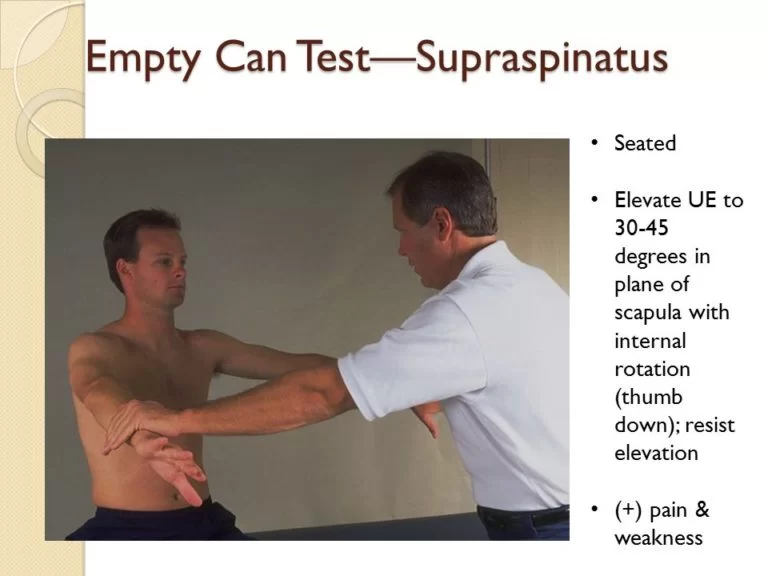
- The clinician asks the patient to raise both arms to 90° of abduction in the scapular plane, about 30° forward of the frontal plane.
- The patient internally rotates the shoulders so the thumbs point toward the floor, as if emptying a can.
- The clinician stands in front and applies a downward force at the distal forearms while the patient resists.
- The clinician compares both sides, noting pain, weakness, or an inability to hold the position.
Positive Sign
The test is positive if the patient has pain, noticeable weakness, or cannot resist the downward pressure. Weakness suggests a possible tear or neurological involvement, while pain with preserved strength points more toward tendinopathy or subacromial impingement.
Full Can Variation
In the Full Can Test, the thumbs point upward (external rotation) instead of down. This position often provokes less pain, so it may be more comfortable for patients with irritable shoulders. Research suggests both versions perform similarly for detecting supraspinatus problems.
Clinical Significance
The test is quick, needs no equipment, and is easy to repeat during follow-up to monitor progress. Rotator cuff problems become more common with age, especially in adults who stay active with gym training and overhead lifting.
Strength training alone won’t repair a tendon injury; therefore, patients managing other elements of their health, such as hormone management at a TRT clinic, should still have new or persistent shoulder pain evaluated by a physiotherapist. Documenting strength and pain response before and after treatment helps track recovery in conditions such as rotator cuff tendinopathy.
Limitations
A single test cannot confirm a diagnosis. The Empty Can Test can also be positive in other shoulder problems, and the downward pressure may be painful for some patients. Clinicians should combine it with other tests, such as the Drop Arm Test, Neer’s Test, and Hawkins-Kennedy Test, along with the patient’s history and, when needed, imaging.
Conclusion
The Empty Can Test is a simple but useful tool in shoulder assessment. Interpreted alongside other findings, it helps physiotherapists identify supraspinatus dysfunction and plan appropriate rehabilitation. This article is for educational purposes and does not replace professional medical advice.