Side-Bend Exercise For Waist Flexibility
Side-Bend Exercise for Waist Flexibility is a simple stretching exercise that gently improves flexibility and mobility in the waist, sides of the trunk, and lower back. It can help reduce stiffness and promote better side-to-side movement when performed with controlled, comfortable movements.
Walking, typing, and texting are examples of daily activities where we frequently move forward, yet we hardly ever move sideways. This lack of lateral mobility might eventually result in stiffness, uneven muscle growth, and bad posture. The Overhead Side Bend with Interlaced Hands is a very easy but effective exercise to correct this imbalance. It simply takes a minute or two, doesn’t require any equipment, and can be done sitting or standing. Let’s examine how this exercise functions and why it should be a part of your everyday fitness regimen.
Table of Contents
Tips for Proper Appearance
The obliques and intercostal muscles along your side are the main targets of the Side Bend Stretch, a static stretching exercise. This stretch can be very useful for releasing tension and avoiding injuries to the sides and lower back. It also helps increase torso flexibility and range of motion.
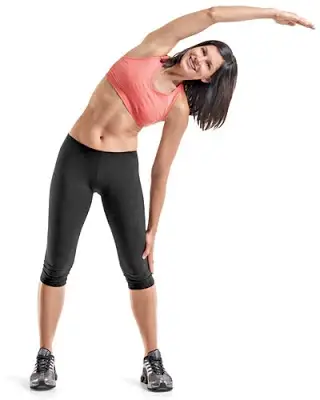
- Place your left hand on your left hip and raise your right arm overhead while standing straight with your feet shoulder-width apart.
- Bend your body laterally to the left, raising your right arm overhead until the right side of your torso feels comfortable.
- Repeat the stretch after holding it for 15 to 30 seconds.
What is a standing side bend?
The standing side bend is a well-known stretch for good reason: it improves your side-to-side mobility and keeps you steadier on your feet. It also relieves tension in the muscles of your chest, hips, and back. In addition, it feels fantastic, to be honest.
As the name suggests, this exercise includes bending your upper body to the side so that your back, hips, and waist are gently stretched.
Which muscles are used in a standing side bend?
Internal and external obliques: These abdominal muscle groups are located along your torso’s sides. They facilitate your body’s rotation during daily tasks.
Rectus abdominis: The standing side bend exercise provides a good stretch for the rectus abdominis, sometimes known as the “six-pack” muscle, a long muscle that runs vertically along the front of the abdomen.
Erector spinae: This muscle group, which runs down the spine, can become tense due to daily activities, workdays that require a lot of desk time, other pressures, and our hectic lifestyles. This stretch relieves that tension.
Intercostal muscles: These little muscles are located in the space between your ribs. The standing side bend is a very efficient approach to stretch these muscles, even though they are not the simplest to target. This is especially true if you take deep breaths while in the side-bend posture.
Quadratus Lumborum: The pelvis, spine, and lower ribs are all connected by this deep lower back muscle. It is essential for maintaining pelvic stability when standing.
Benefits of the standing side bend
Many everyday motions may be made simpler and more comfortable by performing standing side bends to increase the strength and flexibility of the muscles along the sides of your waist and back. Additionally, it could improve your balance and lower your risk of injury and falls. If you incorporate this exercise into your normal exercise regimen, you could see gains in:
Muscle tension: particularly after extended periods of sitting or standing.
Back pain: One of the main causes of back pain is the quadratus lumborum muscle. Stretching this muscle regularly helps increase back mobility and relieve tension that may be causing you pain.
Posture: As we often remark, there is no such thing as ideal posture. However, it is true that prolonged periods of time spent in one position can strain your torso. Side bends while standing can help ease the tension.
Sitting at your desk: Your body will be more resistant to the strain and pain that might result from spending a large portion of the day in front of a computer screen if you have less back pain and pay more attention to taking breaks.
Reaching for a thing: such as reaching to place something in an airplane’s overhead compartment or stooping to take something off the ground.
Twisting movements: such as turning to see behind you or rolling over in bed.
Changing positions: Imagine turning to leave the shower or getting out of a chair.
Carrying unequal loads, which calls for the activation of your obliques to maintain your equilibrium.
Everyday tasks, such as mopping, vacuuming, and dishwashing.
Standing side bend stretch: exercises and modifications
Standing side bend
How to do a standing side bend:
- Start by standing with your feet comfortably apart and your hands at your sides, palms facing your thighs.
- As you progressively bend to one side and slip your arm down your leg toward your knee, lean your shoulder down and to the side.
- Your other hand will naturally travel up your leg and toward your hip as you bend.
- Hold the stretch while paying attention to taking deep breaths and letting them out.
- Return to your previous location.
- Repeat the stretch by extending to the opposite side.
- As you perform each repetition, your low back, hips, and sides of your body may stretch.
- You might have to change this workout to fit your needs because each person is different.
To make the standing side bend easier:
Place one side of your body toward a wall a few feet distant. Your upper arm should be approximately shoulder height when you place your forearm on the wall. Now press hard into your forearm and slowly move your hip toward the wall. Return to the beginning position and repeat on the opposite side after holding for a few deep breaths.
This variant of the sitting side bend is another option.
To make the standing side bend harder:
Slide one hand down your leg and reach the other arm straight up by your ear and above your head in the direction you are leaning.
To make the side bend exercise more challenging
Stretch the other arm straight up by your ear and above your head in the direction you are leaning while sliding one hand down your leg
Another alternative is to have a set of dumbbells by your side.
Tips:
- Don’t hurry the curve or return; instead, go with control and prudence.
- Do not bend backward or forward. Only side-to-side movement should occur.
- To effectively engage your obliques, exhale as you stand back up.
- Avoid going over. Proceed just far enough to feel a stretch instead of a strain.
Upward-facing dog
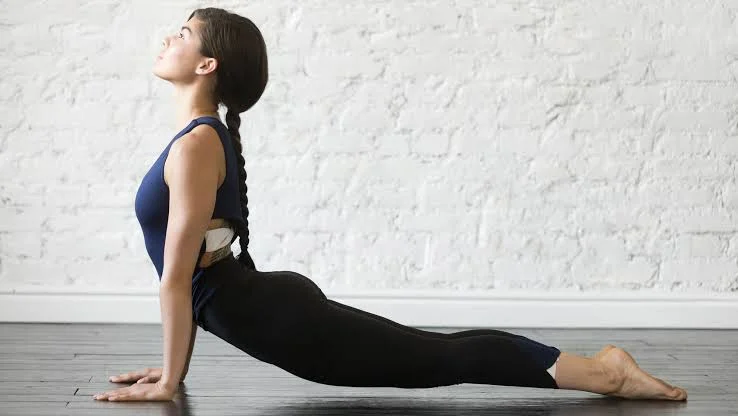
- Upward-facing dog is a bodyweight workout with a yoga theme that mainly works your lower back and core muscles
- Your spine and abdominal muscles will be well stretched if you extend your arms and press your hips toward the floor.
- This exercise may be a fantastic way to stretch in the middle of a workout and is good for improving posture and flexibility.
Thoracic rotation
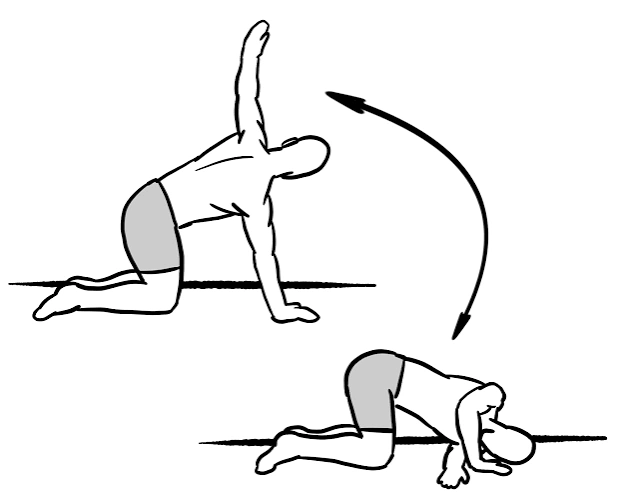
- A mobility exercise that works the shoulders and thoracic spine is the open book stretch.
- Lying on your side with your arms outstretched and legs bent, this dynamic exercise entails opening your upper arm to rotate your body.
- This exercise is fantastic for pre-workout warm-ups or post-exercise recovery since it improves thoracic mobility and reduces stiffness in the shoulders and upper back.
Dumbbell Side Bend

- A solo exercise that mainly works the obliques is the dumbbell side bend.
- By adding resistance to the exercise, using a dumbbell can help you gain strength and muscular growth in your sides.
- This is a straightforward exercise that can be simply added to any abdominal training regimen and helps to improve core stability.
Side bend with Resistance band
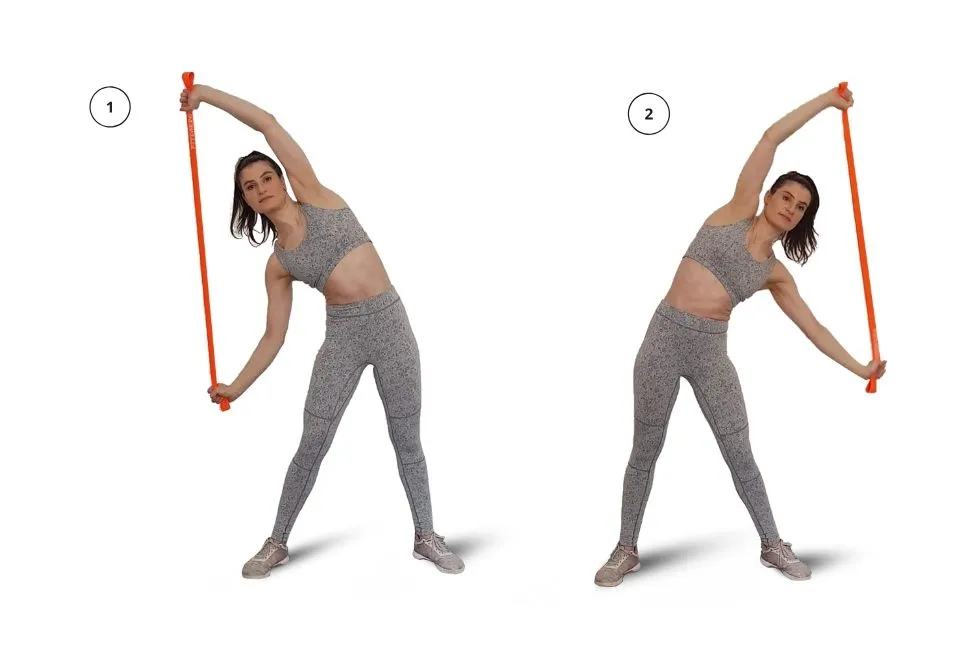
- A mobility exercise that mainly works the obliques and improves flexibility is the Side Bend with a resistance band.
- You may increase your range of motion by stretching the sides of your body by bending laterally while holding a resistance band overhead.
- Anyone who wants to strengthen their core and increase their flexibility should do this workout.
Seated twist
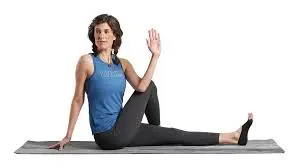
- A core exercise that mainly works the obliques is the Seated Twist.
- You may activate and isolate your oblique muscles by twisting your body while sitting on the ground with your legs straight.
- This is an excellent workout for strengthening your core and enhancing rotational stability, especially for twisting and turning motions.
Single Leg Straight Forward Bend
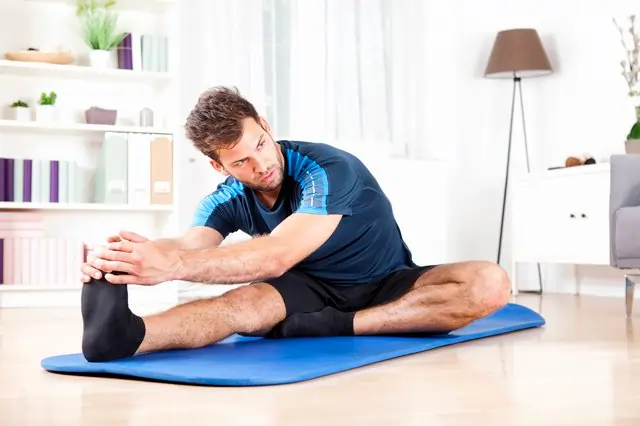
- A bodyweight exercise that works the lower back and hamstrings is the single-leg forward bend.
- You may strengthen your posterior chain and enhance your stability and balance by leaning forward on one leg.
- In addition to helping to increase flexibility and muscle activation, this exercise is excellent for detecting and correcting any strength or mobility disparities between sides.
Tricep Stretch
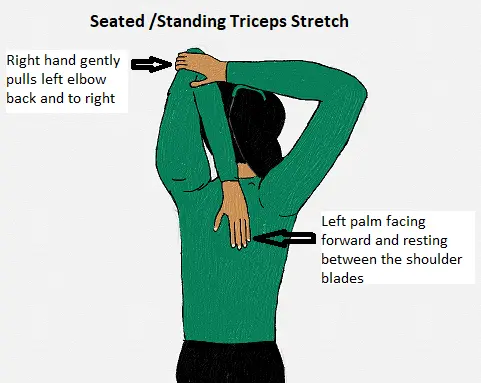
- The triceps are the main goal of this easy and efficient stretch.
- You may get a deep triceps stretch by raising one arm over your head and pulling the elbow behind your head with the other hand.
- This is a fantastic complement to any exercise regimen to increase flexibility and guard against injury.
Hip flexor stretch
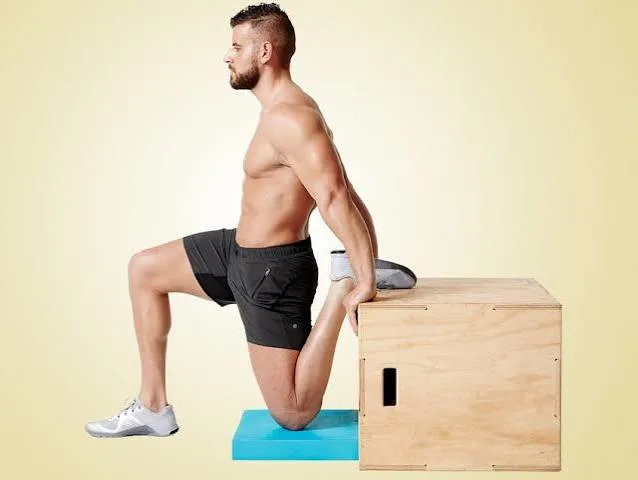
- The hip flexor stretch is an isolated stretch that mainly works the quadriceps and hip flexors.
- Leaning back to stretch while putting one leg on the ground and the other foot up on a couch or bench is the workout.
- This stretch is excellent for increasing hip flexibility and mobility, which may help improve performance and prevent injuries during a variety of lower body workouts.
Side Bend Stretch
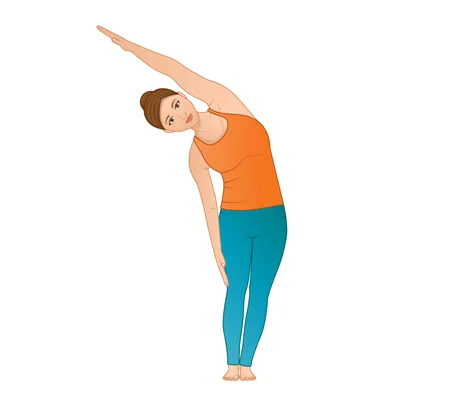
- The obliques and intercostal muscles along your side are the main targets of the Side Bend Stretch, a static stretching exercise.
- This stretch can be very useful for releasing tension and avoiding injuries to the sides and lower back.
- It also helps increase torso flexibility and range of motion.
Stance Jack
- A version of the jumping jack, the stance jack mainly works your legs and core.
- This exercise uses alternating stances, which can aid with stability and coordination, in contrast to regular jumping jacks.
- This complex exercise may help improve your balance and general functional strength, and it’s a wonderful way to add some variation to your fitness routines.
Why These Side Bend Modifications Matter
These substitutes provide you with the desired range of motion and side body opening, but they differ significantly in that there is little to no spinal stress.
The unequal loading caused by the weight of your upper body passing through your vertebrae is not a concern.
Instead, you may relish the sensation of stretching your muscles and fascia while knowing that you are protecting your spine.
Conclusion
Too many people contact me after injuring themselves while “just trying to help themselves” by going to seminars or viewing training videos. Generic exercise regimens aren’t made with your unique needs in mind if you have severe osteoarthritis, osteoporosis, or osteopenia.
These minor adjustments are not restrictions; rather, they enable you to continue being active for many years to come by teaching you smart choices.
The intention is to prevent arthritic flare-ups and spinal compression fractures that might prevent you from engaging in your favorite hobbies.
You may continue to move while safeguarding your most vital structural support system—your spine—with these spine-friendly side bend substitutes.
FAQs
In two weeks, how can I reduce my waist size?
5 Ways to Lose Belly Fat in 2 Weeks: You may start to see a smaller waist in two weeks by adhering to a calorie-controlled diet and core-strengthening regimen. Significant fat reduction takes time, but with certain regular routines, you may quickly tighten your waist and lessen bloating.
How can one get a feminine waist?
Reducing total body fat, strengthening your deep core muscles without significantly enlarging your obliques, and developing your glutes and hips to provide the appearance of an hourglass shape are all necessary to achieve a more feminine waist.
How can someone who is extremely rigid become more pliable?
You must engage in everyday, moderate stretching that teaches your nervous system to feel secure at greater muscle lengths in order to become flexible when you are extremely stiff. The majority of Reddit users concur that significant growth over a few weeks requires perseverance and consistency.
Are side bends effective?
Although fitness professionals and coaches disagree on whether side bends are the best or safest option for your core, they certainly build and engage your oblique muscles.
What is the quickest method for getting a smaller waist?
Spot reduction is a fallacy; thus, the quickest and safest strategy to lower your waist circumference is to build a daily calorie deficit of 300 to 500 calories through food and exercise. True weight reduction is achieved by reducing total body fat rather than focusing on a single muscle area.
What is the easiest approach to burn fat?
Increasing your regular non-exercise activity, such as walking, while enhancing passive habits, such as sleep and protein consumption, is the easiest approach to burning fat since it provides a calorie deficit without requiring strenuous exercise.
You can rely on low-effort behavioral changes instead of rigorous gym sessions to make fat reduction as easy as possible.
References
- Parker, J., & Parker, J. (n.d.). How to do Side Bend Stretch. Fitbod. https://fitbod.me/exercises/side-bend-stretch
- Stretch and Energize with Overhead Side Bends. (2025, June 10). Stretching Videos for Flexibility | STRETCHIT. https://blog.stretchitapp.com/blog/stretch-and-energize-with-overhead-side-bends
- Standing side bend. (n.d.). [Video]. Hingehealth. https://www.hingehealth.com/gb/en/resources/articles/side-bend/