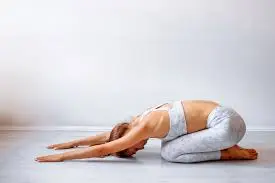
Child’s Pose for Back Stiffness
Balasana, another name for Child’s Pose, is a beginner yoga posture that works the inner thighs and lower back muscles. This stretch promotes deep relaxation, flexibility, and blood flow while perhaps relieving stress caused by excessive sitting.
This all-purpose position helps you relax and relieve stress in your hips, back, and spine. It works well as a warm-up to engage the shoulders, upper back, and core, or as a cool-down to get your breathing back to normal. Additionally, child’s pose relieves stiffness in the spine after prolonged sitting.
If you have ever had low back pain, you are aware that it can interfere with day-to-day activities.
Naturally, you should always consult a doctor if you have chronic back pain. However, even for those who are generally healthy, everyday activities like poor posture when sitting all day or bad form when exercising can strain the back and cause pain.
Fortunately, there are stretches that can ease your pain and promote healing. My favorite? Child’s pose. My go-to stretch for easing the pain that arises from sitting all day is this one. It’s a terrific method to de-stress, relax, and concentrate on your breathing, in addition to helping to stretch out the lower back. Therefore, this is one of those exercises that is equally beneficial to your mental well-being even when your back is feeling strong.
Table of Contents
Child’s Pose Target Areas
- Hips
- Back
- Spine
- Shoulders
Which Muscles Are Used in Child’s Pose?
Child’s pose does not help you build muscle. This indicates that it is not intended to strengthen or push any muscles. Rather, it’s a stretch that emphasizes opening your hips, extending your thighs, and lengthening your spine.
Trapezius muscles: The two big muscles in your back are called the trapezius muscles. Stretching from the nape of your neck to your mid-back and over your shoulder blades, these two muscles work together to produce a diamond shape. Your neck and shoulders may be moved and rotated with the aid of the trapezius muscles.
Erector spinae muscles: The spinalis, longissimus, and iliocostalis are some of these deep, intrinsic back muscles. Your back’s ability to rotate and straighten is facilitated by the erector spinae muscles, which span the length of your spine.
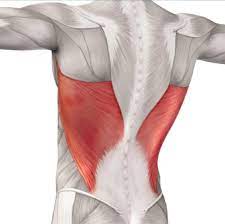
Latissimus dorsi muscles: These muscles extend over the rear of your ribs from your spine. They facilitate the extension and movement of your arms and shoulders.
Teres major muscles: The teres major muscles extend from your underarms to your shoulder blades. They assist you in moving your arms and shoulders by cooperating with the latissimus dorsi muscles.
Oblique muscles: The internal and external obliques comprise the oblique muscles. These muscles extend from the center of your ribcage to your pelvis along your sides. They enable side-to-side twisting of your body.
Gluteus muscles: You can move your thighs with the help of these muscles, which comprise the gluteus maximus, gluteus medius, and gluteus minimus. Stretching your hips in the child’s position releases stress in the gluteal muscle area.
Hip flexor muscles: The muscles at the front of your thighs are called hip flexors. The rectus femoris, sartorius, iliacus, and psoas major are among these muscles. If you spend a lot of time sitting at a desk, this group of muscles can quickly get tense.
Child’s Pose Benefits
- Relieves back pain and stiffness
- Slows breathing and encourages post-workout recovery
- Improves shoulder mobility
- Straightens spine to improve posture
There’s a reason why child’s pose is a well-liked cool-down stretch. It is a great lower-body stretch that works the quadriceps, hips, and ankles in addition to your low back. It’s a good indication that some of these regions need more attention if your body feels constricted when you’re in child’s pose.
Additionally, child’s pose offers both mental and physical relaxation. When you need a moment to breathe and de-stress, this position may be calming and pleasant since it is a static stretch done with your body lying on the floor.
How to strike a modified child’s pose
The child’s position appears straightforward. You’re only lying there, after all. Be aware that appearances might be misleading if you’re having trouble striking a child’s pose. To do the maneuver correctly, you actually need a basic level of hip and back flexibility. It’s okay to start with a reduced version and work your way up.
Get down on your hands and knees. To create a “V” shape with your calves, spread your knees to separate your legs while keeping your toes together. Reach your arms past your head so that your chest is between your thighs while maintaining a straight spine. Remember to take deep breaths while you stay in this posture for 30 seconds.
How to perform the child’s pose correctly
When you’re prepared to attempt the classic form of child’s pose, do the following:
- After getting on all fours, sit back on your heels with your ankles beneath your butt.
- Walk your hands forward while keeping your knees together. Reach your fingertips toward the front of the room while maintaining a straight arm position.
- Stop when your quadriceps, back, and arms begin to stretch slightly.
- If you are flexible enough, place your forehead on the ground while resting your body on your quadriceps.
- Hold this position while taking deep breaths. If you’re having trouble with the stretch, don’t forget to raise your butt in the air and restart.
Five Activities to Improve Your Child’s Pose and Flexibility
Don’t worry if child’s pose sounds scary or feels challenging, since it takes a certain amount of flexibility! The child’s posture may be made simpler and more accessible with a variety of additional stretches.
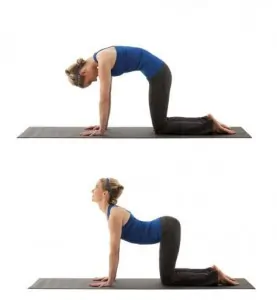
To start, go down on your hands and knees. Place your palms squarely behind your shoulders on the mat. Drop your stomach toward the floor, look up at the sky, and arch your back so that your spine forms a soft “U” shape to enter the cat posture. Pull in your abs, lower your head, and round your back to enter the cow posture as you exhale.
Runner’s lunge
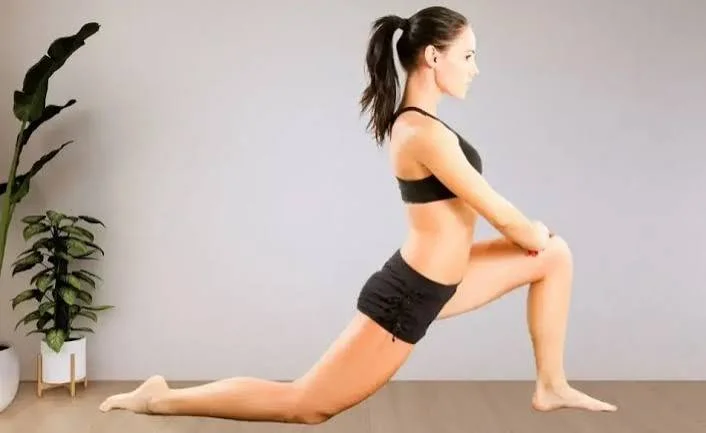
- To begin, stand up. Put your hands on the ground and bend your knees.
- With your leg straight behind you, take a step back with your right foot.
- With your left knee bent over your left ankle, place your left foot between your hands.
- Maintaining proper posture, straighten your back and look in front of you.
- Exhale, allowing your hips to drop to the ground. After a few breaths of holding this position, turn to the other side.
Pigeon pose
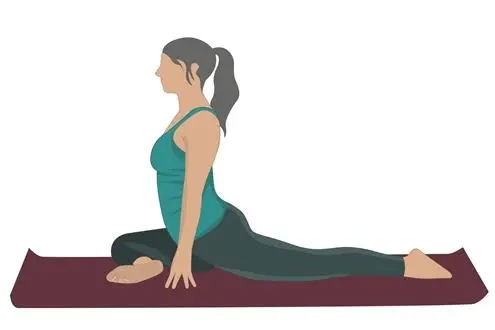
- Start by having the dog glance down. Bring your right leg forward toward your right hand and place it on the mat while extending your right ankle toward your left hand and placing it as close to your hand as feels comfortable.
- Your right shin should ideally be parallel to the mat’s front. Lower your hips toward the floor by placing them on top of your right leg.
- Straighten your left leg behind you. To balance your weight while keeping your hips square, press your hands down onto the mat in front of you.
- If this is a sufficient stretch, stay there and inhale deeply. For a deeper stretch, drop your torso toward the mat, bend at the hips, and reach across your bent front leg.
- Flex your right foot. Hold this position for 60 seconds while taking gentle breaths.
Standing Figure 4
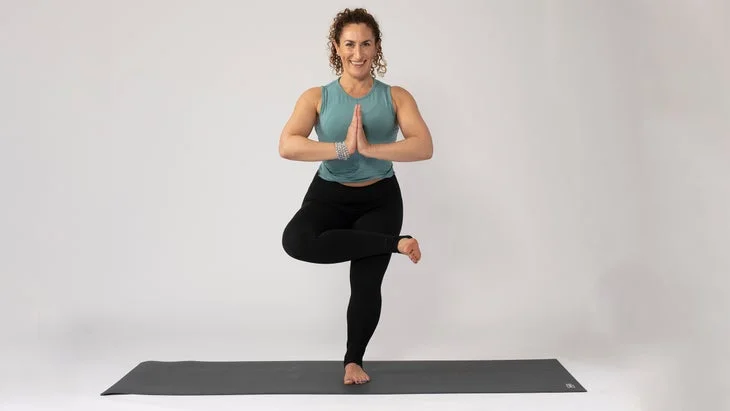
- Balance on your left leg while standing with your feet as wide as your hips, then raise your right leg.
- Cross the right ankle across the left thigh while bending the left knee out to the side.
- Recline as though you’re going to take a seat. Here, strike a balance.
- The right foot should be flexed. If you would like, gently press your palms into your right thigh to slightly expand it.
- You may also do this workout while seated. Switch sides after holding for two to four breaths.
Lying Spinal Twist
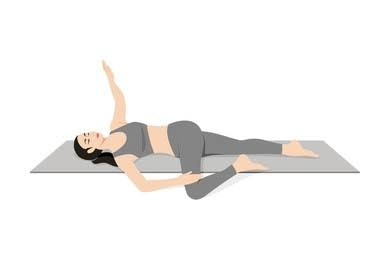
- Lie on your back with your legs extended. Raise your right knee to your chest. Allow your right knee to fall across your body until it makes contact with the floor.
- Maintain a straight left leg on the ground.
- Use your left hand to push your knee to the floor for a deeper stretch.
- Hold for thirty seconds or so. On the opposite side, repeat.
Common Form Mistakes
When performing this exercise, people frequently push themselves excessively hard because they believe that doing so would improve their performance. Craning the neck up while attempting to stretch the arms too far forward or extending the legs too wide in an attempt to descend the chest to the ground are two indicators of this. This might be detrimental and put undue strain on your muscles. The secret is to slowly let your body weight draw you toward the ground as you glide into the stretch.
Don’t push yourself too hard because there are several variants that can make child’s pose more accessible. Pay attention to your body and execute the action as well as you can. When striking child’s pose, bear the following form advice in mind:
- Even if it’s not as far as you anticipate, extend your arms as far as they can go without straining.
- To make this maneuver simpler, raise your butt in the air if necessary.
- If you feel any pain, place a pillow or cushion beneath your knees.
- You can lessen neck tension by placing a yoga block beneath your forehead.
- Pay attention to your body and, if necessary, take a moment to breathe!
Yoga for back pain – child’s pose
Mobilize the Spine
A child’s pose is essentially a flexion pose, which causes the spine to bend forward. It is most effective when used with backward-bending extension positions like Cobra or Sphinx. This combo is a great way to warm up for stability or strength workouts since it works your trunk muscles.
Facet Joint Problems
Child’s Pose may help if your back pain is caused by problems with your facet joints. Stretching the spine backward, such as in Cobra posture, can aggravate the facet joints.
The area in the facet joints where the nerves enter and exit the spine is narrowed by spinal extension, or backward bending. Extension can be painful and uncomfortable if the facet joints are irritated.
Child’s Pose generally gives the traveling nerves more room by moving the spine in the opposite direction of the irritating movement.
Please speak with your healthcare professional if Child’s Pose worsens your radicular symptoms; this might be a sign of increased disk pressure rather than facet syndrome. Please refer to the section on pillowing poses to assist support Child’s Pose if it seems challenging but not uncomfortable.
Disc Problems
Use caution when performing this position if you have degenerative disk disease or a herniated disk. Find out if Child’s Pose is suitable for your back from your doctor or physical therapist.
Before attempting this posture, it is crucial to obtain particular information from your healthcare provider because every person’s disk issue is unique.
If you are permitted to perform Child’s Pose, keep in mind that you may always cushion yourself until you feel comfortable. The goal of yoga for back pain is to establish a comfortable position from which to practice and then gradually advance.
Sacroiliac Instability
You might be able to release tension in the sacroiliac region by supporting your Child’s Pose with a cushion or towel between your thighs and lower legs as explained in the next section.
If you have sacroiliac instability, take a modest approach: use a good pillow, hold the posture for a short period of time, pay attention to your body, and let your pain lead you to a comfortable position. If your low back feels weak, be prepared to skip Child’s Pose.
Pillowing for Support
As you relax, your body’s weight will draw you farther into the posture; therefore, it’s a good idea to think about using strategic pillowing to assist the effort.
Try putting a small cushion or rolled-up towel beneath your hips to protect your knees. This will increase the distance between your lower legs and thighs so that you are almost sitting on the towel or pillow. This will make the posture pleasant and supportive, enabling you to remain in it for a reasonable period of time.
Another option is to put a pillow beneath your stomach or chest. Finding the most effective approach to support your child’s pose requires experimentation.
Experiment for Shoulder Position
Two methods for positioning the arms and shoulders in Child’s Pose are provided by yoga guru Ann Pizer: They are either stretched above your head, palms facing down, or down by your sides, palms facing up.
Once more, you may find the most comfortable option by experimenting. Because each arm position has a somewhat distinct effect on the upper back, you might wish to spend some time in both.
The version with your arms at your sides will be more comfortable if you have a shoulder issue. In any case, pay attention to your body and let your pain direct you to the most comfortable posture.
Releasing at the Hip
Your hips are flexed while you are in Child’s Pose. Many of us don’t know how to relax our extremely tense hip muscles. The preponderance of sitting in our everyday routines is largely to blame for this. Once more, pillow support can help you begin the posture in a comfortable position and help you learn how to thoroughly relax your hip joints.
You might focus on your hip joints while in Child’s Pose and try using your breathing to help the muscles there relax. Imagine the interior of the hip joint folding gently to promote relaxation.
Child’s Pose: Precautions and Contraindications
DO’S
- Warm up first: by stretching or moving gently before easing into Child’s Pose.
- Use props at will: The posture is accessible with bolsters, blankets, or pillows beneath your knees, ankles, or torso.
- Continue to breathe easily: Widen your knees or change your position if you are having trouble breathing.
- Pay attention to your body: If you get tingling or acute pain, stop the pose.
- Support your head and neck: If your forehead doesn’t reach the mat, rest it on a block, pillow, or folded arms.
- Slowly emerge: Avoid making abrupt movements that might cause back pain by using your hands to slowly pull up.
- Practice attentively: Balasana is an active relaxation, not a forceful stretch.
Don’ts
Avoid deep flexion if you have hip or knee issues.
- If necessary, use supports to support your hips so they don’t contact your heels.
- Unless instructed by a prenatal yoga instructor, avoid or alter during the latter stages of pregnancy.
- If you have stomach or back problems, consider a wide-kneed, supported version instead of squeezing the abdomen.
- If you experience numbness or a strong tug in your knees, hips, or ankles, stop the posture.
- Avoid falling shoulders and use your arms to support your spine gently.
- Never hurry it: The advantages of the pose come from steady breathing and gradual relaxation.
FAQs
What is the best way to treat lower back pain?
Physical therapists most frequently recommend the glute bridge to strengthen the supporting muscles surrounding the spine, but there isn’t a single “magic” exercise that works best for lower back discomfort.
Can someone with sciatica do child’s pose?
By gently extending the lower back and expanding the hips, child’s pose can assist some people with sciatica. However, if your sciatica is brought on by a disc herniation or acute flexion intolerance, it may worsen the pain.
Which posture calls for the greatest amount of flexibility?
Because they push several major joints—the hips, spine, and shoulders—to their maximum anatomical limits, extreme full-body contortion poses like the Hanumanasana (Full Front Split), Samakonasana (Middle/Side Split), or deep backbends like Scorpion Pose (Vrischikasana) require the greatest amount of flexibility.
Why does doing yoga make my back discomfort worse?
Because some yoga postures compress discs, overstretch spinal tissues, or require repetitive forward and backward bending that aggravates an existing problem, your back discomfort may worsen afterward.
What is puppy pose over child’s pose?
Kneeling with the hips resting on the heels, Child’s Pose (Balasana) emphasizes repose, grounding, and a little back stretch.
Puppy Pose (Uttana Shishosana) emphasizes shoulder opening and a deeper spine stretch by keeping the hips raised above the knees while stretching the arms forward.
In summary, Puppy Pose focuses on shoulder flexibility and spinal extension, whereas Child’s Pose emphasizes relaxation and inward meditation.
Does Child’s Pose help with back pain?
Yes, if done with awareness. It allows for a slight decompression of the spine and relieves stiff lower back muscles. To guarantee proper alignment, practice under a teacher’s supervision if you have ruptured discs or severe discomfort.
References
- Pohlman, D., & Pohlman, D. (2024, July 8). Child’s Pose for beginners and men | A Step-by-Step tutorial. Man Flow Yoga. https://manflowyoga.com/blog/childs-pose-for-beginners-and-men/
- If sitting all day hurts your back, this 1 stretch can help. (2025, November 14). TODAY.com. https://www.today.com/health/diet-fitness/how-to-do-childs-pose-rcna239372
- Allen, W. (2026, March 24). Balasana. https://myyogateacher.com/yoga-asana/balasana