Pelvic Tilt For Back Pain Relief
Table of Contents
Introduction:
Walking, running, and lifting weights off the ground are all made possible by your pelvis. It also helps maintain posture.
When your pelvis is turned forward, your spine is forced to curve, resulting in an anterior pelvic tilt. It is frequently caused by prolonged sitting without adequate exercise and stretching.
The muscles at the front of your pelvis and thighs may be tense, while the muscles in the rear may be weak if you have an anterior pelvic tilt. You may also have weak abdominal and gluteal muscles. This can result in:
- lower back pain
- knee and hip pain
- improper posture
- forceful rotations of the knee and hip
- An Anterior pelvic tilt may be lessened by hip-focused stretches, exercises, and awareness practices, according to research.
To assist your pelvis in returning to a pain-free, neutral posture, try these exercises at home.
Importance of pelvic tilt:
Anterior aspect of the bony pelvis
Patients with chronic lower back pain (LBP) usually do pelvic tilting exercises in the sagittal plane to correct their lumbar spine. A posture that encourages lumbar lordosis is one of the primary causes of LBP. When treating LBP, it is essential to minimize the use of the lumbar lordosis-causing posture. While posterior pelvic tilting has the opposite effect, anterior pelvic tilting increases lumbar lordosis. Exercises for posterior pelvic tilting are frequently performed in rehabilitation.
According to research, these local muscles regulate motion in the pelvic sagittal plane and may be connected to anterior and posterior pelvic tilting. Patients with LBP may benefit from local muscle training to improve their lumbar alignment in the sagittal plane. Training the multifidus in patients with less lumbar lordosis and the transversus abdominis in those with excessive lumbar lordosis may be beneficial.
Chronic low back pain sufferers have reduced pelvic proprioception, are less “movement-aware,” and may have worse postural control. This raises the issue of whether specific activities or postures that involve extremes of particular movements—such as excessive or limited movement may put people at risk for lower back pain.
Pelvic Tilt Measurements:
To measure anterior pelvic tilt, use the “pelvic tilt angle.” The angle formed by a line joining the anterior superior iliac spines (ASIS) with a vertical line is commonly used to compute this measurement. With the patient lying supine on a table and the examiner palpating the ASIS to find the landmarks for measurement, the angle might be measured using a goniometer.
The patient is asked to lie supine with their feet flat on the table and their knees bent as part of the “supine pelvic tilt test.” After that, the examiner looks at the patient’s pelvic posture and records any asymmetry or departure from the neutral position. Additional tests include the “prone hip extension test,” which assesses posterior pelvic tilt, and the “Thomas test,” which gauges hip flexor tightness and may detect anterior pelvic tilt..
The application of artificial intelligence to the evaluation of pelvic radiographs has been investigated recently. Over 500 pelvic radiographs using a deep learning algorithm in research that was published in the journal International Orthopaedics. They discovered that the AI software had an accuracy rate of over 90% in identifying fractures and other abnormalities in the pelvic area.
According to the authors, using AI-powered software may enhance precision and effectiveness, especially when several pictures need to be examined. To assess the software’s effectiveness in various clinical contexts and with various types of radiographs, more investigation is necessary. This study demonstrates artificial intelligence’s potential in medical imaging and how it might assist radiologists in their clinical practice.
Pelvic tilt causes:
The most frequent cause of severe pelvic tilt is prolonged sitting. particularly if you are seated for extended periods of time.
One extended playing session or a weekend movie marathon won’t cause pelvic tilt. However, if you remain in the same posture for days on end, your body will eventually automatically correct the angle of your pelvis. One of the most prevalent causes of it is working at a desk every day.
Our bodies are incredibly flexible. This is often a positive thing. But occasionally, your body will undergo excessive changes. Your butt, belly, and leg muscles adapt to prolonged sitting.
- Gluteal Muscles
- Hamstrings
- Hip flexors
- Abs
These muscles often cooperate to support you in keeping a steady, comfortable posture. However, if you don’t utilize them frequently enough, they may eventually deteriorate. They are unable to keep your pelvis straight as they get weaker or less flexible. It may also lean forward or backward as a result.
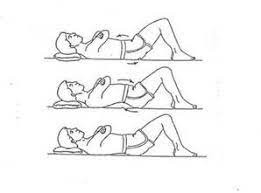
How to Perform a Simple Pelvic Tilt?
Beginners and people with back pain can usually effectively practice the basic pelvic tilt while lying on their back.
How to Perform a Pelvic Tilt While Standing
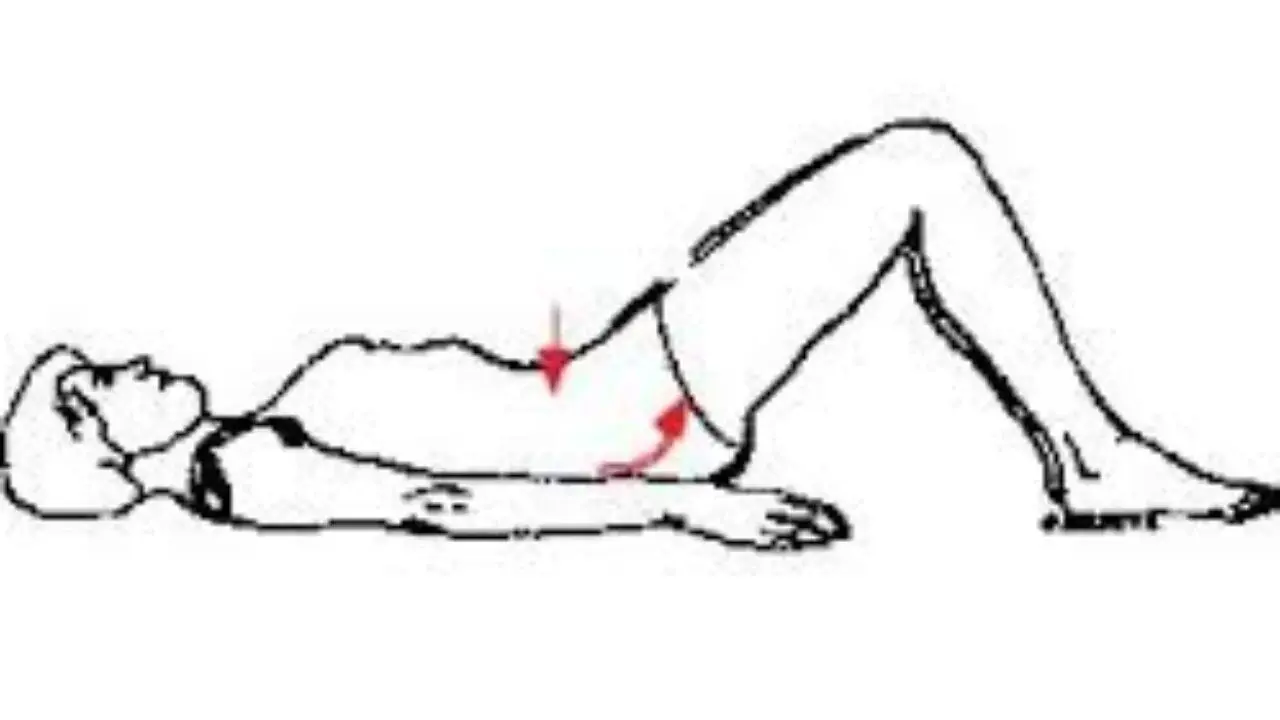
Try a standing pelvic tilt for greater comfort if you’re pregnant or find sleeping on your back difficult.
- Lean slightly while standing with your back against a solid wall.
- Take a breath and bend your knees gently.
- As you gently shift your hips forward or backward, release the breath.
- For you to press against the wall, this should straighten your lower back’s curve. Take a breath and go back to the neutral starting position.
- Do five to ten repetitions.
How to Use Your Hands and Knees to Perform a Pelvic Tilt
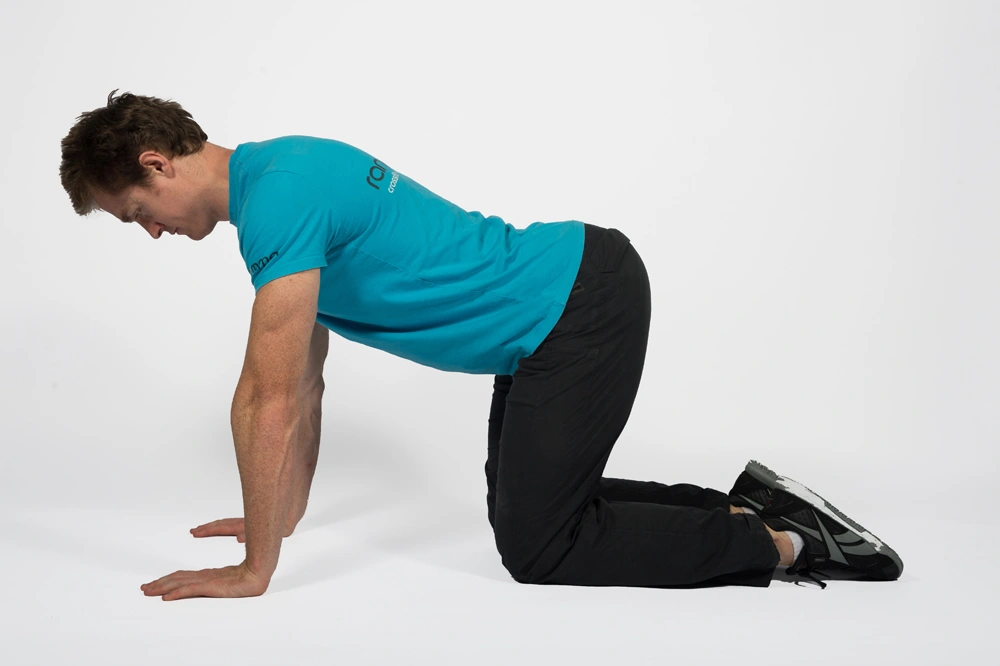
- If your level of fitness permits, do the pelvic tilt on your hands and knees for a more difficult variation.
- With your knees between your hips and your wrists between your shoulders, kneel and assume an all-fours standing position. Inhale deeply
- This is best done on a comfortable surface.
- Breathe out, round your back, and press into your arms while you draw upward with your abdominals.
- Return to the neutral position after relaxing gently.
- Perform five to ten repetitions.
- You should only perform this variant of pelvic tilt if your knees and wrists are pain-free.
How to Perform a Pelvic Tilt While Seated
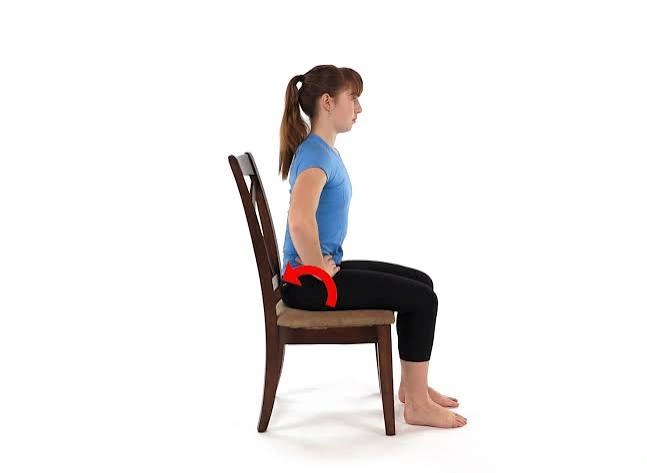
- To perform the pelvic tilt while seated:
- Sitting on an exercise ball with your feet shoulder-width apart, take a deep breath. To assist you in keeping your balance and posture, contract your core muscles.
- Breathe out, tuck your tailbone below your body, and carefully roll the ball backward.
- To roll the ball away from your feet and back to a neutral position, take a breath and squeeze your tailbone back.
- Perform five to ten repetitions.
- This variant is more difficult than others because using an exercise ball necessitates maintaining your balance by using your core muscles.
Starting position for severe low back pain
- The non-weight-bearing positions of supine/hook lying and quadrupod are the ideal beginning exercises for a large percentage of individuals with acute low back pain, even though pelvic tilts can be performed in a variety of positions. These postures not only lessen the load on the spine but also release tension in the hip muscles, increasing pelvic rotation. (Note: To prepare for the subsequent phases of the rehabilitation program, pelvic tilts can be performed in various positions as soon as the patient has the capacity to perform so. See the discussion that continues.
Anterior Pelvic Tilt
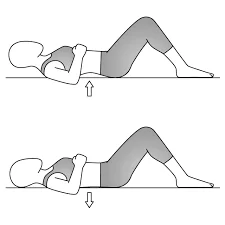
- Nutation of the sacrum, increased lumbar lordosis, and relative hip flexion are all linked to an anterior pelvic tilt. Tell the patient to slowly move their pelvis forward to ensure good form.
- They are attempting to raise the lower spine off the ground while in a supine position. They may see the pelvis shifting forward on their hip joints, which are quadrupedal in nature.
- Patients with low back pain frequently struggle to execute an anterior pelvic tilt correctly. Most frequently, there will be underactivity of the multifidus (and likely the psoas) and a lack of lower lumbar movement into extension.
- Rather, the patient is more likely to start the thoracolumbar erectors. This is demonstrated by a forward thrust of the thorax’s anterior pole rather than a rolling motion concentrated at the sacral base and lower lumbar spine.
- To prevent this, make sure the patient focuses on propelling the motion with the deep muscles in the lowest region of their spine.
Posture and posterior pelvic tilt
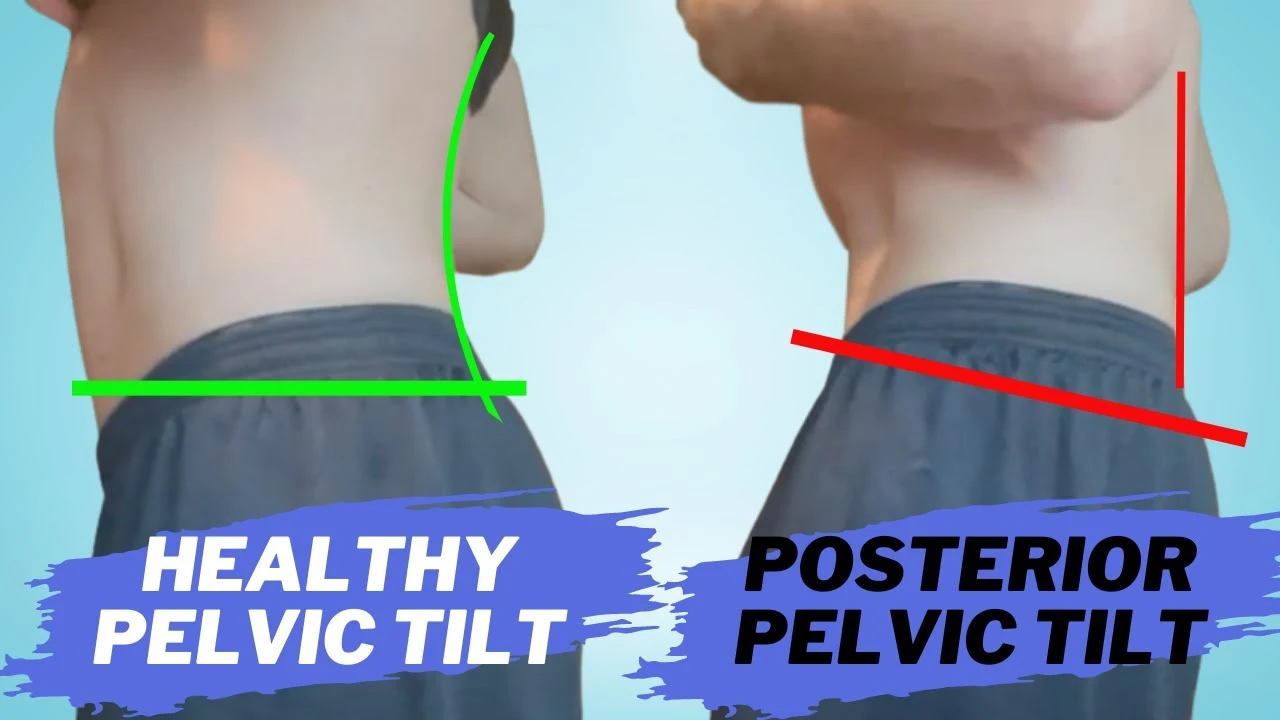
- Lack of mobility frequently leads to body imbalances, particularly for those who spend most of their time sitting down. This immobility leads to:
- Leg muscles that are weak and tense
Tendons around the pelvic bones that are shorter
inadequate equilibrium
bad posture - A posterior pelvic tilt may result from any of these causes. At this point, your upper body turns back, and your glutes tuck inward.
- A posterior pelvic tilt causes significant strain on the lower back, similar to an anterior pelvic tilt when the lower back arches inward. Sciatica, or pain that travels down the back of one of your thighs or glutes, is one type of back pain that may eventually result from this.
- With exercise, a posterior pelvic tilt can be corrected. Discover five exercises you may use to strengthen your core and leg muscles and enhance your posture.
Lunges leg:
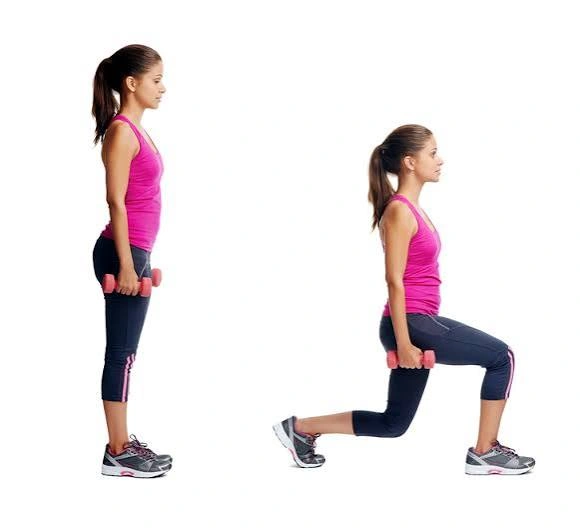
- Lunges strengthen your hamstrings, quadriceps, and glutes. By preventing any one muscle from taking over, strong leg muscles can help rectify a posterior pelvic tilt.
How-to:
- Keeping your feet together, extend your right leg in front of you.
- Make a 90-degree bend in your right leg. Your right leg should remain at a 90-degree angle when your other knee touches the ground.
- Place your right knee at a 90-degree angle to the floor and take a step forward with your left leg.
- Perform 10 to fifteen lunges in a set.
Caution:
- Avoid bending your knees past your toes, as this might cause knee pain.
- You might want to avoid lunges and focus on other leg workouts if you have trouble with your knees.
Hip flexor stretch while half-kneeling
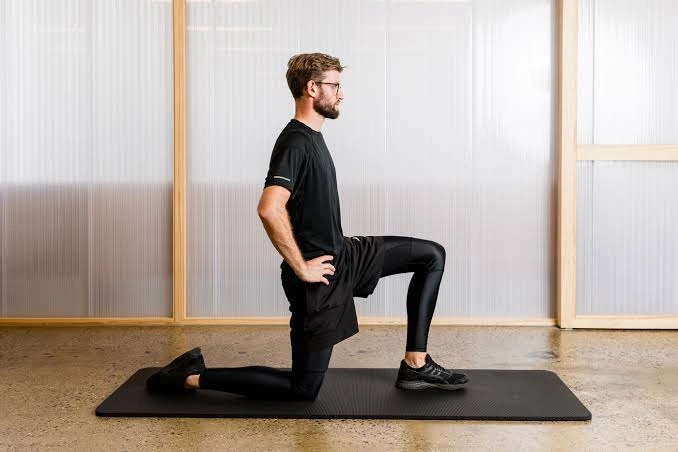
Your hip flexibility may improve, and your hip flexors may become more relaxed with this workout.
- Hip flexor exercises were proven to help quickly minimize anterior pelvic tilt in a small 2021 trial.
- Lunge with your left leg extended in front of you until your right knee touches the floor.
- If this is unpleasant, put a cloth beneath your knee. At the knee, your left leg should form a 90-degree angle.
- Tighten your abdominal and gluteal muscles to move your pelvis forward.
Lean forward from your right leg until your right leg’s inner thigh and hip flexor become tense. - Repeat up to five times after holding for 30 seconds and releasing.
- Change your legs.
You should have tightness in the hip flexors and potentially the quadriceps at the front of your thigh during this stretch. Nevertheless, the stretch shouldn’t be painful. Throughout the entire stretch, be careful to maintain a small tilt in your pelvis.
Bridge
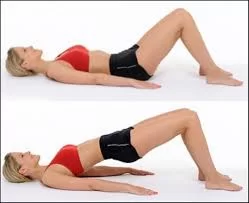
- Your hamstrings, glutes, and abdominal muscles may all be strengthened by this workout
- With your arms by your sides, lie flat on your back with your knees bent and your feet flat on the floor, hip-width apart.
- As you raise your pelvis off the ground, push your heels into the ground until your thighs and upper torso are in a straight line.
- Repeat 8–12 times after holding for 5–10 seconds and then gently lowering.
- To maintain proper bridge alignment, be careful to contract your gluteus and abdominal muscles while in this posture.
Kneeling leg lift with back stretch
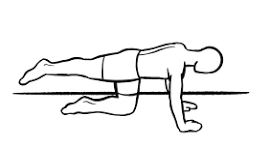
- This exercise may assist in extending your back and glute muscles while tightening your abdominal muscles.
- Put yourself on your hands and knees.
- Place your hands on the ground shoulder-width apart. Make sure your knees and hips line up.
- Make sure your pelvis is in a neutral posture by keeping your back parallel to the floor.
- As you release the breath, arch your back and pull your belly button in toward your spine.
- After two seconds of holding, return your spine to its neutral position.
- To line your elevated leg with your body, extend one leg back and raise it to the same height as your body. Keep the neutral position of your spine.
- Repeat up to ten times, lowering your leg after holding this posture for up to five seconds.
- Change your legs.
- Maintain alignment between your outstretched leg and your body. Back pain can result from excessive back arching.
Squats:
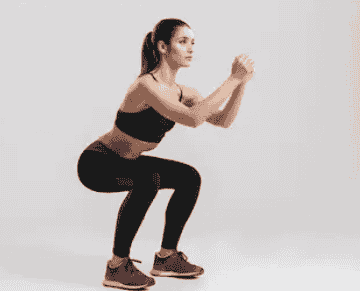
This full-body exercise strengthens the quadriceps, hamstrings, and gluteus muscles, among other muscles.
- With your toes pointed forward, place your feet shoulder-width apart.
- Your thighs should be parallel to the floor as you lower yourself to a sitting posture.
- Maintain a neutral back and firm abs.
- Tighten your glute muscles as you push yourself to a standing position and shift your pelvis slightly forward.
- Do this 15–20 times.
- Keep your knees from rotating inward or going over your toes when you squat. Maintain a neutral back posture.
- Avoid overarching your back or flattening the contour of your lower back.
- Squeeze your gluteus and abdominal muscles.
The final result
An anterior pelvic tilt, which results in an excessive curvature of the spine, can be caused by extended sitting without stretching or strengthening activities.
Your posture and tilt may be corrected with a few stretches and exercises.
If you have an anterior pelvic tilt, think about consulting a physical therapist. They might assist in creating a personalized treatment plan for you.
Safety Advice and Safety Tips to Remember:
- When performed correctly and in the proper posture, pelvic tilts are typically safe. But you might have to refrain from supine pelvic tilts or lying on your back if:
- You have a pregnancy.
Lying on your back hurts because of a medical issue you have.
In these situations, think about standing or doing all-fours pelvic tilts. - Avoid standing pelvic tilts if you have:
- Issues with balance
Knee or foot injuries that prohibit you from carrying weight
A pelvic tilt on all fours should be avoided if you: - Have a hand, wrist, or knee injury
Have you recently had knee, wrist, or hand surgery?
As usual, before beginning or stepping up an exercise regimen, see your healthcare professional
Key Habits to Avoid:
When performing pelvic tilts, there are a few things to be aware of.
- Forgetting to breathe: Breathing helps you stay focused, provides oxygen to your muscles, and prevents injury.
- Lifting your pelvis: This is a distinct workout known as a bridge if your butt lifts off the ground during a pelvic tilt.
- Misuse of abdominal muscles: When doing a pelvic tilt, pushing your belly out or sucking it in does not activate the core muscles. When your abdominal muscles are completely engaged, you should feel a tightening of the deeper muscles (transverse abdominus).
FAQs
Is it possible to fix pelvic tilt with exercise?
Indeed, to assist in correcting anterior pelvic tilt, experts usually advise a mix of mobility, strengthening, and stretching activities.
What is the duration required to correct an anterior pelvic tilt?
Hip stretches may help correct anterior pelvic tilt almost instantly, according to some studies (Trusted Source), but it may take eight weeks, according to other studies. Your degree of physical activity and your muscles’ strength and flexibility may have an impact on how long it takes
What Advantages Does the Pelvic Tilt Exercise Offer?
Your back and abdominal core muscles can be strengthened with pelvic tilt exercises. The transverse abdominis, the deepest abdominal muscle that wraps across the spine to give stability, is activated by a posterior pelvic tilt. Exercises for pelvic tilt can also be beneficial
Boost the flexibility and mobility of your spine.
Diminish persistent lower back pain
References:
- Ginta, D. (2026, May 19). 5 exercises for anterior pelvic tilt. Healthline. https://www.healthline.com/health/fitness-exercise/anterior-pelvic-tilt-exercises
- https://www.verywellhealth.com/pelvic-tilt-exercise-for-your-lower-back-296802
- Pelvic tilt. (2026, June 11). Cleveland Clinic. https://my.clevelandclinic.org/health/diseases/pelvic-tilt