High Cholesterol
Table of Contents
What is High Cholesterol?
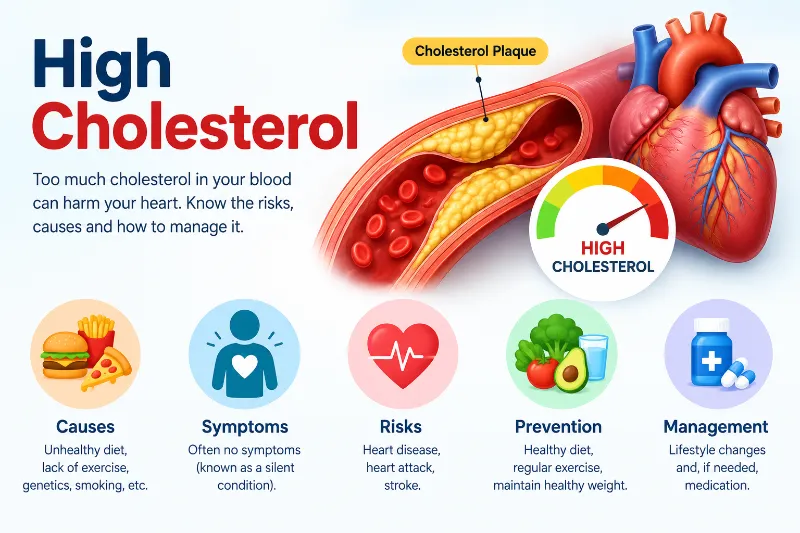
High cholesterol is a common health condition in which there is too much cholesterol in the blood. Over time, excess cholesterol can build up inside the arteries, increasing the risk of heart disease, heart attack, and stroke. Healthy eating, regular physical activity, maintaining a healthy weight, and appropriate medical care can help manage cholesterol levels and support overall heart health.
To function, your body needs the correct quantity of lipids. Your body cannot utilize all of the lipids if you have too much of them. Your arteries begin to accumulate the excess lipids. They develop fatty deposits in your blood when they mix with other chemicals.
This plaque may not cause any problems for years, but it progressively enlarges inside your arteries. For this reason, untreated elevated cholesterol can be dangerous. Just recognizing to you, the excess lipids in your blood contribute to the fatty deposites growth. Although this plaque gradually grows inside your arteries, it may not create any issues for years.
You can find out how much lipid is in your blood by getting a blood test called a lipid panel. What is considered high cholesterol depends on a person’s age, sex, and history of heart disease.
Good cholesterol vs. Bad Cholesterol:
Lipids come in a variety of forms. “Good cholesterol” and “bad cholesterol” are the two basic types that you have most likely heard of.
HDL stands for high-density lipoprotein, or good cholesterol. Think of the letter “H” as representing “helpful.” Your HDLs provide cholesterol to your liver. Your liver maintains the equilibrium of your cholesterol levels. It produces enough cholesterol to meet your body’s requirements and eliminates the remainder. To transport cholesterol to your liver, you need to have an adequate amount of HDLs. If your HDLs are too low, you will have too much cholesterol in your blood.
One form of poor cholesterol is called low-density lipoprotein, or LDL. This is the reason why your arteries are clogged with plaque. An overabundance of LDLs can eventually lead to heart disease.
When to get your Cholesterol checked?
High cholesterol can start in childhood or adolescence. For this reason, screenings should begin in childhood, according to current norms.
- Children and teens: Children and teenagers: Get your cholesterol checked every five years starting at age nine. If both parents have a history of heart problems or high cholesterol, a child may begin much earlier.
- Males: Get your cholesterol checked every five years until you are 45. Between the ages of 45 and 65, get examined every one to two years. Get checked annually beyond the age of sixty-five.
- Females: Get checked every five years until you’re 55. Between the ages of 55 and 65, get examined every one to two years. Get checked annually beyond the age of sixty-five.
These are only broad recommendations. Your healthcare provider will talk to you about what is best for you. For example, a person in their 20s with high cholesterol may need to be tested annually for a while. More frequent testing may also be necessary for people with other heart disease risk factors.
Causes of High Cholesterol:
Lifestyle decisions and genetics both contribute to high cholesterol. Among the lifestyle aspects are:
Smoking and tobacco use: Your “good cholesterol” (HDL) decreases and your “bad cholesterol” (LDL) increases when you smoke.
Being under a lot of stress: Your body produces cholesterol as a result of hormonal changes caused by stress.
Drinking alcohol: Your total cholesterol can rise if you consume too much alcohol.
Not moving around enough: Your cholesterol levels are improved by physical activity, such as aerobic exercise. If you work at a desk job or spend a lot of time sitting down, your body won’t produce enough “good cholesterol.”
Diet: Your cholesterol may rise or fall with certain foods. Sometimes, medical specialists will recommend dietary changes or a session with a nutritionist to discuss your diet.
Symptoms of High Cholesterol:
For most people, high cholesterol has no symptoms. You could run marathons and have high cholesterol. You won’t notice any signs until the high cholesterol causes other problems for your body.
How does High Cholesterol affect my body?
Over time, too much cholesterol causes bacteria to build up inside your blood vessels. We refer to this accumulation of bacteria as atherosclerosis. Atherosclerosis raises an individual’s risk of a variety of diseases. This is due to the vital functions that your blood vessels perform throughout your body. Therefore, there are repercussions when there is an issue with one of your blood vessels.
The arteries in your body are like a complex network of pipes that keep blood flowing. Bacteria slow down the drain from your shower and clog your pipes at home. The amount of blood that can pass through your blood vessels is restricted by plaque, which adheres to their inner walls.
Plaque forms inside your blood vessels when you have excessive cholesterol. The plaque grows larger the longer you don’t get therapy. Your blood vessels narrow or become clogged as the plaque grows. Your blood vessels could continue to function for a long time, much like a partially plugged drain. However, they won’t operate as effectively as they need.
Depending on which blood vessels are blocked, high cholesterol increases your risk of developing further illnesses.
Coronary artery disease (CAD):
Coronary heart disease (CHD) or ischemic heart disease are other names for coronary artery disease (CAD). When most people use the term “heart disease,” they mean this. In the United States, coronary artery disease (CAD) is the most prevalent kind of heart disease and the primary cause of mortality.
When atherosclerosis damages your coronary arteries, CAD results; your heart receives blood from these blood vessels. Your heart weakens and stops functioning properly when it doesn’t receive enough blood. A heart attack or heart failure may result from CAD.
Younger people can be affected by CAD, something that many people are unaware of. In actuality, one in five CAD deaths occur in those under 65. For this reason, it’s critical to have your cholesterol checked from an early age. Plaque can silently accumulate in your coronary arteries over time. Many people are unaware of it until they get angina, or chest discomfort, or another heart attack symptom.
Carotid artery disease:
Carotid artery disease is the term used to describe atherosclerosis that affects your carotid arteries. The big, front portion of your brain receives blood flow from your carotid arteries. Plaque narrows these arteries, which prevents enough oxygen-rich blood from reaching your brain.
A stroke or transient ischemic attack (TIA or “mini-stroke”) can result from carotid artery disease.
Peripheral artery disease (PAD):
Peripheral artery disease (PAD) is the term used to describe atherosclerosis that affects the arteries in your arms or legs. Because they are distant from your heart and the core of your body, the arteries in your arms and legs are referred to as “peripheral.” Although it can occur in the arms as well, PAD is more frequent in the legs.
PAD is risky since it often shows no symptoms. A peripheral artery that is at least 60% obstructed may be the point at which you begin to experience symptoms. One of the primary signs is intermittent claudication. When you move about, this leg cramp begins, yet when you relax, it stops. It is an indication of decreased blood flow caused by the artery’s developing plaque.
In addition to other parts of your body, PAD can create serious issues with your legs and feet. This is so because your cardiovascular system connects all of your blood vessels. Plaque accumulation in one place slows down your entire system of “pipes.”
Although they are connected, PAD and coronary artery disease (CAD) are not the same. It’s likely that people who have one condition also have the other. Many risk factors for CAD and PAD are similar.
There is a connection between high blood pressure (hypertension) and high cholesterol. Your arteries narrow and harden as a result of calcium and cholesterol buildup. In order to pump blood through them, your heart must work significantly harder.
Excessive blood pressure and excessive cholesterol are two of the primary causes of heart disease. Approximately one in three persons in the United States suffers from excessive blood pressure and high cholesterol. More than half of the adults in each group are either not receiving any treatment at all or feel that it isn’t helping them enough.
While prescription drugs can be very helpful, lifestyle modifications can maximize the effectiveness of those drugs. Changing one’s lifestyle is crucial for controlling high blood pressure and high cholesterol. Among the modifications are:
Eat less saturated fat and trans fat: Both can be found in high concentrations in fast food. However, depending on how they are prepared, even meals at formal restaurants may contain a lot of saturated fat.
Eat fewer fried foods and processed foods: Prepackaged snacks and desserts are among them.
Eat less sodium (salt): Salt is hidden in some meals. It’s critical to read store labels. Some eateries might be able to provide menu item nutrition information.
Quit using tobacco products and smoking: One of the main risk factors for heart disease and blood vessel issues is smoking.
What medical problems affect my Cholesterol levels?
There is a reciprocal association between cholesterol and medical issues. Atherosclerosis is one of the health issues that high cholesterol can cause. However, you may also be more susceptible to high cholesterol if you have certain medical issues. Your cholesterol levels may be impacted by the following conditions.
Chronic kidney disease (CKD):
Coronary artery disease is more likely to occur in people with chronic kidney disease (CKD). This is because CKD accelerates the accumulation of plaque in their arteries. Heart disease is more likely to claim the lives of those with early-stage CKD than kidney disease.
Triglycerides, a kind of fat, are elevated in those with chronic kidney disease (CKD). You also have higher levels of very low-density lipoprotein (VLDL) cholesterol as a result. Triglycerides are carried by VLDL particles. Your “good cholesterol” (HDL) levels are lowered by CKD, which also impairs the function of HDLs. Additionally, CKD alters the structure of your LDL (or “bad cholesterol”) particles, making them more harmful.
HIV:
Heart attacks and strokes are almost twice as common in those with HIV as in those without the virus. Previously, researchers believed that HIV drugs (antiretroviral therapy) were the cause of this increased risk. They believed that the medications raised a person’s cholesterol. More recent research, however, indicates that the true offender is a person’s immune system.
Even if you are managing your HIV, your immune system could still be active. This leads to chronic inflammation in your body. Atherosclerosis and plaque accumulation are caused by this inflammation.
People with HIV are living longer, which is wonderful news. However, this means that further research is needed to examine the effects of chronic conditions like heart disease.
Thyroid disease:
Your cholesterol levels can be impacted by thyroid dysfunction. This is due to the fact that the thyroid hormone affects how your body breaks down lipids, or fats. The type of thyroid condition you have will determine the impact.
Hyperthyroidism: Your body produces too much thyroid hormone as a result of this disorder. The medications used to treat this illness may cause your total, LDL, and HDL cholesterol levels to rise. If you are undergoing treatment for hyperthyroidism, talk to your doctor about managing your cholesterol.
Your body produces insufficient thyroid hormone as a result of this disorder. Additionally, it raises your cholesterol levels. In this instance, lowering cholesterol is a result of thyroid illness treatment. To get your cholesterol into the optimal range, however, you might still need to take statins. The appropriate course of action for your particular situation will be discussed by your provider.
The connections between heart disease and thyroid disorders are still being investigated by researchers. According to certain research, cardiac issues unrelated to plaque or cholesterol accumulation can be brought on by thyroid disorders. For instance, a person’s risk of heart failure may be increased by both hyperthyroidism and hypothyroidism.
In people with lupus, triglycerides and “bad cholesterol” (LDL, VLDL) are usually elevated. Additionally, their levels of “good cholesterol” (HDL) are lower. Compared to people with well-managed (silent) lupus, those with active lupus are more likely to have elevated cholesterol.
Your risk of coronary artery disease is increased if you have lupus. This is due to the chronic inflammation that lupus generates in your body. Your arteries accumulate plaque more quickly as a result of this inflammation.
Polycystic ovary syndrome (PCOS):
Heart disease is more common in people who have PCOS. As they become older, this risk increases. Numerous heart disease risk factors, such as diabetes and high blood pressure, are increased by PCOS. Low levels of “good cholesterol” (HDL) and high levels of “bad cholesterol” (LDL) are more common in PCOS patients.
Diabetes mellitus:
Your risk of peripheral arterial disease and coronary artery disease is doubled if you have diabetes mellitus (Type 1 and Type 2 diabetes). Lower HDL levels and greater triglyceride and LDL levels are associated with diabetes.
Diabetic dyslipidemia affects about 7 out of 10 individuals with Type 2 diabetes. This indicates that individuals have low HDL, high “small dense” LDL, and high triglyceride levels. A particular kind of cholesterol protein known as “small dense” LDL can readily penetrate your arterial wall and harm it. Plaque might develop if your blood contains an excessive amount of tiny, dense LDLs.
The relationship between diabetes and heart disease is still being investigated by researchers.
Risk factors of High Cholesterol:
Among the risk factors for elevated cholesterol levels are:
- Eating habits: High cholesterol can result from consuming excessive amounts of trans or saturated fat. Full-fat dairy products and fatty meat cuts contain saturated fats. Trans fats can occasionally be detected in packaged desserts or snacks.
- Obesity: Excess body fat is a factor in this complicated condition.
- Lack of exercise: The “good” HDL cholesterol in the body is increased by exercise.
- Smoking: Smoking cigarettes may cause HDL levels to drop.
- Alcohol: Excessive alcohol consumption might increase overall cholesterol. Limit alcohol consumption to no more than one drink per day for women and two drinks per day for men.
- Age: High cholesterol can affect even young toddlers. However, those over 40 are far more likely to have it. Your liver’s capacity to eliminate “bad” LDL cholesterol decreases with age.
Complications:
Complications are additional health issues that might result from high cholesterol. A hazardous amount of plaque can accumulate on the arterial walls as a result of excessive cholesterol. We refer to this as atherosclerosis. Arteries may restrict and stop blood flow as a result of plaque accumulation over time. Complications from reduced blood flow through the arteries include:
- Angina, another name for chest pain, can occur if there is damage to the arteries that carry blood to the heart. It may also result in additional symptoms of coronary artery disease, a prevalent kind of heart disease.
- Heart attack: Plaques may fracture or shatter, causing a blood clot to form. At the location where it ruptured, the clot can stop the blood flow. Alternatively, it can totally separate and obstruct a distant artery. A heart attack is a serious condition that has to be treated right away.
- Stroke: When a blood clot stops blood flow to a portion of the brain, a stroke occurs. Additionally, it’s an emergency that requires immediate medical attention.
How can I lower my Cholesterol?
Discuss the best strategy to reduce your cholesterol with your healthcare professional. Some people just require minor lifestyle adjustments, such as cutting back on saturated fat. Others require medicine in addition to lifestyle modifications. A more sophisticated strategy might be required for people with illnesses that impact their cholesterol. Discuss your medical history, family history, and lifestyle choices with your healthcare professional. Together, you will devise a strategy to reduce your cholesterol levels.
Keep in mind that even the best plans require time to implement. We all have setbacks. It’s acceptable to struggle and to let your provider know when a strategy isn’t working. Even the most rigorous lifestyle modifications may not always be sufficient to reduce your cholesterol levels. This is because the majority of the cholesterol in your body is produced by your liver. Therefore, a lot of other things that are outside your control and unrelated to what’s on your dinner plate come into play.
Remember that having high cholesterol is not a sign of personal failure, and take things one step at a time. It is the outcome of numerous subtle changes that are taking place within your body. Know that drugs and other medical treatments are available to fill in the gaps, but take charge of what you can.
Summary:
High cholesterol can be avoided by adopting the same heart-healthy lifestyle choices that can lower cholesterol. You can develop the following routines:
- Consume a diet high in fruits, vegetables, lean protein, and whole grains. Limit additional sugar and sodium.
- Reduce your intake of trans and saturated fats as well. Eat meals high in healthful fats instead, like almonds, olive or canola oil, and fatty or oily fish.
- Reduce excess weight and maintain it.
- Ask your care team for assistance quitting smoking if you smoke.
- Spend at least half an hour exercising most days of the week.
- If you drink alcohol at all, cut back. Keep alcohol consumption to a maximum of one drink per day for women and two drinks per day for men.
FAQs
What is the primary reason for elevated cholesterol?
The most frequent reason for low “good” HDL cholesterol or high “bad” LDL cholesterol is an unhealthy lifestyle. However, other medical conditions, some medications, and genes inherited from your parents can also cause your LDL cholesterol levels to rise or your “good” HDL cholesterol levels to fall.
Is it possible to eliminate high cholesterol?
The first line of treatment for children with high cholesterol who are 2 years of age and older is typically dietary and exercise modifications. Children with extremely high cholesterol levels who are 10 years of age or older may be administered statins or other cholesterol-lowering medications.
Which fruit lowers cholesterol?
Fruits include oranges, pears, bananas, apples, and prunes. Black-eyed peas, chickpeas, kidney beans, lentils, and lima beans are examples of legumes.
How can I do a home cholesterol test?
The first step in using a cholesterol home test kit is to use the lancet to prick your finger. The blood droplet is then put on the test strip. After a few minutes, the unique compounds in the cholesterol home test strip change color. After that, you compare the finished color to a color guide that comes with the package.
Is high cholesterol a result of stress?
Long-term stressors may have persistently elevated cholesterol levels in their bodies. The hormone cortisol may be to blame for this. Due to increased fat deposition, high cortisol levels can exacerbate stomach obesity.
Can high cholesterol be eliminated?
It can, really. Being physically active enables your body to transport bad cholesterol, sometimes referred to as non-HDL cholesterol, to your liver for elimination. If you don’t prefer going on lengthy runs or joining a gym, you can start by increasing your daily movement.
Do bananas have a low cholesterol content?
Foods that can help decrease cholesterol include citrus fruits like oranges and bananas, as well as fruits like avocados and apples. The liver produces cholesterol, which is then consumed through animal products including meat, eggs, and dairy. There are two types of cholesterol: healthy and harmful.
References:
- High cholesterol – Symptoms and causes. (n.d.). Mayo Clinic. https://www.mayoclinic.org/diseases-conditions/high-blood-cholesterol/symptoms-causes/syc-20350800
- Rashmi Jadeja. (2025). High Cholesterol – Symptoms, Causes & Treatment. samarpanweightlossclinic.com. https://samarpanweightlossclinic.com/high-cholesterol/
- Professional, C. C. M. (2025, March 19). High cholesterol diseases. Cleveland Clinic. https://my.clevelandclinic.org/health/articles/11918-cholesterol-high-cholesterol-diseases