Bird Dog Exercise for Back Stability
Bird dog exercises are quadruped bodyweight exercises that educate your core, hips, shoulders, and spinal stabilizers to function as a single unit by having you raise one arm and the opposite leg from a tabletop posture. They require no equipment, support a healthy lower back, and develop deep core stability.
If you’ve ever wondered what bird dog exercises are, the answer is straightforward: they’re quadruped bodyweight workouts that educate your shoulders, hips, core, and spinal stabilizers to function as a single unit. The bird-dog exercise may seem simple, but it’s one of the most reputable core-stability exercises utilized by yoga instructors, strength coaches, and physiotherapists. This book will teach you the proper bird-dog exercise form, its true advantages, who may benefit from it, and how to include it in a daily routine that fosters consistency.
A well-liked exercise for strengthening the back, hips, and core is the Bird Dog. This can alleviate lower back discomfort and enhance mobility and postural alignment.
You could know full well what a bird dog is, but have never heard of the bird dog exercise.
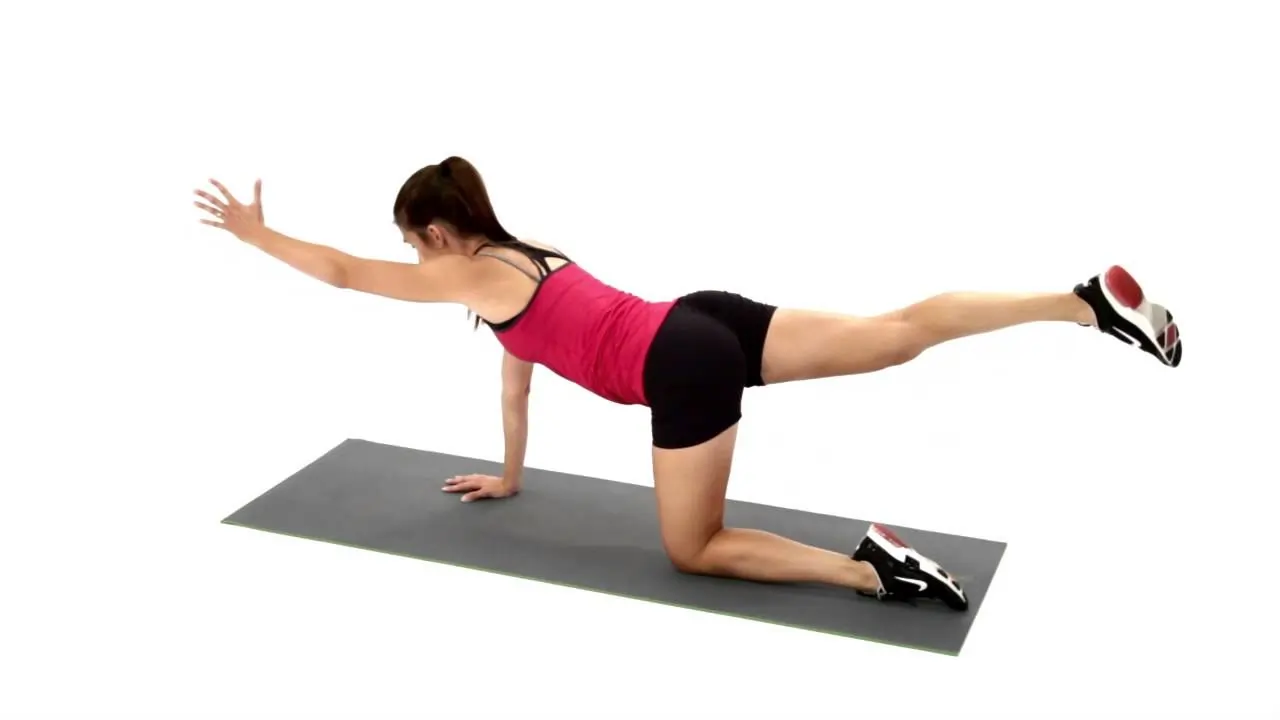
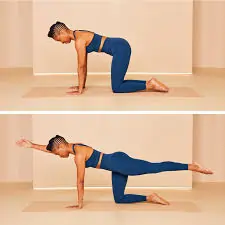
So named because the stance resembles a hunting dog looking at its prey, the bird dog appears quite basic. Also dubbed an opposite arm and leg raise, it’s performed on the hands and knees and entails raising one arm and the opposing leg simultaneously.
But despite its simplicity, the bird dog workout packs a significant punch. Indeed, it’s one of the most effective workouts for enhancing the stability of our core — the big collection of muscles in the belly, back, pelvis, and hips that serve to maintain the spine
All fitness levels, even older people, can benefit from this activity.
Continue reading to discover some more exercises that use the same muscles, as well as the advantages and variants of the Bird Dog exercise.
Table of Contents
What advantages does the Bird Dog workout offer?
The Bird Dog exercise strengthens several lower and upper body muscles, enabling appropriate mobility, control, and stability throughout the entire body. Among these muscles are:
- Erector spinae
- Rectus abdominis
- Glutes
- Hamstrings
- Multifidus Muscle
It’s a great workout for anyone with low back issues, including hypermobility, and it helps improve posture and balance.
The Bird Dog teaches you to maintain your low back while moving your limbs by using the stabilizer muscles in your spine, hips, and core. This makes many of your everyday and athletic actions easier and more mobile.
What is the bird dog exercise?
The bird dog is a bodyweight workout where you stretch opposing limbs while keeping your core stable on all fours.
Although it may seem simple, it teaches your body to maintain your spine while working many different muscle groups.
Almost every everyday action, from carrying groceries to participating in sports, requires this stability skill.
Science-backed bird dog benefits
Here are four main advantages of incorporating this workout into your program before we go into technique.
Safe core stability training
The bird dog exercise works many deep core stabilizers that you utilize every day, as opposed to crunches, which mainly work your six-pack muscles.
Better still? Numerous studies support the fact that it is extremely useful, safe, and efficient.
For instance, a 2012 study found that the bird dog exercise, also known as the contralateral arm and leg lift, was safe for core stability training since it produced little lumbar compressive stress, or pressure on the spine.
Reduced lower back pain
I’ve discovered that this exercise is quite beneficial for people who require therapy for low back pain in my clinical practice.
Research demonstrates that the bird dog exercise significantly reduces back pain, building on the work of spinal.
Improved balance and coordination
The bird dog teaches you how to move more effectively in daily life by requiring you to maintain your balance while moving your limbs in opposing directions.
Do you want to go one step further?
Because the bird dog puts a lot of strain on your core to remain steady, a 2023 study revealed that simply adding movement to the exercise, such as moving your arm and leg while standing, greatly improved balance and stability.
Strengthened posterior chain
Bird dogs stimulate important muscles in the posterior chain, such as the glutes, hamstrings, and lower back muscles, even if core stability is the main goal.
People who sit a lot or lead sedentary lifestyles sometimes have weaknesses in these areas, but research indicates that the bird dog exercise engages the glutes sufficiently to increase strength.
How to perform the Bird Dog exercise
You’ll need an exercise mat for this workout. For additional padding, place a folded towel or flat pillow beneath your knees. To verify your alignment, use a mirror.
Here’s how to do it:
- Start in the tabletop posture on all fours. Put your hands behind your shoulders and your knees beneath your hips.
- Use your abdominal muscles to keep your spine in a neutral position.
- Bring your shoulder blades together.
- With your shoulders and hips level to the floor, raise your left leg and right arm.
- To look down at the floor, tuck your chin into your chest and extend the back of your neck.
- After a few seconds of holding this position, return to the beginning position.
- For a few seconds, raise your right leg and left arm.
- Go back to where you were. This is one rep.
- Perform 8–12 repetitions in 2–3 sets.
Tips on alignment and proper technique
You must properly position your body and employ the appropriate strategies if you want to get the most out of the Bird Dog workout.
When you’re practicing this exercise for the first time, the following advice could seem like a lot to take into account. Rather than attempting to learn them all at once, try concentrating on a couple of these tips at a time:
- Maintain a level hip position. Avoid rotating your pelvis.
- Don’t let your spine flex past its normal posture or raise your leg too high.
- Feel a line of energy extending from your fingers through your toes and throughout your entire body.
- To keep your back from drooping, maintain a neutral spine and use your core.
- Keep your chest from lowering itself toward the ground.
- Pull your shoulder blades down, back, and away from your ears.
- Maintain alignment between your spine and the back of your neck.
- Proceed cautiously and gently. Instead of concentrating on specific muscles or motions, move your body as a whole.
- Continue breathing evenly and smoothly.
Bird Dog Exercise Variations
You may increase the difficulty of the Bird Dog workout by using a few different versions. Here are several to try:
Weighted Bird Dog

A dumbbell, ankle weights, or a weighted household item like a soup can, book, or filled water bottle can be used to complete this workout.
Bird Dog: full-body resistance band
Resistance bands are reasonably priced workout equipment that may assist in activating the deeper muscles, enhancing strength and stability.
This version involves wrapping one end of a resistance band loop around your foot’s bottom and the other over the opposing hand’s thumb. For instance, one end should encircle the left hand and the other the right foot.
The band should expand beneath your core as you work through the workout.
Bird Dog resistance band for the lower body
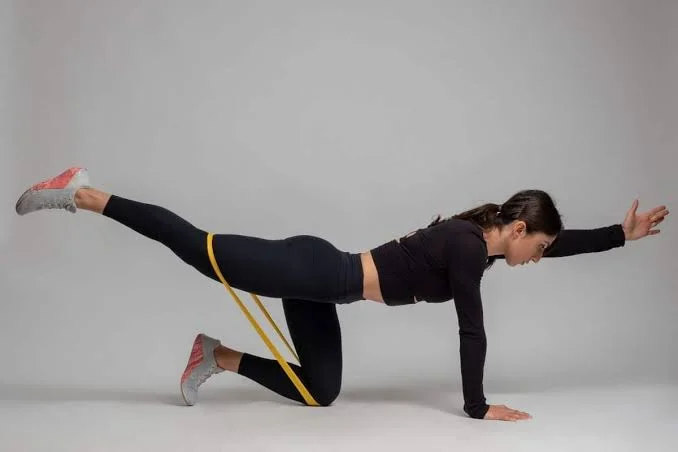
The hips, glutes, and hamstrings are the main muscles targeted by this Bird Dog version, which also makes use of a looped resistance band. Position the resistance band around your thighs, about three inches above your knees, to complete this workout.
Bird Dog Exercise While Standing
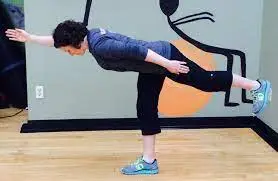
Similar stabilizer muscles in the hips, core, and spine are worked by the standing Bird Dog exercise. However, because it necessitates standing on one leg while moving other body parts, it could be more beneficial for improving balance.
To perform this exercise:
- Place your feet shoulder-width apart and keep your arms by your sides to begin.
- Raise your left knee till your thigh is level with the ground. Simultaneously, lift your right hand while keeping your arm straight.
- Return to the beginning position by lowering the arm and leg.
- Use the opposite arm and leg to complete the exercise.
Additional advice to make it harder
Additionally, you may make the exercise more challenging by:
- Starting from the push-up posture, complete the exercise by bringing your elbow to your knee after each extension.
- Every time you extend an arm or leg, twist your upper body and rotate the extended wrist or ankle.
- Make little circles in both directions, or pulse your outstretched arm and leg
Additions to the Bird Dog Exercise
You can perform the Bird Dog exercise in addition to or instead of some other exercises that target the same muscles.
Bird Pose
Your lower back may be strengthened, mobilized, and stabilized with this yoga position.
To perform the Bird Pose:
- To begin, lie on your back with your arms at your sides, your feet flat on the ground, and your knees bent.
- Your spine should make a straight line as you raise your hips toward the ceiling.
- Concentrate on using your hamstrings, glutes, and core.
- After three to five seconds of holding this position, return to the beginning position.
Pelvis tilts
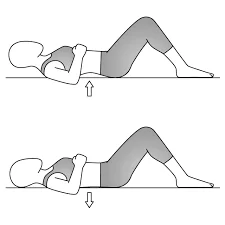
The pelvic tilt exercise strengthens the abdominals, glutes, and low back.
- Begin by lying on your back with your feet flat on the ground and your knees bent. Put your hands under your head for extra support.
- Take a breath. Tilt your pelvis downward and contract your core muscles such that the base of your spine presses against the floor as you exhale.
- After five seconds of holding, let go.
Donkeys Kicks
By strengthening your hips and glutes, donkey kicks may improve your overall stability and balance.
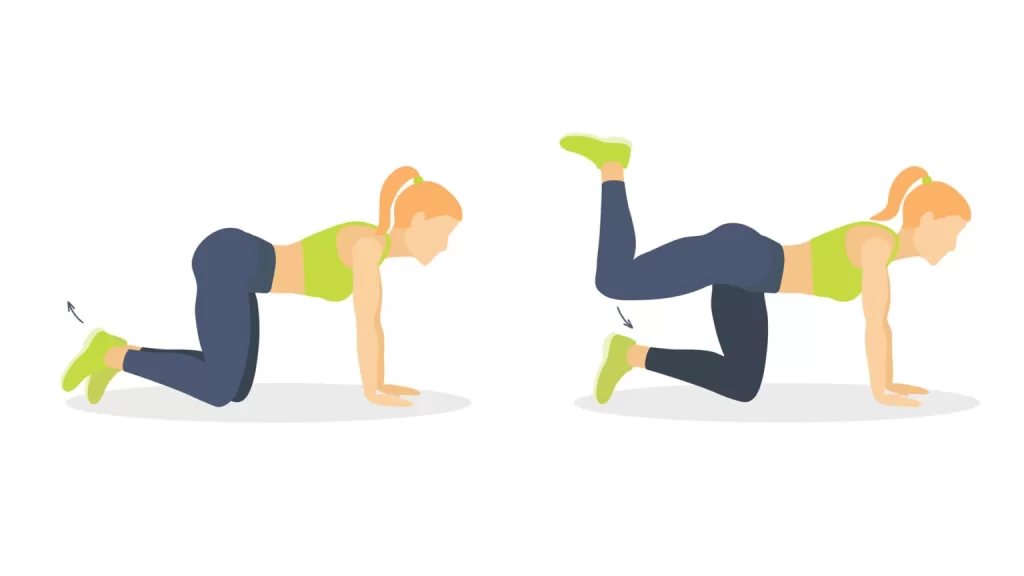
To perform this exercise:
- Place your hands under your shoulders and your knees under your hips to begin in a tabletop posture.
- Kick your foot back and raise your right leg behind you.
- Avoid lifting your leg over your hip and distribute your weight evenly.
- Return the leg.
- Do it on the opposite side.
Uses:
- From a tabletop quadruped stance, simultaneously extend one arm and the opposing leg.
- Activates deeper spine stabilizers than crunches, such as the transverse abdominis and multifidus.
- Utilized extensively as a core-stability exercise by yoga instructors, strength coaches, and physiotherapists.
- Trains the neural system to synchronize the body’s opposing sides for a more stable gait.
- During the hold, the glute medius and shoulder stabilizers contract to maintain the body’s level.
- Two sets of eight repetitions each side, three days a week, with control as the priority, is a reasonable beginning.
Typical Errors to Avoid
Inadequate Form
Allowing the hips to rotate or the lower back to droop when the leg raises is the biggest error. Imagine balancing a glass of water on your lower back to maintain a level spine.
Ignoring the Warm-Up
A chilly, inflexible spine makes bird-dog less beneficial and more likely to cause strain. This can be resolved with two minutes of mild marching or cat-cow.
Excessive training
More repetitions do not equate to greater advancement. Prioritize quality over quantity. Compared to daily careless sessions, three concentrated sessions each week foster more steadiness.
Inconsistency
In all honesty, the majority of folks struggle with showing up rather than skill. A one-hour session done once and forgotten will be outperformed by five minutes done every day for a month. A guided routine helps close this precise consistency gap.
Bird Dog Exercises: Who Should Try Them?
Beginers
It is among the safest ways to start core training. It is minimal impact, requires no equipment, and is simple to scale by narrowing the range of motion.
Women
Outstanding for pelvic stability, posture support, and postpartum recuperation. It enhances milder exercises like yoga and provides strength without adding bulk.
Senior Citizens
aids with coordination, balance, and mild back support. If you already have worries about your spine, please consult your doctor first. Bird dog is a supplement to your care, not a replacement for medical guidance.
Employed Professionals
If you spend eight hours a day sitting down, this is one of the finest five-minute workouts you can do. It wakes your glutes, widens your hips, and realigns your spine. Include it in a quick morning routine with core muscle exercises for reliable results.
FAQs
How can the stability of the spine be improved?
To improve spinal stability, you must strengthen your deep core muscles, such as the pelvic floor and transverse abdominis, to keep your spine in a neutral, safe posture throughout movement. Instead of doing a lot of bending or twisting, concentrate on controlled, low-impact exercises that increase neuromuscular control and endurance.
Is it possible to do bird dogs every day?
The bird dog exercise is safe to perform on a daily basis. Daily practice is usually well tolerated and excellent for improving posture or relieving back discomfort since it is a low-impact bodyweight exercise that strengthens core stability and improves spinal health without severe loading.
Are bridge exercises beneficial for sciatica?
In general, glute bridges are beneficial for sciatica. They strengthen your lower back, hamstrings, and glutes, which stabilizes your spine and lessens strain on the sciatic nerve. On internet communities like Reddit, opinions are divided; some people report immediate relief, while others find the exercise too painful to finish during a flare-up.
How can the stability of the spine be improved?
To improve spinal stability, you must strengthen your deep core muscles, such as the pelvic floor and transverse abdominis, to keep your spine in a neutral, safe posture throughout movement. Instead of doing a lot of bending or twisting, concentrate on controlled, low-impact exercises that increase neuromuscular control and endurance.
Which Indian pill is the best for treating back pain?
In India, common non-steroidal anti-inflammatory medicines (NSAIDs) such as aceclofenac and ibuprofen are often provided as first-line pills for back pain.
The appropriate medication mostly depends on the reason and intensity of your suffering because back pain can have a wide range of causes, from basic muscular strain to nerve compression. Before beginning any medication, always get advice from a physician or a pharmacist via websites like Apollo Pharmacy.
Refererances
- Zehra, S. (2026b, August 7). What Are Bird Dog Exercises? Benefits, Form & Routine. Habuild Blogs. https://habuild.in/habitology/strength-and-fitness/what-are-bird-dog-exercises/
- Cronkleton, E. (2026b, May 12). How to perform the bird dog exercise and its core benefits. Healthline. https://www.healthline.com/health/bird-dog-exercise
- Green, R. (2025, November 26). Bird Dog Exercise: How-To Video Variations, Mistakes to Avoid. PRICE Health. https://www.pricehealth.ca/blog/bird-dog-exercise/