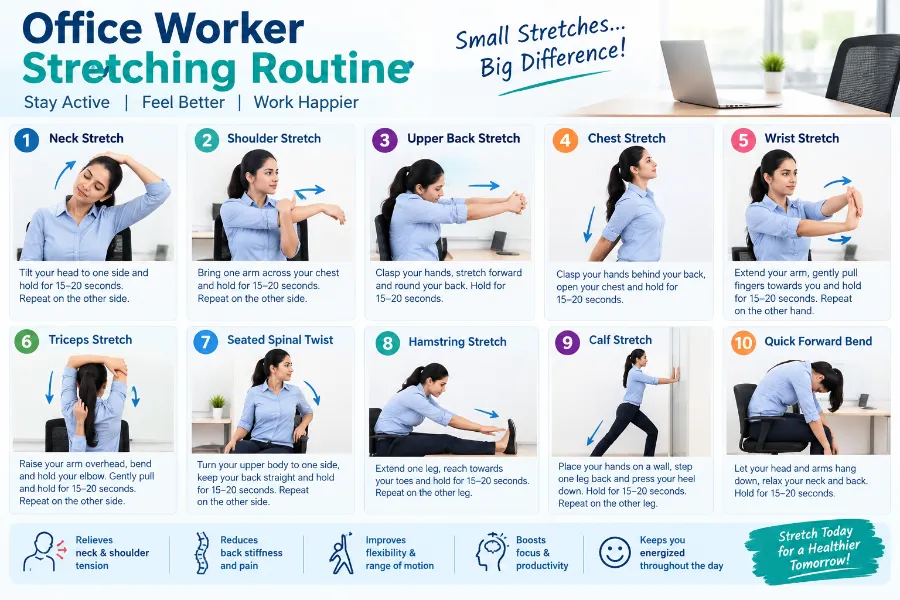
Office Worker Stretching Routine
Table of Contents
Introduction
Construction and heavy industry are not the only industries where work-related health problems occur. They may occur in various sorts of businesses and locations, including offices.
If you work at a desk, you may need to pause to conduct repeated responsibilities, but this may not be the healthiest or most comfortable position, particularly if you work at a desk for extended periods of time.
Our work habits, especially when sitting, can cause pain and health problems such as:
- Obesity
- Neck and shoulder pain
- Musculoskeletal disorders
- Stress
- Lower back pain
- Carpal tunnel syndrome
You can even practice some stretches at your desk if you’re short on time. These are some simple exercises you may do from the comfort of your recliner. Remember to breathe correctly and never hold your breath during the stretches. With every stretch, your flexibility may increase. It’s more comfortable.
That takes a toll on your back, hips, neck, and shoulders, and it’s not always simple to find the time to take care of aches and pains. However, you can stretch anywhere there’s a chair or wall. Office workers often suffer from acute or chronic back pain because they spend so much time sitting down. This puts the person’s hips, shoulders, back, and neck in danger. We recommend stretching exercises for our patients. Pay particular attention to the benefits of stretching!
Sitting in front of a computer. Back pain, headaches, stress, and stiffness in your shoulders, neck, and back might be caused by this lack of variety, hunched shoulders, and an uncomfortable chair.
Stretching has several advantages, including lessening shoulder and neck pain, according to studies. Your entire body can feel more relaxed, and your eyes can rest when you take flexibility breaks.
Risks of Prolonged Sitting
Your body is made to move, not to remain still for long. Reduced life expectancy is one of the several negative health implications of extended sitting.
A large study with 8,000 people found that prolonged sitting increases the chances of diabetes, cancer, heart disease, and even early death. Additionally, experts say that prolonged sitting can cause issues with the shoulders, hips, neck, and back.
Experts recommend taking a 1-3 minute exercise break every 30-45 minutes, or at least once an hour, to break the cycle of prolonged sitting. Bottom line: We need to find ways to reduce the amount of time we spend sitting. This movement not only relaxes your muscles and improves blood circulation, but also gives your mind a little boost and helps you stay focused.
The following flexibility exercises focus on your neck, back, shoulders, hips, and buttocks.
- Do the stretches as instructed and set an alarm to sound every 45 to 55 minutes.
- For at least 15 seconds, hold each stretch.
- Avoid any workouts that cause pain or pain.
- Enjoy doing as many repetitions as you can.
How to Begin Stretching at Your Desk
What You Must Start
You don’t need a yoga mat, resistance bands, or any other equipment. Make sure your chair is placed up against a wall if it has wheels so it won’t move away while you’re sitting. The majority of desk stretches are effective even in professional clothes; however, comfortable, non-restrictive clothing is helpful.
Realistic Goal-Setting
You may do this once in the morning, once after lunch, and once before you close for the day. If you take three quick breaks every day for a month, you’ll visibly improve your mobility and feel less stressed. On your initial session, resist the need to go too deep; instead, work within your comfort zone and gradually increase.
Begin with the Fundamentals
The neck, the thoracic spine (mid-back), and the hip flexors are the three regions most impacted by desk work. Throughout each stretch, learn to breathe evenly and gently; if you’re holding your breath, you’re probably pushing too hard. Before introducing more difficult poses, beginner-friendly yoga instruction can help you grasp breath-body synergy.
Best Stretching for Office Workers
1. Chest stretch
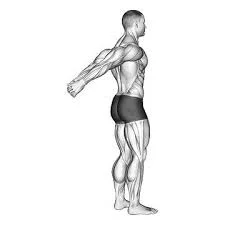
Since most of us spend most of our time hunched over, it’s important to stretch our pectoral muscles and shoulders. Avoid if you have shoulder problems.
- Stand with your feet shoulder-width apart. We can also complete this type of exercise while seated in a chair.
- Move your arms behind you and, if you can, weave your fingers together.
- To feel a stretch in your chest, extend your arms and move your hands a few inches.
- Press and hold for 10-30 seconds.
Repeat 5-10 times.
Another option is to hold it over your head using a resistance band. As an alternative, position your forearms on each side of the doorway and advance gently until your chest begins to extend.
2. Shoulder Shrug
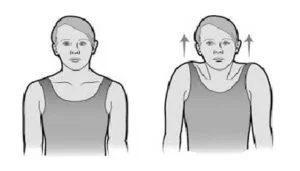
The shoulders and neck are severely strained when typing, clicking, and scrunching. In reality, most of us probably hunch far more than we know, making the trapezius and other shoulder muscles stiff with strain.
- Maintain a straight back and back shoulders whether you are standing or sitting.
- Squeeze your ears as firmly as you can by raising your shoulders toward them.
- Hold the position for 1-2 seconds, then relax and return to the starting position.
- Repeat this 8 to 10 times. To finish the workout, just roll your shoulders up and down a few times.
3. Upper back stretch
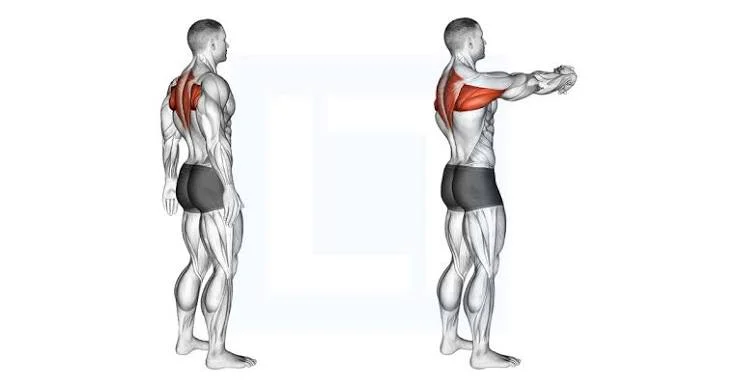
While shoulder shrugs will help get the circulation going, this upper back move will stretch all the muscles between the shoulder blades as well as the traps and the shoulders.
- Start in a seated or standing position. Straighten your arms and turn your hands so that your palms are facing each other.
- Cross your arms, palms together, and clasp your fingers.
- If you don’t like wringing your hands, just clasp your fingers together.
- Tighten your abs and straighten your back while extending your arms and straightening your head.
- Imagine yourself bending over a fictitious ball rather than fainting.
- For ten to thirty seconds, hold the stretch.
4. Seated Spinal Twist
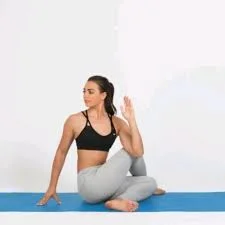
Additionally, prolonged sitting can lead to lower back pain and stiffness. You may gently release some of the stress by performing this twisting stretch in combination with an acupressure mat. This stretch and other back exercises will help you strengthen your core.
- To start, place your feet flat on the ground.
- To improve your stretch, put your hands on the seat or backrest provided by the chair.
- Move as much as is comfortable while maintaining a straight back and square hips.
- Continue for 10 to 30 seconds, and then repeat on the other side.
- On each side, repeat 5- 10 times.
5. Torso stretch
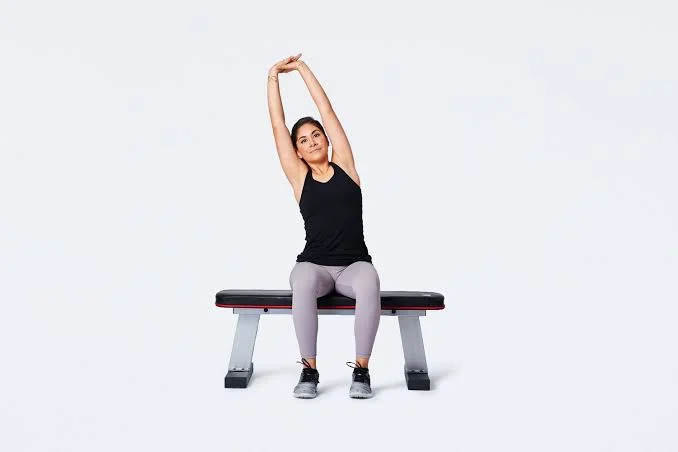
In addition to providing the look of a hunchback, bad posture can lead to back discomfort. Your arms, sides, and back will all be extended by this simple workout. You may also shift your arms to either side to further prolong the stretch along the sides of your body.
- Take a seat or stand to begin.
- Once the fingers are laced together, extend them toward the sky.
- Breathe deeply and stretch as high as you can.
- To extend your sides, you can also bend to the left and right.
- Breathe out, spread your arms, and then sweep them back down.
- Do this eight or ten times.
6. Forearm stretch
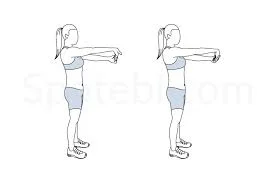
Until you stretch them out, you might not even be aware of how tense typing can make your forearms. By extending the muscles in the forearms and wrists, this simple exercise helps prevent the onset of hand and wrist pain.
- Take a seat or stand to begin.
- Lower your hand so that your fingers point downward while extending your right arm.
- Pull your left hand’s fingers slowly toward your body until your forearm starts to lengthen.
- Continue with a different hand after holding for ten to thirty seconds.
- Continue 5 to 10 times on each side.
7. Neck stretch
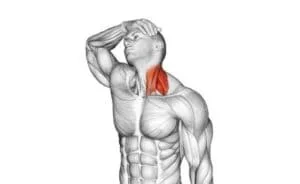
Headaches and upper back pain can also result from holding tension in the neck. Many of us lean our heads forward when using a computer, which can place additional strain on our neck muscles. Although doing this stretch and being mindful of your posture will help, using a neck massager can also be beneficial.
- Start by sitting with your back straight and your shoulders back.
- With your right hand, reach down and grasp the upper portion of the chair.
- Pull progressively until your right neck and shoulder begin to extend after turning your head to the left.
- Repeat on a different side after resting for ten to thirty seconds.
- Continue 5 to 10 times on each side.
8. Hip flexor stretch
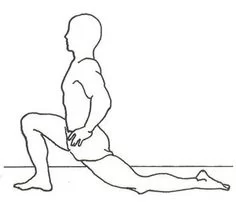
Another consequence of extended sitting is tightness in the lower body, particularly in the front of the hips. Sitting causes the hip flexors to shorten and the glutes to stretch, which results in tightness. Stretching your hip flexors frequently throughout the day can help them become less stiff. Additionally, it helps you move out of the chair, which provides some instant comfort.
- To begin, stand upright.
- Retract the right leg many feet.
- In a lunge, bend both knees and straighten the rear knee till the front of your right knee extends.
- Contract the glutes of the back leg to increase the difficulty of the stretch.
- Continue on the other side after holding for 10 to 30 seconds.
- On both sides, repeat 5 to 10 times.
9. Seated hip stretch
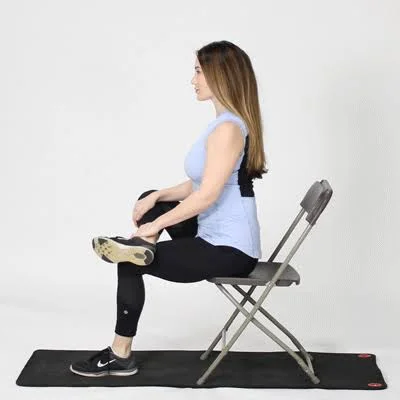
The complicated structure of muscles in the hips and glutes is stretched by this relatively basic exercise that helps open up the hips. After a long day of sitting, it feels fantastic. If this exercise causes knee pain, skip it.
- Cross your right ankle across your left knee while sitting upright.
- Bend forward and extend your torso while maintaining a straight back until your right hip and glute start to stretch.
- For a deeper stretch, you can also apply pressure to the right knee.
- Continue for 10 to 30 seconds, then repeat on the other side.
- Continue 5 to 10 times on both sides.
10. Inner thigh stretch
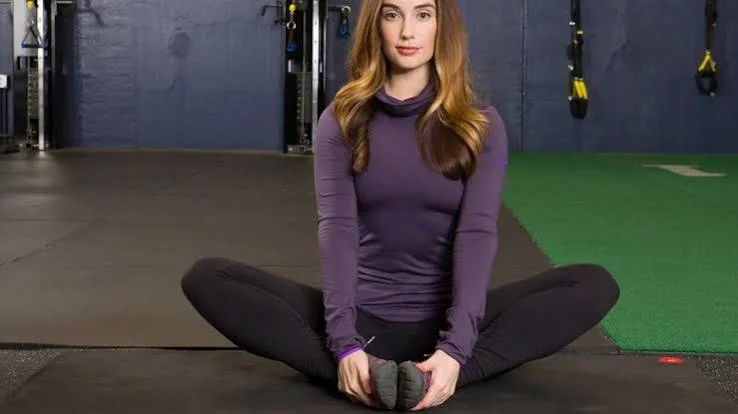
Lower quadriceps movements have advantages for the hips and groin.
- Lean forward with your elbows on your thighs, spread your legs wide, and extend your toes while seated.
- Maintain a straight back and tight abs.
- Until you feel a stretch in the inner thighs, gently press forward while pushing the thighs out with the elbows.
- Hold for ten to thirty seconds, then repeat as many times as you like.
Advantages of Stretching
- Relieves stress in the neck and upper back: Sitting with your head turned toward a screen strains the muscles in your upper back and the base of your skull. A few times a day, even simple stretches for the neck and upper back will help release that built-up tension. Many people find that holding their head in a neutral position without effort gets easier after many weeks of constant practice.
- Supports Improved Posture: Sitting over extended periods of time leads the shoulders to round and the chest to cave forward. This trend is countered by strengthening the mid-back and stretching the muscles that expand the chest. This is a progressive recalibration that builds up with consistent yoga-based posture training; it’s not a quick fix.
- Reduces Pain in the Lower Back: When sitting for extended periods of time, the lumbar area and hip flexors absorb the most tension. By mid-afternoon, targeted hip and lower-back exercises may help relieve the tension that many office workers experience while also preserving the spine’s natural bend.
- Enhances Energy and Circulation: Sitting decreases circulation by compressing the blood vessels in the legs. Without the need for an additional cup of coffee, short bursts of activity and stretching promote blood flow to the brain and muscles, which frequently results in improved attention and less afternoon tiredness.
- Encourages Better Sleep: It might be more difficult to completely relax when the body retains built-up muscle tension into the evening. A regular stretching routine aids in the nervous system‘s transition to a calmer state, which enhances the type of peaceful sleep that most desk workers believe they’re lacking.
Typical Errors to Avoid
- Ignoring the Warm-Up: After sitting still for two hours, jumping right into a deep hip stretch or spinal twist is a sure way to get strained. Before going deeper, spend the first 60 to 90 seconds of every stretching break just breathing and performing light shoulder rolls or neck circles to increase circulation in the targeted area.
- Holding Your Breath While in Poses: Holding your breath is the most common sign that you’ve stepped beyond your comfort zone. Back off a little till you can breathe easily if you find yourself grasping or bracing. The stretch will still work and be much safer.
- Compelled to Take Up Advanced Positions Too Quickly: Office workers benefit most from progressive neck and back stretches. Over the course of a month, a little neck tilt maintained for a few seconds will be more effective. A single, vigorous stretch won’t be as helpful as six breaths per day. Instead of aiming for maximum range right now, trust the process of incremental buildup.
- Variations in Practice: Five days of nonstop sitting won’t be made up for by performing 10 stretches in one session on Friday. The body reacts to repetition and frequency. Compared to uncommon, lengthier sessions, short daily practice—even five minutes dispersed throughout the day—produces considerably more consistent development.
Who Should Try Desk Stretching?
Beginners: Desk chair stretches are an excellent place to start if you haven’t worked out in a while. There is no minimum level of fitness needed, no equipment, and no particular attire.
Women: Regular workstation stretching typically offers significant daily comfort for women who feel greater tension during hormonal swings, especially around the lower back and hips. Additionally, it enhances specialized hormonal balance therapies like yoga poses that take a more comprehensive approach.
Older persons: Maintaining joint flexibility and spinal mobility becomes more crucial for persons over 50. The majority of people in this category may safely perform desk stretches, but before starting a new stretching regimen, see your doctor if you have any known spinal or joint disorders.
Working Professionals: Those who spend six to ten hours a day in front of a screen and develop stiffness without realizing it are the main target demographic for desk stretching. Taking short stretching breaks, which also serve as natural cognitive resets, may help you return to work with better focus and less physical distraction from discomfort.
FAQs
Desk stretching exercises: what are they?
The purpose of desk stretching exercises is to relieve tension in the muscles that are most strained by extended sitting, namely the neck, shoulders, upper and lower back, and hip flexors.
Do beginning desk stretching exercises work well?
Of course. Regardless of your present level of fitness, the majority of desk stretches are mild, low-intensity, and accessible. They are among the safest methods for a total novice to begin developing body awareness and movement without running the danger of overdoing it.
How frequently should I stretch at my desk?
Aim for two or three quick breaks during the day, ideally in the morning, mid-afternoon, and right before you finish. It’s sufficient to take breaks of even five minutes. Frequency is more important than duration; everyday practice yields much greater outcomes than a single, lengthy session each week.
Can desk stretches be done at home?
Yes, and since standing up for a short while doesn’t make one feel self-conscious, many individuals find that a home office layout is even more suited to frequent stretching. An office chair and desk are equally useful as a kitchen chair or eating table.
Do desk chair stretches require any special equipment?
It doesn’t require any equipment. All you need is a sturdy chair and enough floor room to stand next to it. A yoga mat can improve the comfort of floor-based poses; however, it is entirely optional for the sitting and standing variations.
How long will it take for frequent desk stretching to show results?
After two to three weeks of regular practice, the majority of people report a slight decrease in daily stiffness. After six to eight weeks of consistent work, more significant changes in posture and long-term comfort usually become apparent. The crucial factor is how frequently you turn up, not how hard you stretch on a given day; results develop gradually.
References
- Bothra, T. (2026, September 19). Desk stretching Exercises: Best poses to ease stiffness at work. Habuild. https://habuild.in/habitology/strength-and-fitness/desk-stretching-exercises
- Local, D. (2024, September 17). 10 best stretches for office workers. Center for Spine & Orthopedics. https://centerforspineandortho.com/10-best-stretches-for-office-workers//
- Stretches you can do at work. (n.d.). WebMD. https://www.webmd.com/fitness-exercise/ss/slideshow-stretches-at-work
- The Healthline Editorial Team. (2026, July 1). Stretches to do at work every day. Healthline. https://www.healthline.com/health/deskercise