
How to Heal a Cervical Herniated Disc Quickly?
A cervical herniated disc occurs when the soft inner material of a disc in the neck presses on nearby nerves, leading to pain, stiffness, numbness, or tingling in the neck, shoulders, and arms. While healing takes time, quick relief can be achieved through rest, posture correction, gentle exercises, pain management techniques, and professional care like physiotherapy.
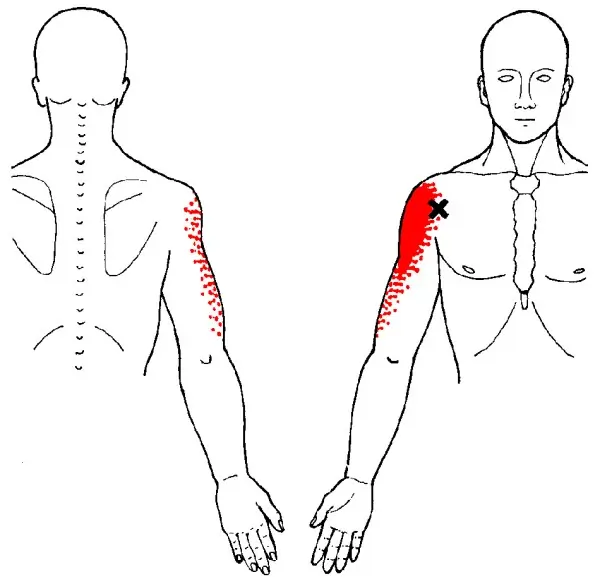
One arm is usually the site of cervical herniated disc aches and associated symptoms. Depending on which nerve root has been pinched or irritated and which disc has herniated, symptoms might vary. In rare cases, if the spinal cord is damaged, the pain, tingling, numbness, and/or weakness may spread to both arms or lower body parts. Loss of bladder and/or bowel control is another uncommon but probable symptom.
Table of Contents
How a Cervical Disc Herniates
When the disc’s inner core protrudes through its outer layer, it is said to have herniated.
The cervical spine has six intervertebral discs. To cushion the vertebral bodies and aid in distributing stresses from the head and neck above, each cervical disc is positioned between two neighboring vertebrae, one above and one below. A disk is made up of two fundamental parts.
- Fibrosus Annulus. The disc is tough enough to protect its soft inner layer thanks to its robust outer layer made of concentric collagen fibers. The annulus fibrosus aids in shock absorption and supports the spine’s high stresses.
- pulposus nucleus. This gel-like core is a loose network of fibers that are shielded by the annulus fibrosus and suspended in a mucoprotein gel. Movement flexibility and extra cushioning are provided by the nucleus pulposus.
When a portion of the disc’s outer layer tears and some of the nucleus pulposus leaks into the tear, the disc becomes herniated. The most painful symptoms of a herniated disc usually occur when the inflammatory protein-containing nucleus pulposus seeps out of the disc and onto a neighboring nerve root. The possibility of a herniated disc leaking onto the spinal cord is less frequent.
Risk Factors for a Cervical Herniated Disc
As people age, their chance of getting a herniated disc increases. According to some estimations, the risk of developing a cervical herniated disc is highest between the ages of 30 and 50. Although a recent study indicates women may be at higher risk, the majority of studies have shown males to be at higher risk for a cervical ruptured disc.
It has been estimated that between 0.5% and 2% of adults suffer from cervical herniated discs. However, estimations may differ by population, and many cervical herniated disc instances may remain undetected.
Pain Management for a Cervical Herniated Disc
A cervical herniated disc can cause arm and/or neck discomfort that is either temporary (lasting a few days) or chronic (lasting months or more). It is typical for the pain to flare up during specific activities or to come and go. Even though the herniated disc itself may not heal, the symptoms of neck and/or arm discomfort usually go away entirely in 4 to 6 months.
Nonsurgical methods, including over-the-counter painkillers, physical therapy to strengthen and extend the neck, cold or heat packs, and/or activity changes to avoid painful motions until the pain has gone away, can effectively manage the majority of cervical herniated disc pain situations.
To assist in reducing pain and promoting recovery, it may occasionally be necessary to administer oral steroids, an epidural, or a selective nerve root injection with x-ray guidance and contrast.
Exercise for Cervical Herniated Disc
Chin Tucks
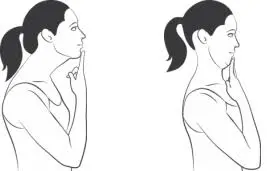
This exercise will strengthen and activate the deep cervical muscles, located in front of your neck.
- Put two fingers at your chin’s base.
- Pull your head back and tuck your chin in gently. At the same time, keep your chin tucked in the whole time with your fingers.
- For three to five seconds, hold the end position.
- Take a moment to relax your neck (let it come forward).
- Try to complete two or three sets of ten reps
Neck Extensions (Supported with a towel)
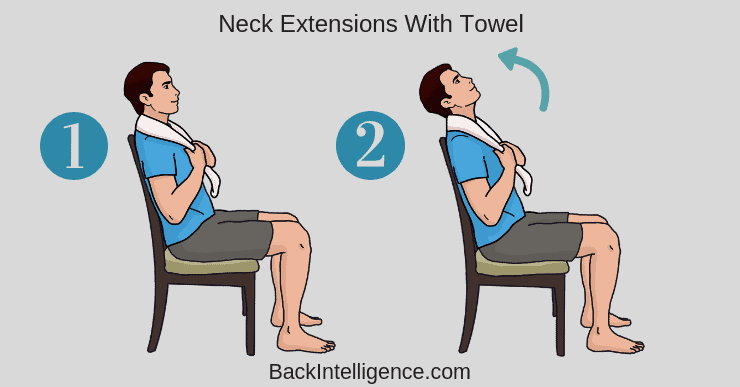
This stretch can help press the disc material back into place and relieve some of the discomfort. Proceed to the next stretch if this one causes more discomfort.
- The method is to hold a towel over your neck while sitting erect at the back of a chair.
- Now extend your back over the back of your chair and up your spine.
- To support your neck, keep the towel taut.
- Perform 5–10 Extensions
One Arm Pec- Stretch
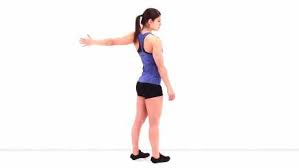
This will pull the neck into poor posture and stretch out the chest, which might be tight. You may improve your posture and reduce some of the pain by releasing your pecs.
- Reach a wall and extend one arm behind you, placing the palm on the wall.
- When you want to lean forward and slightly away from the outstretched arm, pull in your stomach (do not arch your back).
- Your chest should feel stretched.
- Give it 30 seconds.
- Repeat on the opposite side.
Upper Trapezius Stretch
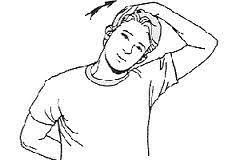
The scalene and upper trapezius muscles, which can become very tight in people with forward head syndrome, will be stretched out as a result.
- You can begin standing or sitting down.
- Tuck one hand behind your back and place the other on the other side of your head.
- Drop your head toward your shoulder now.
- If you want a deeper stretch, push your head down with the hand on top (not too hard).
- Do both sides while holding for 20 to 30 seconds.
Scapular Retraction (Using Resistance Bands)
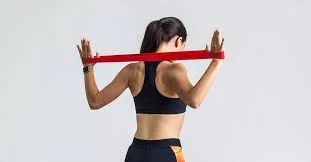
The goal of this workout is to enhance your posture by stabilizing and strengthening the mid-back muscles.
How to Complete It:
- Start by standing with proper alignment.
- Straighten your elbows and extend your arms in front of you while holding a resistance band in both hands. The amount of resistance you use will depend on your own strength level.
- Slowly extend and retract your arms behind your body while maintaining a locked elbow position. You should feel a contraction or a squeeze in the muscles between your shoulder blades.
- Don’t push farther than is comfortable. While some heat in the muscles is OK, neck or arm pain is not.
- Do not shrug your shoulders in the direction of your ears.
- Repeat 2×10, then progressively increase to 3×10.
- This should be difficult by the time you reach repetitions 8, 9, and 10 if it is not up to the level of the resistance band.
FAQs
Which workout is best for a neck herniated disc?
Neck exercises for a herniated disc
Maintain proper posture as you sit.
Maintaining your chin level, slowly move your head to the left.
After five seconds of holding, turn right.
Return to the center after holding on the right for five seconds.
How can a cervical herniated disc be healed as soon as possible?
Nonsurgical methods, including over-the-counter painkillers, physical therapy to strengthen and extend the neck, cold or heat packs, and/or activity changes to prevent painful motions until the pain has gone away, can effectively manage the majority of cervical herniated disc pain situations.
When you have a herniated cervical disc, what should you not do?
One certain method to aggravate your herniated disc and cause back pain is to bend over. Therefore, you should stay away from any activity that involves bending over. This includes washing laundry, feeding your dogs, and tidying up things when cleaning.
What is the diagnostic test for a disc herniation?
MRI. The interior structures of the body are imaged using radio waves and a powerful magnetic field. This test can be performed to determine which nerves are impacted and to verify the location of the herniated disk.
What symptoms indicate the healing of a herniated disc?
Indications That Your Herniated Disc Is Healing: The Advanced Spine Center Indicates the Healing of a Herniated Disc
Reduced Pain. A decrease in discomfort and an increase in mobility are two of the most obvious indicators that a herniated disc is mending. Increased range of motion and mobility, fewer muscle spasms, improved sleep, and less nerve irritation are all signs that a herniated disc is recovering.
References
- Parkin, M., DC. (2023, July 3). Cervical herniated disc exercises you can do at home. PostureFlow (Formerly Back Intelligence). https://backintelligence.com/cervical-herniated-disc-exercises/
- Staehler, R., MD. (2019, July 18). Cervical herniated disc symptoms and treatment options. Spine-health. https://www.spine-health.com/conditions/herniated-disc/cervical-herniated-disc-symptoms-and-treatment-options