Painful Arc Test
Table of Contents
Objective:
The Painful Arc Test is a clinical assessment tool used primarily to diagnose shoulder impingement, particularly in conditions like subacromial impingement syndrome. This test helps determine if the tendons or structures within the shoulder are being compressed during specific movements.
A positive outcome on the painful arc test, as with most special tests, does not always mean that a subacromial impingement occurred.
The Painful Arc Test is regarded as a defining characteristic of patients with subacromial pain syndrome. Patients with shoulder pain can be divided into three basic categories:
- 1) individuals with a painful abduction motion
- 2) individuals who indicate instability
- 3) individuals who have a seen reduction in both active and passive range of motion.
Hedgedus et al. (2012) analyzed the literature on the physical examination tests that medical professionals can use to examine the shoulder most effectively. During their review, they discovered a 53% sensitivity and a 76% specificity. It has a low clinical use as a stand-alone test since it is neither highly sensitive nor very specific in the diagnosis of subacromial pain syndrome.
Purpose:
This examination is frequently performed to rule out subacromial impingement syndrome. A positive outcome on the painful arc test, as with most special tests, does not always mean that a subacromial impingement exists.
Method:
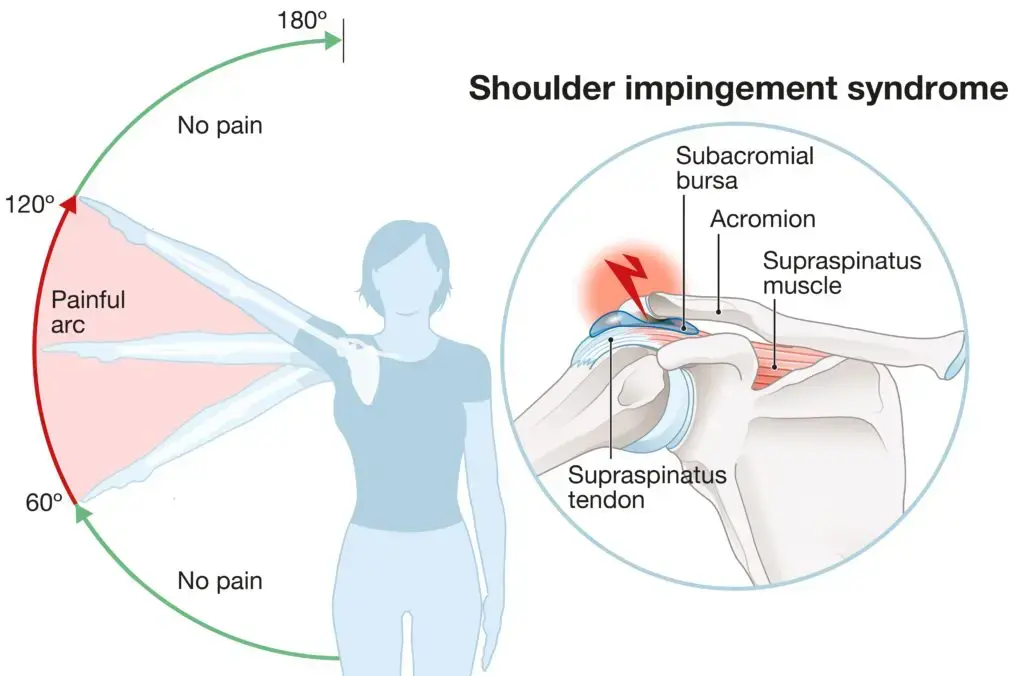
The patient should be taught to abduct the arm in the scapular plane when they are either seated or standing. The patient must inform the physiotherapist of any pain they feel in or around the glenohumeral joint during arm abduction.
The physiotherapist will advise the patient to keep abducting their arm as high as they can as soon as the pain begins. There should be a decrease in pain until the patient reaches about 120 degrees of abduction.
The patient should gradually reverse the motion after completing the abduction movement and move the arm back into a neutral position using the adduction movement. The test is deemed successful if the patient experiences pain between 60 and 120 degrees of abduction and if the pain ends after 120 degrees of abduction.
Evidence:
| Sensitivity | 0.33 |
| Specificity | 0.81 |
| Positive Likelihood Ratio | 1.70 |
| Negative Likelihood Ratio | 0.84 |
Test-Item Cluster:
The positive likelihood ratio is 10.56 when this test is clustered with the Hawkins-Kennedy Impingement Sign and the Infraspinatus test, and the negative likelihood ratio is 0.17 if all three tests report a negative result. The positive likelihood ratio is 5.03 if two out of the three test results are positive.
Two or more positive tests, including the painful arc, empty can, and external rotation resistance, are the best combination for diagnosing Subacromial Impingement Syndrome.
To rule out Subacromial Impingement Syndrome, painful arc and external rotation resistance are the most effective combination (both tests are negative).
Positive Sign:
If you feel pain when raising your arm between 60 and 120 degrees, but not when raising it over 120 degrees, the painful arc test is deemed positive.
FAQs
What does the painful arc test mean?
This test is usually ordered by your physician to confirm the impingement diagnosis. The first 60 degrees of movement are usually pain-free, and the second 60 to 120 degrees of movement will usually cause shoulder pain.
What is a positive arc test?
The painful arc test requires the subject to resist elevation slightly posterior to the coronal plane. The discomfort that develops between 60° and 120°C is usually a sign of rotator cuff disease; its presence is regarded as a positive test result.
What is a painful arc of 60 120 degrees?
A painful arc of motion between 60 and 120 degrees of abduction suggests that the pain may very likely be coming from the subacromial region. Instead of being a diagnosis, painful arc syndrome is a clinical symptom.
What is the painful arc of bursitis?
When the subacromial bursitis is examined physically, it is evident that there is less elevation, internal rotation, and abduction in the active range of motion, mostly due to pain. The range of motion that causes the most pain is between 70 to 120 degrees of abduction.
What causes a painful arc?
This fluid-filled sac prevents rotator cuff injuries by reducing potential friction between the anterior borders of the bones. Inflammation may develop in this location if there is a reduction in fluid or damage to the subacromial bursa. Painful arc syndrome is caused by bone spurs or the Acromion’s inherently non-flat bone.
What is the painful arc test for?
The best ways to detect Subacromial Impingement Syndrome when two or more tests are positive include the empty can, a painful arc, and external rotation resistance.
What is the anatomy of painful arc syndrome?
A painful movement arc may occur when raising the arm forward from 60° to 120°. In passive shoulder mobility, a driven downward acromion will cause discomfort; however, this discomfort will subside as the force is released.
References:
- Physiotutors. (2024, May 20). Painful Arc Sign | Subacromial Pain Syndrome Assessment. https://www.physiotutors.com/wiki/painful-arc-sign/
- Al-Ani, Z. (2023, April 30). What is Painful Arc Syndrome? MSK US Injections. https://www.mskultrasoundinjections.co.uk/post/what-is-painful-arc-syndrome
- Shoulder Exam Tutorial. (n.d.). Stanford Medicine 25. https://stanfordmedicine25.stanford.edu/the25/shoulder.html
- ProHealth Prolotherapy Clinic. (2024, July 13). Painful Arc – Causes & Best Treatment Options in 2024. https://prohealthclinic.co.uk/blog/painful-arc/
- Creech, J. A., & Silver, S. (2023, April 17). Shoulder Impingement Syndrome. StatPearls – NCBI Bookshelf. https://www.ncbi.nlm.nih.gov/books/NBK554518/