
Moving Patellar Apprehension Test
Table of Contents
Introduction
The Patellar Apprehension Test is a clinical examination used by healthcare professionals, particularly in orthopedics, to assess the stability and integrity of the patella (kneecap) in individuals who may have experienced patellar dislocation or subluxation. This test is performed to determine if the patient is apprehensive about the possibility of their patella shifting out of its normal position, which can be indicative of patellar instability.
If you feel pain in the front of the knee, around the patella means patellofemoral pain.
This patellofemoral pain syndrome is also known as jumper’s knee and runner’s knee. This patella-femoral pain syndrome is more common in sports such as running and jumping.
You also feel this pain when you do certain activities like walking, sitting for a long time, running, squatting, and squatting. This syndrome occurs most often in women and young adults. You also experience difficulties in your daily activities.
Clinically equivalent anatomy
Anatomy of patellofemoral pain syndrome
The knee joint is our bodies’ biggest joint. This knee joint is one of the most complex joints in the body. This knee joint consists of three bones. The femur is the bone at the lower of the thigh. Tibia = the outermost part of the shin.
Patella = patella
This knee joint becomes a Form 2 joint
Patellofemoral joint
Tibiofemoral joint
Many lower leg tendons and ligaments are connected to the femur. Many of the muscles around the knee joint are connected to the bones of the knee joint by tendons. Quadriceps tendon = This tendon connects the muscles of the front of the thigh to the knee bone. Patellar Mesh = This mesh is attached to the tibia to help stabilize your knee bones. Thus, the multi-structure knee joint becomes easier to move the knee joint. Articular cartilage = is the slippery substance of the knee joint.
This articular cartilage covers the ends of the femur, trochial groove, and patella [lower side]. This articular cartilage helps the bones slide smoothly against each other during knee joint movement. Synovium = is also a thin lining of tissue that covers the surface of the knee joint. This synovium creates a small quantity of fluid that goes to the cartilage to lubricate it. This synovium is transformed into a patellar pad, which means a knee cap, and acts as a shock absorber.
Purpose
This is a test designed to clinically detect lateral instability of the patella.
Technique
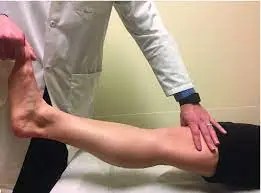
The trial of fixing a mobile patella is done in two parts. Part 1 is a trial-based test. The examiner places the examined knee in its full range. The examiner’s thumb is used to apply a lateral force to the patella. The examiner then moves the knee from full extension to 90 degrees of flexion and then returns to full extension while maintaining a lateral force applied to the patella.
The second part of the test (Part 2) consists of symptom relief. The examiner repeats part 1 of the test, applying a medial force to the patella. The examiner places the examined knee in its full range. Medial force is applied with the index finger of the patellar examiner. The examiner then moves the knee from full extension to 90 degrees of flexion and then back to full extension while maintaining a medial force applied to the patella.
A positive test consists of verbally expressed fear or fearful quadriceps recruitment in the provocation test (part 1) and relief of these symptoms with normal ROMs in part 2 of the test.
Evidence
The authors of the test compared the results of the mobile patella apprehension test with the stability of the patella in lateral anesthesia.
During the test, the following was found:
Sensitivity: 100% Positive Predictive Value: 89.2%
Specificity: 88.4% Negative predictive value: 100 %
FAQ
What is the moving patella apprehension test?
The examiner places the examined knee in its full range. With the examiner’s thumb, a lateral move is applied to the patella. The examiner then moves the knee from full extension to 90 degrees of flexion and then back to full extension while maintaining a lateral force applied to the patella.
What is the sensitivity and specificity of the moving patella apprehension test?
The Moving Patellar Apprehension Test for Lateral Patellar.The score. Compared with the ability to move the patella under anesthesia, the Moving Patellar Apprehension Test had a sensitivity of 100%, a specificity of 88.4%, a positive predictive value of 89.2%, a negative predictive value of 100%, and an accuracy of 94.1%.
What are the names of the 3 special tests in the patella mobility test?
Passive knee extension test. Patellar Apprehension Sign.
Patellar Grind Test.
Pivot Shift.
Posterior Drawer Test (Knee)
Reference
Moving Patellar Apprehension Test. (n.d.). Physiopedia. https://www.physio-pedia.com/Moving_Patellar_Apprehension_Test
Clinic, M. P. (2023, August 5). Knee pain: physical therapy management. Mobile physiotherapy clinic. https://mobilephysiotherapyclinic.in/knee-pain-physiotherapy-management/