Knee-To-Chest Stretch For Tight Lower Back
Table of Contents
Introduction:
The knees-to-chest stretch is a quick and effective way to release tension in your lower back muscles. To improve your flexibility, you might just incorporate this exercise into your routine.
You might do an extended toe touch to try to improve back flexibility. The movement of the toe touch largely happens at the hip joints, even if you are supposedly extending those muscles by rounding your back. Back rounding, which is also not very safe, is typically the result.
Stretching from knees to chest can assist with that. It’s a great way to assist your low back muscles in becoming more flexible after spending an afternoon doing housework or gardening, and it feels great most of the time.
Or after spending the entire day on a computer. But the benefits of the knees-to-chest stretch extend beyond the release of low back muscles. As a range-of-motion exercise that improves joint flexibility, the knees-to-chest stretch may help reduce stiffness caused by spinal arthritis and/or spinal stenosis. Exercises, including range of motion, can help people with osteoarthritis lubricate their joints, increase blood flow, and provide nutrients to the afflicted region.
What is a Knee-to-Chest stretch?
A straightforward stretching exercise that helps release tense hip and low back muscles is the sitting knee-to-chest stretch. It entails sitting with one knee brought against your chest.
What muscles does the knee-to-chest stretch work?
Hip flexors: Located in front of the hip joint are the rectus femoris and iliopsoas muscles. Hip flexors facilitate walking, sitting, standing, riding a motorcycle, and kicking a ball.
Glutes: Located in the buttocks, these muscles are essential for walking and jogging, climbing stairs, squatting, and maintaining your balance. Strong glutes also aid in preventing hip, knee, and lower back issues.
Lower back muscles: By strengthening and extending these muscles, lower back pain can be reduced.
The hamstrings: The muscles at the rear of the thigh are called the hamstrings. They are necessary for activities including walking, running, jumping, climbing, squatting, and bending.
How to Do the Knees-to-Chest Exercise?
Start the knee-to-chest stretch with just one leg for safety. If, after a few days, you can raise both legs without experiencing any pain, you can proceed.
Single Knees-to-Chest Exercise Steps:
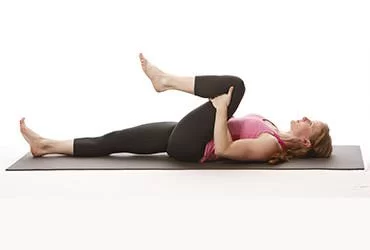
- Lying on your back with your knees bent and your feet flat on the floor is known as the supine posture.
- You can grasp your lower leg with both hands by gently lowering one bent knee and interlacing your fingers just below the knee.
- As in the single-legged form, clasp your wrists or interlace your fingers between the lower thighs just below the knees.
- Gently pull your bent knee toward your trunk with your hands. As you pull, try to keep your lower back, pelvis, and legs as relaxed as you can. When the low back muscles remain passive, the stretch is most effective.
- Hold for a little while.
- Put your leg back on the ground.
- Continue on the opposite side
Double Knees-to-Chest Exercise Steps
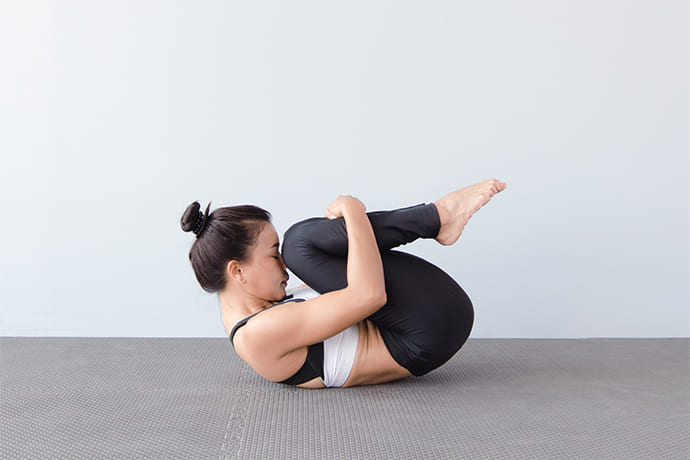
- Lying on your back with your knees bent and your feet flat on the floor is known as the supine posture.
- For the two-legged version, raise one leg first, then the other. Lifting both at once requires a lot of abdominal force, especially for frail backs, so it’s typically safest to start with one and quickly follow with the other.
- If you’re using both legs, clasp your wrists or interlace your fingers between the lower thighs just below the knees.
- Gently pull your bent knees toward your trunk with your hands. As you pull, try to keep your lower back, pelvis, and legs as relaxed as you can. When the low back muscles remain passive, the stretch is most effective.
- Hold for a little while.
- Put your leg back on the ground
A Chain Reaction Stretch
As a passive stretch, knees-to-chest works best when your legs and hips are relaxed. By permitting the natural chain response from thigh to hip to lower back, this aids in achieving adequate spinal flexion.
The bottom of your pelvis should rise slightly as you draw your thigh to your chest. This movement frequently reaches your lumbar spine.
Try supporting your sacrum with a small towel or folded blanket if you have trouble raising your lower pelvis.
According to a 2017 study published in the journal Spine, research has not yet shown a clear connection between low back pain and tight lumbar muscles. But when problems emerge, a proper release is helpful for many.
Why should you stretch your back to prevent future pain?
Your muscles may be strengthened and made to feel fluid and mobile with the simple and cost-free practice of stretching. Stretching increases blood flow and stimulates muscles, both of which are critical for back support. Stretching is a fantastic place to start if you’re searching for easy, low-impact strategies to enhance your health, even if you might not think of it as strength training.
Additionally, stretching helps repair some of the harm you inflict on your spine during the day. Simple stretches release pressure from tight spots and enable the muscles, joints, and bones to adopt new postures. If you often move heavy goods or stand for several hours at work.
After you stretch, drink a glass of water. You’ll stay hydrated and maintain the health of your muscles by doing this. These are only two things you may do to relieve back pain and strengthen your spine.
How often should you stretch?
Doing stretches properly is vital to maintaining your back health; however, it is also necessary to do them regularly and for the optimal duration. In addition to following industry best practices, your doctor should advise you on how frequently to perform back stretches.
Don’t push yourself too hard if your doctor advises you to stretch less frequently. When you get into a stretch, hold it for roughly 30 seconds. If it feels comfortable, you can hold it for a longer period. Your muscles should be contracting, but you shouldn’t feel any pain. If you are in a substantial amount of pain, alter the stretch
During the 30 seconds of your stretch, you can either strive to get into a deeper stretch or relax in one position. For instance, you can begin the sitting spinal twist by placing your hand or forearm on your knee before easing into a deeper twist that extends over your elbow. Don’t force yourself into pain or bounce to get a deeper stretch.
Perform each stretch two or three times. If you are executing a repeating stretch, like the cat-cow, alternate positions at least eight times total
If you perform these stretches daily, they are most likely to be beneficial. To perform your stretches, consider setting an alarm each day or designating specific times for them.
Talk to a doctor about your back pain
Pain, stiffness, and achiness in the lower back can be relieved with these exercises. Stretches, however, are not always effective in treating back pain. Even while these exercises might lessen your pain, you could require further care to improve your comfort and regain your mobility.
Waiting for back pain to go away is not a good idea. It might just as easily develop worse to the point where you can’t enjoy life. Make an appointment to visit a doctor as soon as you have lower back pain that doesn’t go away.
FAQs
Is the knees-to-chest stretch good for low back muscles?
Lie on your back. Bring one knee to your chest, keeping the other foot level on the floor (or the other leg straight, whatever feels best on your lower back). Keep your lower back pushed to the floor. Hold for at least 15 to 30 seconds
Does knee-to-chest decompress the spine?
Many people believe that the knee-to-chest exercise is the most effective way to decompress the spine. Your back’s pressure points are massaged on the floor during this exercise.
Is the knee-to-chest stretch good for herniated discs?
Lie on your back with your legs bent. Before swapping sides, gently raise one knee to your chest and keep it there for 15 to 30 seconds. This stretch can give mild decompression and relieve lower back stress. For a deeper, more controlled stretch, some patients find it helpful to raise both knees toward their chest.
References:
- 5 Back stretches for lower back pain – spine surgery. (2023, April 28). Spine Surgery. https://www.spine.md/insights/5-back-stretches-for-lower-back-pain
- https://www.verywellhealth.com/knees-to-chest-exercise-296870
- https://www.mayoclinic.org/healthy-lifestyle/adult-health/in-depth/back-pain/art-20546859
- Seated knee-to-chest stretch. (n.d.). [Video]. Hingehealth. https://www.hingehealth.com/gb/en/resources/articles/knee-to-chest/