Astavakrasana (Eight Angle Pose)
Table of Contents
Introduction:
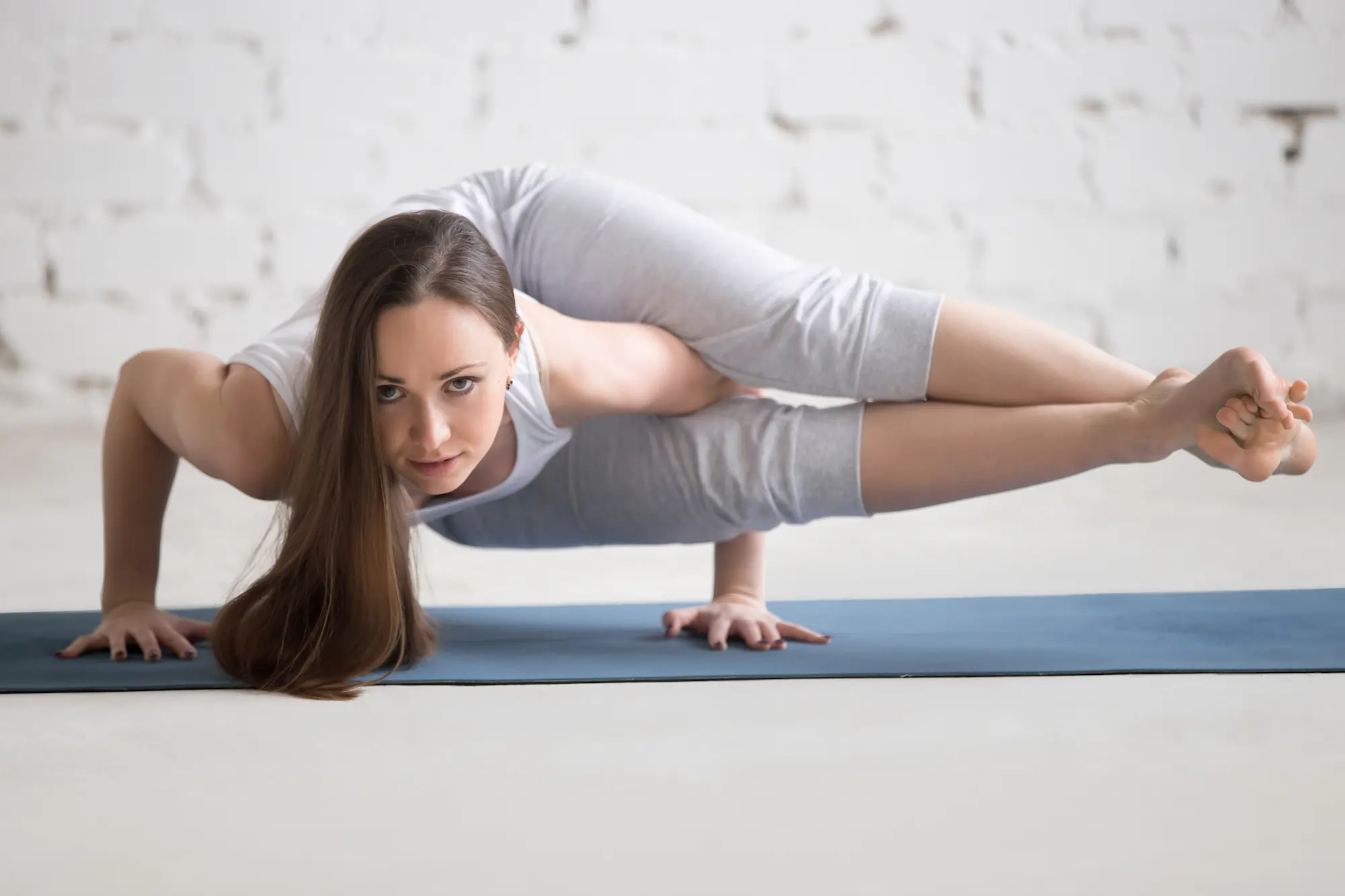
Astavakrasana, frequently referred to as the Eight Angle Pose, is a difficult arm-balancing and core-strengthening exercise. At a higher level, practice helps the practitioner overcome mental and physical barriers and maintain equilibrium and balance. Increasing strength and flexibility are the main objectives of practice.
Astavakrasana, or Eight Angle Pose, derives its name from the Sanskrit words “asta,” meaning “eight,” and “vakra,” meaning “circular” or “bent.” Classical Hindu books mention Astavakra as the spiritual guru of King Janaka of Mithila. When Astavakra was still in his mother’s womb, his father, Kagola, made several mistakes when reciting the Vedas.
When he heard this, the unborn child in his mother’s womb laughed. The father, Kagola, grew angry and cursed his child for being corrupt from birth. Astavakra, his son, was born with eight twisted parts (neck, feet, hands, knees, and chest).
How to Do Astavakrasana:
The following are the specific instructions for performing Ashtavakrasana, also known as the Eight Angle Pose:
- Start by sitting in Dandasana, sometimes called Staff Pose, and extending your legs in front of you.
- Bend your right leg, grasp your right foot with your left hand, lift your thighs, and place your right hand beneath your thigh so that your right thigh is resting on your right arm’s upper shoulder.
- Squeeze the elbows toward the right thigh and hips after placing the right leg firmly over the right shoulder with the left hand and placing the right palm on the floor close to the right hip.
- Press the right palm toward the floor while the right leg is lying on the right shoulder, and the shin is parallel to the floor. Exhale, then use your core and pelvic floor muscles to lift your hips off the ground by sliding them slightly forward.
- As in Eka Hasta Bhujasana (One-Legged Insect Pose), keep your balance while flexing your left ankle and extending your left leg in front of you.
- Focus on your core, biceps, and triceps while practicing your breathing, posture, and balance for two to three breaths.
- Breathe, bend the left leg, and wrap the left ankle over the right ankle from below to help support the right leg over the shoulder. Move the legs to the side once they are secured.
- Get comfortable with the ankles wrapped while keeping the hips off the ground, then release your breath and contract the required muscles.
- Once you’re relaxed, let go of your breath and softly move your head and chest forward. You can only accomplish this by consciously utilizing your pelvic floor and abdominal muscles.
- To advance your torso, bend your arms at the elbows. Strengthen your wrist and palm grip on the ground, lift your hips, advance with your shoulders parallel to the ground, and lock your legs to the right at the same time.
- Maintaining straight shoulders and looking forward rather than down is essential. Now the upper body is parallel to the floor, the legs are extended to the side, the hips are rotated to maintain leg balance, and the elbows are bent to support the torso.
- After taking the first two to three breaths in the Eight Angle Pose, fully exhale and keep taking slow, deep breaths.
- Identify each muscle that keeps the body balanced.
- In Dandasana, stretch by letting go, lowering your legs, and relaxing.
- Repeat the steps for the left side, spreading your legs wide while keeping your balance. Stay for two or three breaths first. Relax and let go.
Benefits of Astavakrasana:
Increasing the body’s strength, flexibility, and endurance is the main objective of advanced postures. But the same advanced positions can also be utilized to enhance mental and physical balance and stability. Astavakrasana (Eight Angle Pose) has several benefits, including the following:
- Stretches and Strengthens: Ashtavakrasana, known as the Eight Angle Pose, assists in stretching and contracting some muscles, including the diaphragm, back, core, and core muscle groups, psoas, pelvic floor muscles, gluteus, hamstrings, quadriceps, and calves. This stretch strengthens the wrists, elbows, arms, shoulders, chest, hips, knees, ankles, and spine.
- Energy and Endurance: Because the Eight Angle position keeps the body very close to the ground without touching it, it is a challenging arm balance position that supports endurance. It is done to strengthen the muscles. Maintaining stability is, therefore, challenging and requires endurance. This endurance increases the body’s power and energy, preparing it for challenging balancing poses.
- Awareness and Focus: By ignoring its boundaries and focusing on its variations, the Eight Angle Pose can be performed with a thorough awareness of what is needed while in balance. This focus is on using the breath to elevate the body off the ground while strengthening the core and abdomen.
- Balance and Stability: Ashtavakrasana can be performed mindfully, focusing on preserving mental and physical stability. When there are no mental distractions, the body helps with balance, and the mind keeps the body stable. As a result, it’s an excellent workout to enhance both physical and mental stability.
- Internal Organs and Energy: Ashtavakrasana strengthens the abdominal muscles and awakens the navel, which is home to the Manipura Chakra (Sacral Chakra). These muscles contract to activate the organs in the abdominal area and to increase their strength and flexibility. This helps the body produce energy and maintain control over digestion. The pelvic floor muscles tighten when the posture is released, stimulating the reproductive organs with fresh blood.
- Power and Confidence: Every challenging position is enjoyable to perform, and it is much more enjoyable when it includes multiple tasks, including forward bending, twisting, stretching, and balance. The Eight Angle Pose, which increases physical and mental power and confidence, produces similar feelings.
- Toning and Lengthening: This is a whole-body strengthening position that keeps the muscles of the abdomen, legs, arms, buttocks, hips, and sides of the back well-toned. When the body is generally toned, the spine can be stretched without losing its original shape.
Contraindications of Astavakrasana:
Astavakrasana, also known as the Eight Angle Pose, is a difficult lateral twist and arm-balancing pose. Beginners should practice the Astavakrasana (Eight Angle Pose) while keeping a few safety precautions in mind to avoid injury.
The contraindications are:
- High Blood Pressure and Heart Disorders: Because this pose might restrict breathing when attempting to hold the body in a forward fold and balance, practitioners with high blood pressure, heart disorders, or vertigo should avoid it.
- Back Pain or Herniated Discs: Students with back pain or herniated discs in any part of their spine should avoid this position.
- Pregnant Women: Because astavakrasana places a lot of strain on the pelvic and abdominal regions, which inhibits breathing, pregnant women should avoid doing it.
- Injury and Surgery: The Eight Angle Pose, or Astavakrasana, places a lot of strain on every joint and muscle in the body. Therefore, if students are recovering from a recent surgery or have a physical injury, they should avoid using this pose. Contraindications include injuries to the shoulder, arm, wrist, neck, hip, knee, lower back, ankle, foot, and pelvis. Additionally, anyone with carpal tunnel syndrome shouldn’t practice this pose.
Conclusion:
Astavakrasana, also known as the Eight-Angle position, is a strong and difficult yoga position aimed at improving flexibility, strength, and balance. It strengthens the arms, shoulders, and core in particular and enhances focus and body control.
Although it improves confidence and develops coordination with regular practice, this pose is a helpful supplement to a deeper and more challenging yoga practice.
FAQs:
Is Astavakrasana challenging?
Astavakrasana, sometimes referred to as the Eight-Angle posture, is a challenging yet rewarding pose that calls for a combination of confidence, strength, flexibility, and balance. Astavakrasana is a great way to strengthen your upper back, but you must first build your back and core.
Can Ashtanga be practiced at home?
In basic terms, it makes sense to think that you would run into some mental problems, alternatives, and temptations to focus on those “more important things.” However, I think that as long as you have a mat, you may start practicing Ashtanga anywhere, at home.
What kinds of mistakes are common in Ashtanga?
If you keep your arms straight, your legs are going to slide down your arms, placing your ass on the floor. To avoid this, spread your fingers and place your hands flat on the ground to provide a firm base.
What physical changes are brought about by Ashtanga?
Increased strength, flexibility, balance, and stress resilience are important health benefits, regardless of your weight. Many Ashtanga practitioners report improved body awareness, improved quality of life, and improved posture—all of which can support long-term healthy behaviors.
Is hatha yoga inferior to ashtanga yoga?
Blending the two approaches. A foundation of alignment, breath awareness, and peace of mind is provided by Hatha Yoga; many practitioners find value in practicing with both styles to discover their complementary benefits.
Does Astavakrasana help to strengthen the core?
You may keep your yoga practice challenging while also developing resilience and confidence by practicing more difficult poses. Astavakrasana strengthens your arms, shoulders, back, and core while stretching your hamstrings and IT bands.
What is Astavakrasana’s past?
Astavakrasana, which means “eight-angle pose,” was named after Astavakra, a sage who was born with eight bends or angles in his body. Considering his physical restrictions, Astavakra became a well-known scholar and spiritual instructor.
Is Ashtanga appropriate for beginners?
Beginners may need to start with a more comfortable practice regimen because Ashtanga Yoga is physically challenging. Here are a few general suggestions: Beginners: By beginning two or three times a week, you can improve your strength, flexibility, and familiarity with the sequence.
Is Ashtanga the hardest kind of yoga?
Physical Requirements: Ashtanga is clearly physically taxing, requiring physical endurance, strength, and flexibility. However, the method is designed to be easily accessible, allowing for modifications and adjustments.
What does the English term Astavakrasana mean?
Astavakrasana, sometimes called Eight-Angle Pose, is a complex arm balancing pose that requires hip flexibility, challenges core control, and strengthens the upper body. This pose, named after the sage Astavakra, who was said to have eight bends in his body, signifies inner strength, endurance, and attention.
What does Astavakrasana mean?
Pose of Eight Angles
Astavakrasana, sometimes called Eight-Angle Pose, is one of the more challenging arm balance positions in yoga. “Asta” signifies eight in Sanskrit, while “vakra” implies coiled or bent. It’s an excellent way to strengthen your wrists and arms and enhance your stability and balance.
Is Astavakrasana difficult?
Eight-Angle Pose, sometimes referred to as Astavakrasana, is a difficult arm balance that requires strength, flexibility, balance, and focus. This pose strengthens the upper body, core, and abdominals while stretching the hamstrings and back.
References:
- Stephen. (2023, March 31). How to do Astavakrasana – Yoga Pose Tutorial & Benefits. Adventure Yoga Online. https://adventureyogaonline.com/astavakrasana/
- Yoga Journal. (2025d, February 25). Eight-Angle pose. https://www.yogajournal.com/poses/eight-angle-pose/
- Astavakrasana Yoga(Eight Angle Pose)| yoga sequences, benefits, variations, and Sanskrit pronunciation | Tummee.com. (n.d.). Tummee.com. https://www.tummee.com/yoga-poses/astavakrasana
- Wikipedia contributors. (2025a, June 17). Astavakrasana. Wikipedia. https://en.wikipedia.org/wiki/Astavakrasana
- Umel, A. U. (2025, May 22). How to do Astavakrasana (Eight-Angle Pose). Liforme. https://liforme.com/blogs/blog/astavakrasana-eight-angle-pose?srsltid=AfmBOoojXTlJrGOzU-HMvBPzlfsdwogX_wuR8D3WFs-pd47B4owuab_a