
Simple Sciatica Stretches You Can Do at Home
Sciatic nerve pain, an agonisingly prevalent condition that affects up to 40% of individuals at some time in their life, can be relieved with exercises and stretches.
Sciatica pain can arise from many causes, according to licensed physical therapist Mindy Marantz. “The first step towards solving the problem is identifying what doesn’t move,” she says. The hips and lower back are frequently the most troublesome body areas.
Experts stress the need to find limited movement in the hips and lower back in order to get relief.
A primer on sciatic nerve pain
You probably know more than one person with this condition, as it’s relatively common, with a lifetime incidence of 10- 40% (Trusted Source.
Compression or irritation of the sciatic nerve, which travels from the lower back through the hips and down each leg, causes this pain. Common triggers include ruptured discs, spinal stenosis, or injuries.
Additionally, piriformis syndrome can cause the nerve to become trapped by muscle spasms in the buttocks, leading to significant pain and limited mobility.
Table of Contents
What is sciatica and why is it painful?
Sciatica is a severe disorder that affects your lower body, from your lumbar spine to your toes. Usually, just one side is affected.
A tiny spinal canal or a herniated disc, for some reason, might compress the sciatic nerve, generating pain that can range from a little pain to excruciating shooting sensations from your buttock down one leg. Referred groin pain may result from sciatic pain. Typical sciatica symptoms include:
- Numbness in the area affected (your legs are able to fall asleep quicker than usual).
- Needles and pins or tingling from the lower back to the foot.
Radiating shooting pains down your leg. - Anywhere along the sciatic area, there is mild pain.
- Lower back pain alone is typically a symptom of sciatica; rather, lower back pain along with pain in the legs, hip joints, feet, or lower back is.
The most effective way to treat sciatica is to release pressure on the sciatic nerve. Sciatica is usually only permanently treated by particular types of surgery.
But not everyone will benefit from surgery, and in many situations, more conservative treatment alternatives can provide quick relief from sciatica. But it’s often easier said than done, even though you don’t know where the nerve compression has occurred or which exercises will likely release it.
What is the duration of sciatica?
Because sciatica pain is frequently severe, you may believe that there is a significant problem. However, three out of four sciatica sufferers often get better in a few weeks. For pain relief, you can take over-the-counter medicine and try moving more and sitting less.
If your pain persists for longer than four months, self-care and painkillers might not be the greatest choices. Physical therapy, where a therapist leads you through passive and active exercises to reduce pain and avoid future back issues, may be recommended by your doctor. Back surgery may provide more effective pain relief for people with persistent pain caused by a herniated disk.
If you’re in pain, should you perform sciatica exercises?
Sciatica pain can be reduced with little movement. For the first several days following a sciatica episode, resting is acceptable. However, avoid sitting for extended periods of time or staying in bed. As soon as you can, begin practicing mild back stretching and strengthening exercises. Over the course of two to three weeks, you can gradually resume your regular level of exercise. However, stay away from hard lifting and back-twisting activities for the first six weeks.
If the pain doesn’t go away or grows worse, consult your physician.
The Best Exercises for Sciatica
The majority of sciatica workouts target the lower back. Although you may perform these exercises at home, it’s advisable to see your physician before attempting them. You can perform these exercises more frequently if it feels good, but try to do them at least twice a week. Avoid exercising in a way that worsens your pain.
1. Knee to chest
This easy stretch works the upper thigh and lower buttocks.
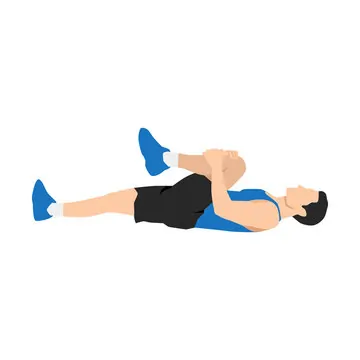
- Step 1: Bend your legs and place your feet flat on the ground while lying on your back.
- Step 2: With one foot on the ground, raise one knee to the chest.
- Step 3: Hold the position for up to 30 seconds while keeping the lower back pushed on the floor.
- Step 4: Repeat on the other side.
On each side, try performing two to four repetitions. Raising one leg to the chest with the other straight on the ground will make the exercise a little harder. Also, you may raise both legs to your chest.
2. Standing hamstring stretch
When performing this workout, maintain caution. Don’t overstretch; if necessary, hold onto anything.
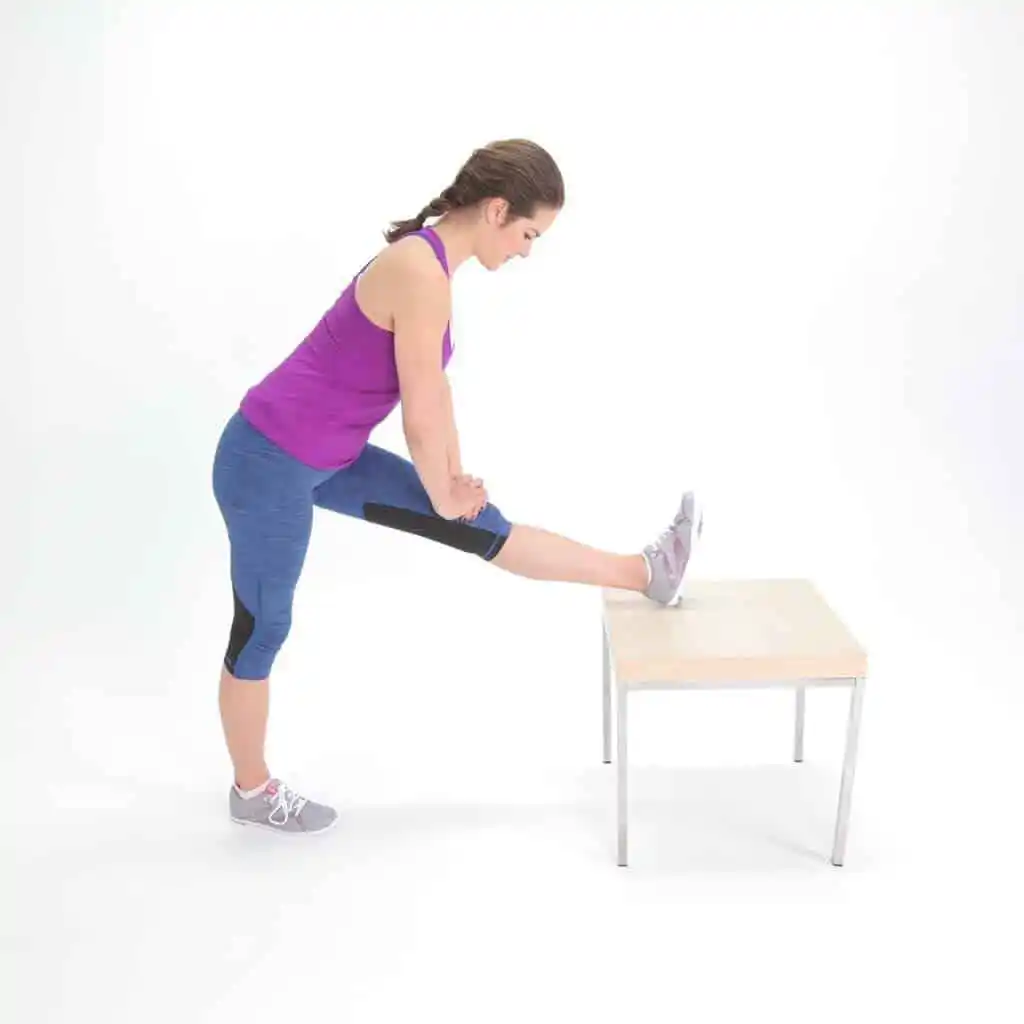
- Step 1: Place one foot on a slightly elevated surface, like a stair step, while standing upright.
- Step 2: Point the toes up and stretch the leg on the step.
- Step 3: Maintain a straight back while falling slightly forward.
- Step 4: Hold for twenty to thirty seconds. Keep in mind to breathe.
- Step 5: Continue with the opposite leg.
3. Pelvic tilts
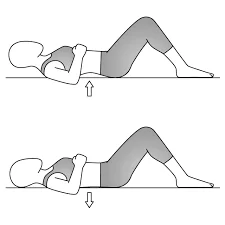
- Step 1: Bend your legs and place your arms by your sides while lying on your back.
- Step 2: Rock your hips and pelvis slightly upward, tighten your stomach muscles, and press your back into the floor.
- Step 3: Maintain this posture while attempting to make your belly button come into contact with your backbone. Remember to breathe.
- Step 4: After a few seconds, let go.
- Aim for two to eight reps.
4. Glute bridge
Your buttocks contain a group of muscles called the gluteal muscles, or glutes. If they’re tight, they might impinge on the sciatic nerve.
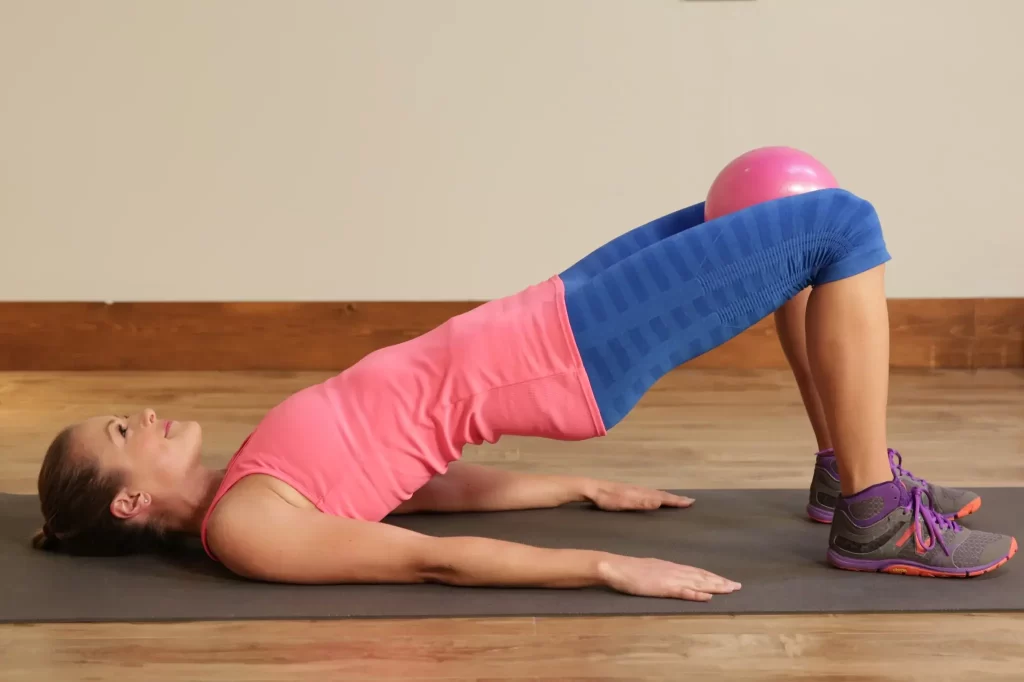
- Step 1: Bend your knees and lie with your back on the ground. Your feet should be roughly shoulder-width apart. Let your arms drop to your sides.
- Step 2: Raise your hips while pushing through your heels to create a straight line from your knees to your shoulders.
- Step 3: Maintain the posture for a little while.
- Step 4: Lower your hips to the floor gradually.
5. Lying gluteal stretch
You might need to slightly alter this exercise if you are not very flexible.
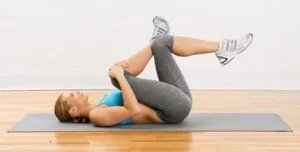
- Step 1: Lying on your back.
- Bend your legs.
- Bend your right ankle and lay it on your left knee.
- Step 2: While keeping your head and back on the floor, gently draw your left thigh toward you by connecting your fingers behind it with both hands.
- Step 3: Hold for twenty to thirty seconds.
- Step 4: Continue with the opposite leg.
It might be necessary to elevate your head a little by placing a book or sturdy pillow beneath it. If your thigh is difficult to reach, wrap a towel over it and pull it in your direction. With each leg, perform two to three repetitions.
6. Clamshell exercise
Your lower back and core are improved by this exercise.
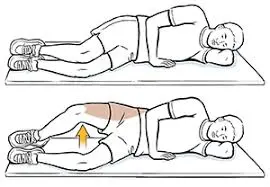
- Step 1: Fold both legs and stack one on top of the other when resting on one side. Begin tightening the muscles in your abdomen and consider dragging your belly button into the correct position of your spine.
- Step 2: Raise the upper leg until your legs are like an open clamshell, keeping your feet together and your knees bent. Put the upper arm on the ground level to steady yourself.
- Step 3: Lower your leg slowly after holding for 5 to 30 seconds.
- Repeat with the other leg on top after 8–10 repetitions.
7. Bird dog pose
This exercise involves extending your legs and the other leg to make a shape that simulates a hunting dog as it “points.”
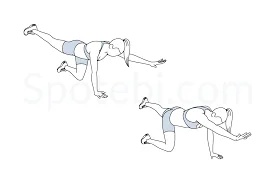
- Step 1: Get on your hands and knees, putting your knees in front of your hips and your hands under your shoulders. Keep your eyes fixed on a foot in front of your hands and keep your abdominal muscles tensed.
- Step 2: Lift your left arm straight out in front of you. Lift your right leg straight behind you at the same time. Create a straight line with your arm, leg, and back.
- Step 3: Lower your arm and leg after some time of standing.
- Step 4: Repeat the same with your left leg and right arm.
- Perform 8–10 repetitions on each side.
Other sciatica exercises
Low-impact aerobic exercises can also reduce sciatica pain and stop new attacks. You might attempt:
- Walking on land or in a swimming pool
- Water aerobics or swimming
- Using a workout bike
- Making use of an elliptical
Sciatica Exercises to Avoid
Bending, lifting, and twisting motions might worsen sciatica pain. So can strenuous, high-impact exercises like sprinting on a hard surface and carrying large weights.
When you’re recovering, stay away from:
- Leg circles and double leg lifts (lifting both legs while lying on your back)
- Squats
- Forward bends or toe touches
- Rows that are bent over
- Twists, like the Russian twist ab workout
Safety Things to Keep in Mind
One exercise routine isn’t successful for everyone since sciatica can have a variety of reasons. Never encourage yourself to complete an exercise that doesn’t feel right. Instead, focus on discovering some that work for you.
You may be able to do particular exercises that didn’t work at first as you develop better. However, keeping continuity in your program is more crucial than raising the degree of level of complexity.
Before performing these sciatica exercises, see your doctor if you have any other medical concerns. See your doctor if your pain increases after working out.
Where do you deal with severe sciatica pain?
See your doctor if your pain is intolerable. Additionally, see a physician if you observe:
- Tingling
- numbness
- A sensation of pins and needles
Visit the emergency department if you have:
- Pain so severe that it keeps you from engaging in your regular activities for longer than a few hours
- Abrupt, severe pain or numbness following physical trauma (such as a fall or auto accident)
- Weakness in your muscles
- Loss of control over one’s bowels or bladder
Does Exercise Make Sciatica Go Away?
There are several ways that mild exercise might relieve sciatica and other forms of back pain:
- Your spine’s supporting muscles get stronger as a result.
- It increases flexibility to facilitate more comfortable movement.
- Increased blood flow to the lower back facilitates recovery and reduces stiffness.
However, a home workout regimen isn’t always effective. Physical treatment and/or medication may be recommended by your physician. In addition to teaching you back pain-relieving exercises, a physical therapist can offer sciatica-supportive therapy like:
- To relieve pain and relax muscles, use hot or cold packs.
- Use massage therapy to release tension in your lower back and legs.
- With transcutaneous electrical nerve stimulation (TENS), a machine passes an electric current into your legs and back muscles.
- Warm water and massage jets are used in hydrotherapy to increase blood flow and ease muscular tension.
Conclusion
Inflammation of the sciatic nerve, which extends from your lower back through your buttocks and down your leg, is known as sciatica. Sciatica pain can be reduced with mild stretching exercises. See your doctor if it worsens or doesn’t get better after a few weeks.
FAQs
How quickly can sciatica be cured?
Seeing a doctor, who can develop a treatment plan tailored to your individual circumstances, is the quickest approach to alleviating sciatica pain.
Some people get relief from pain using over-the-counter medications, but be sure to properly follow the directions on the box. Another option is heat and cold treatment, which involves applying a cold pack wrapped in a towel to the uncomfortable area for 15 to 20 minutes at a time during the first three days after the pain begins. Do this as often as necessary. Use a heating pad after the first three days. Don’t leave it there for longer than 20 minutes at a time.
What are the types of sciatica?
Physicians may use the term “sciatica” to describe two different conditions:
The sciatic nerve is immediately impacted by true sciatica.
Sciatica-like disorders that affect the sciatic nerve and exhibit sciatica-like symptoms
What causes sciatica buttock pain?
The sciatic nerve travels down your legs and through your buttocks. Any part of your body with nerves that connect to the sciatic nerve may experience sciatica.
What should you do if your sciatic nerve is malfunctioning?
Try the following when sciatica flares up:
Painkillers sold over-the-counter
Heat and/or ice pads
Stretching exercises
Low-impact aerobic training
Preventing activities that harm you, such as lifting heavy items and bending or twisting your spine
See your doctor if at-home sciatica remedies are ineffective.
Where does the sciatic nerve run?
Your lower spine is where the sciatic nerve, a bundle of five nerves, begins. They go down each leg to just below the knee, passing through each hip and buttock.
References:
- Kokotsis, M. (2024, April 22). 12 ways to get sciatica Relief in 8 Minutes (Or Less). Harley Street Specialist Hospital. https://hssh.health/blog/12-ways-to-get-sciatica-relief-in-8-minutes-or-less/’
- WebMD Editorial Contributor. (2026, June 9). Sciatica: Exercises for Pain Relief. WebMD. https://www.webmd.com/pain-management/sciatica-exercises-pain-relief