Hyperreflexia
Table of Contents
What is hyperreflexia?
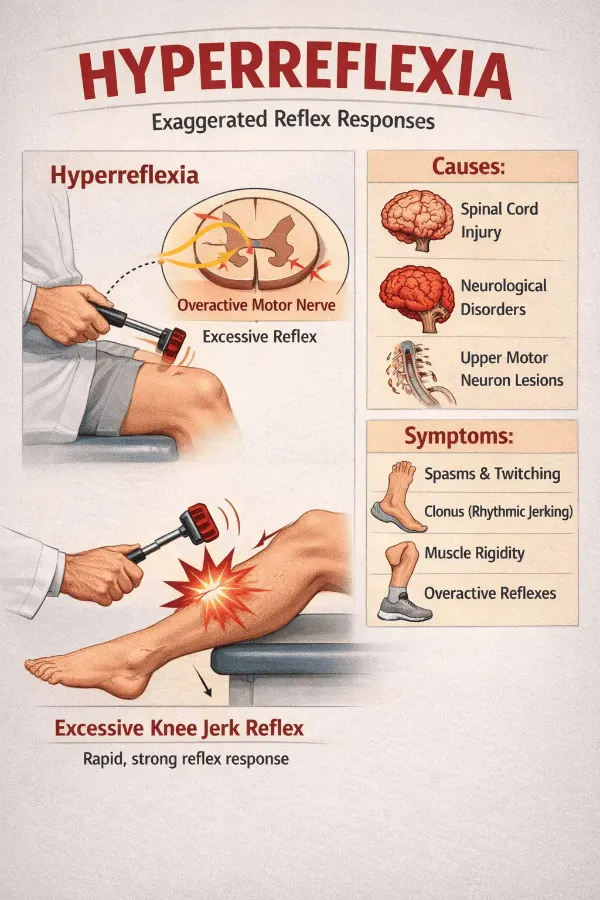
Hyperreflexia is a condition characterized by overactive or exaggerated reflexes, where muscles respond too strongly to stimulation. It commonly occurs due to problems affecting the brain or spinal cord, particularly the upper motor neurons. People with hyperreflexia may experience muscle spasms, twitching, stiffness, or repetitive reflex movements.
These reflexes become excessive in people with hyperreflexia, resulting in abnormal movements such as jerks, spasms, or fast contractions of the muscles. This disorder, which usually results from injury to the brain or spinal cord, shows that the neurological system is impacted.
Autonomic dysreflexia, also referred to as hyperreflexia, is a neurological condition characterized by an exaggerated response of the autonomic nervous system to various stimuli. Typically associated with spinal cord injuries occurring above the T6 vertebra, it manifests as a sudden and potentially dangerous spike in blood pressure triggered by factors such as skin irritation, bowel obstruction, or bladder overdistension.
If not addressed, this heightened reflex activity can lead to symptoms such as bradycardia, excessive sweating, and severe headaches, all of which present significant health risks. Healthcare providers need to recognize the causes, symptoms, and treatment strategies for hyperreflexia to effectively care for patients and prevent complications.
This condition can be associated with neurological disorders such as stroke, spinal cord injury, multiple sclerosis, or other nervous system conditions.
Factors caused hyperreflexia
- Spinal Cord Injury: Damage to the spinal cord can disrupt normal reflex pathways, resulting in hyperreflexia. This is particularly common among individuals with spinal cord lesions or injuries.
- Multiple Sclerosis (MS): MS is an autoimmune condition that damages the protective covering of nerve fibers, impairing communication between the brain and body. This damage can lead to hyperreflexia as a result of the neurological challenges presented by MS.
- Stroke: A stroke can inflict harm on the brain’s motor pathways, which may cause an exaggerated reflex response. Hyperreflexia can manifest after a stroke, especially if the injury impacts regions responsible for reflex regulation.
- Sexual activity: People with spinal cord injuries may experience hyperreflexia when stimulated during sexual activity.
- Temperature variations: Severe heat or cold exposure, for example, might cause autonomic dysreflexia.
- Infections: Hyperreflexia symptoms can be made worse by urinary tract infections (UTIs) or other systemic illnesses.
- To effectively prevent and manage autonomic dysreflexia events, it is essential to comprehend these triggers.
- Medication: When taken in combination with other pharmaceuticals, certain medications, such as monoamine oxidase inhibitors (MAOIs) or selective serotonin reuptake inhibitors (SSRIs), may cause hyperreflexia as a side effect.
Hyperreflexia and UMN damage can result from some disorders, some of which are benign and may not require treatment.
- Amyotrophic lateral sclerosis.
- Infection of the brain (encephalitis).
- Multiple sclerosis.
- Parkinson’s disease.
- Damage to the spinal cord.
- Traumatic brain damage.
- Vitamin B12 deficiency.
Other factors that can lead to hyperreflexia include:
Anxiety disorders make your body’s stress response get overactive. This is also known as the “fight-or-flight” response. When you have anxiety, like panic disorder or generalized anxiety disorder, your body gets extra sensitive.
Your muscles and reflexes can become too sensitive, leading to hyperreflexia. People with anxiety might have hyperreflexia now and then. It can be more noticeable when they are under a lot of stress or feeling anxious.
Hyperreflexia happens because your muscles and reflexes get overly sensitive with anxiety. Anxious people may experience hyperreflexia due to their anxiety. It could be more apparent during periods of stress or anxiety related to their anxiety disorders.
Sometimes people’s bodies can make a hormone called thyroid hormone. This is called hyperthyroidism. Your cells, the nerve cells, go into overdrive. This can make your reflexes act fast, which is also called hyperreflex… The good news is that if you treat the hyperthyroidism, the hyperreflexia will go away.
Signs and symptoms
Depending on the underlying causes, hyperreflexia frequently coexists with other neurological symptoms. Typical concomitant symptoms consist of the following:
- Muscular Spasms: Exaggerated reflexes can result in unpleasant or disruptive muscular spasms or jerks.
- Increased Muscle Tone (Spasticity): People who have hyperreflexia may have increased muscle tone, which can make the affected muscles stiff and difficult to move.
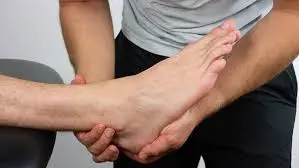
- Clonus: A quick, involuntary contraction of the muscles that might happen in reaction to a stimulus is known as clonus. People with hyperreflexia frequently exhibit it.
- Loss of Coordination: Exaggerated reflexes can impede coordination and fine motor control, making tasks like writing, walking, and object grabbing more challenging.
- Pain: In certain situations, hyperreflexia may result in pain from excessive muscle tension or spasms.
- Incontinence: Hyperreflexia can cause issues with bladder or bowel control if it affects the autonomic nervous system.
- Severe headache: A typical sign of hyperreflexia, headaches are sometimes described as throbbing or pounding.
- Blood pressure spikes that are noticeably higher than baseline values can happen suddenly, increasing the risk of stroke or other cardiovascular issues.
- Sweating: Excessive perspiration, particularly above the site of injury, is a common reaction to an overactive autonomic nervous system.
- Bradycardia: An erratic heartbeat may result from a drop in heart rate that coincides with an increase in blood pressure.
- Flushing or blotchy skin: Vasodilation may cause skin discoloration or flushing, especially on the upper body.
Treatment for hyperreflexia
- The goals of treating hyperreflexia, often referred to as autonomic dysreflexia, are to quickly reduce symptoms, recognize and treat causes, and avoid consequences. Acute interventions and long-term preventive measures customized to the individual’s needs are often combined in management regimens.
- Quick Reaction: It’s critical to respond quickly to reduce blood pressure and ease discomfort as soon as hyperreflexia symptoms are identified. This could entail loosening tight clothing, sitting the person upright to lower venous pressure, and identifying and treating potential triggers, such as skin irritation or bladder distention.
- Medication: To quickly reduce symptoms and lower blood pressure in severe cases of hyperreflexia, medication may be required. Under medical supervision, antihypertensive medications such as hydralazine or nifedipine can be used to treat the hypertensive crisis.
- Finding Triggers: Long-term management of hyperreflexia requires an understanding of and attention to the underlying triggers. Healthcare professionals collaborate with patients to pinpoint particular triggers that may cause episodes, such as changes in body temperature, skin irritation, or distention of the bladder or intestines. Recurrent episodes can be avoided by putting mitigation or elimination techniques into practice.
- Bladder and Bowel Regulation: Preventing autonomic dysreflexia requires effective regulation of bladder and bowel functions. Stool softeners, frequent bowel care, and intermittent catheterization can help reduce the risk of constipation, urine retention, and hyperreflexia.
- Skin Care: For people with spinal cord injuries who are susceptible to hyperreflexia, preventing skin deterioration and irritation is crucial. Pressure ulcers can be avoided, and the risk of autonomic dysreflexia caused by skin irritation can be decreased by using pressure-relieving devices, proper placement, and routine skin examinations.
- Education and Prevention: Preventing instances of hyperreflexia is mostly dependent on education. People with spinal cord injuries and those who care for them are trained to identify early indicators of hyperreflexia, put preventative measures in place, and effectively manage episodes. Instruction on maintaining healthy bowel and bladder function, skin care practices, and lifestyle changes to reduce triggers may all fall under this category.
Conclusion
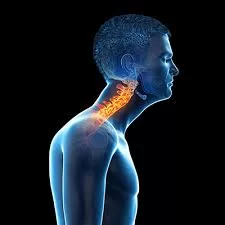
- Aphasia, neglect, hemianopia, or cranial neuropathies are examples of neurologic findings that could indicate cortical or brainstem dysfunction. If these findings are present, a focal brain or brainstem lesion is strongly suggested, and brain magnetic resonance imaging (MRI) is recommended for evaluation. In addition to indicating a lesion above the cervical cord, a quick movement of the jaw should draw attention to the brainstem and brain functions.
- ALS or multifocal spine illness, including both myelopathy (which causes the hyperreflexia) and radiculopathy (which causes the lower motor neurone symptoms), is suggested when hyperreflexia and lower motor neurone signs of atrophy and/or fasciculations coexist. It is necessary to assess the results’ anatomic pattern. Lower motor findings at the lesion level and upper motor neurone indications (such as hyperreflexia) below the lesion are indicative of a cervical cord lesion involving the anterior horn cell. For instance, ipsilateral triceps and leg hyperreflexia, as well as biceps atrophy and fasciculations, may result from a C6 cord injury affecting the anterior horn cell. An MRI of the cervical spine that detects the lesion would be diagnostic in this situation.
- ALS or multifocal spine illness, including both myelopathy (which causes the hyperreflexia) and radiculopathy (which causes the lower motor neurone symptoms, is suggested when hyperreflexia and lower motor neurone signs of atrophy and/or fasciculations are present. The findings’ anatomic pattern has to be assessed. When a cervical cord lesion affects the anterior horn cell, it will show evidence of higher motor neurons (such as hyperreflexia) below the lesion and lower motor findings below the lesion level. For instance, an anterior horn cell-related C6 cord lesion may result in ipsilateral triceps and leg hyperreflexia, as well as biceps atrophy and fasciculations. In this situation, a cervical spine MRI that shows the lesion would be diagnostic.
- Hyperreflexia is an important clinical indicator of central nervous system dysfunction rather than a disease entity, and it is critical for diagnosis, prognosis, and therapy planning.
FAQs
What is hyperreflexia?
Hyperreflexia is an abnormal condition in which there is an exaggerated or overactive deep tendon reflex response, usually due to loss of inhibitory control from the central nervous system.
What are the clinical signs of hyperreflexia?
Brisk deep tendon reflexes
Clonus (rhythmic jerking)
Muscle spasticity
Positive Babinski sign
Why does hyperreflexia occur in UMN lesions?
In UMN lesions, there is a loss of inhibitory signals from the brain to the spinal cord, leading to increased excitability of reflex arcs, resulting in exaggerated reflexes.
What is clonus, and how is it related?
Clonus is a series of involuntary, rhythmic muscle contractions. It is a key sign of hyperreflexia and indicates UMN involvement.
Is hyperreflexia always pathological?
No. Mild hyperreflexia can be seen in:
Anxiety
Hyperthyroidism
But persistent or severe hyperreflexia usually indicates neurological pathology.
References:
- Textbook of Neuro-Physiotherapy — Shalu Jain
- Merritt’s Neurology — Elan Louis et al.
- Cash’s Textbook of Neurology for Physiotherapists — P.A. Downie
Standard physiotherapy neurology reference used in Indian physiotherapy colleges. - Indian Academy of Neurology (IAN)
- National Institute of Mental Health and Neurosciences (NIMHANS)
- AIIMS New Delhi – Neurology Department
- Professional, C. C. M. (2025, August 15). Hyperreflexia. Cleveland Clinic. https://my.clevelandclinic.org/health/symptoms/24967-hyperreflexia