
Functional Exercises
Functional exercises that target many muscle groups at once are the main emphasis of functional training, which uses motions that duplicate daily activities to enhance balance, coordination, and the capacity to carry out daily duties effectively.
Squats, lunges, dead lifts, and farmer’s walks are typical examples that help develop strength, endurance, and flexibility, which in turn make everyday tasks like lifting, carrying, bending, and climbing safer and simpler.
Table of Contents
What it is:
- Simulates everyday motions: Functional exercises are made to mimic the motions you use regularly, including standing, bending, lifting, tugging, and carrying.
- Focus on compound movements: Functional training places a strong emphasis on functional exercises that work many muscle groups and joints simultaneously, in contrast to conventional workouts that isolate specific muscles.
- Improves functional strength: The objective is to create a powerful body that can withstand the demands of the real world and enhance your capacity to carry out daily duties more efficiently.
Benefits of Functional Exercise
Improves Daily Strength
- Functional workouts replicate everyday motions such as twisting, lifting, bending, and reaching.
- Therefore, the power you develop instantly translates into your everyday tasks, such as lifting boxes, climbing stairs, and carrying groceries.
Improves Stability and Balance
- Your core and stabilizer muscles, which are crucial for preserving balance when moving, are activated during functional exercise.
- Your capacity to stay stable and prevent falls is enhanced by exercising your body in numerous planes of motion, which is particularly crucial as you become older.
- For example, lunges and single-leg balancing routines enhance joint and muscle coordination.
Improves Motor Skills and Coordination
- Multiple muscle groups are trained to cooperate rather than to contract independently through functional workouts.
- This enhances neuromuscular coordination, or the efficient exchange of information between your brain and muscles.
- Better movement efficiency, quicker response times, and more fluid performance in everyday life and sports are the outcomes.
Improves Core Strength
- The core muscles (lower back, obliques, and abdominals) are used in practically all functional motions.
- During every exercise, a strong core increases stability, protects the spine, and improves posture.
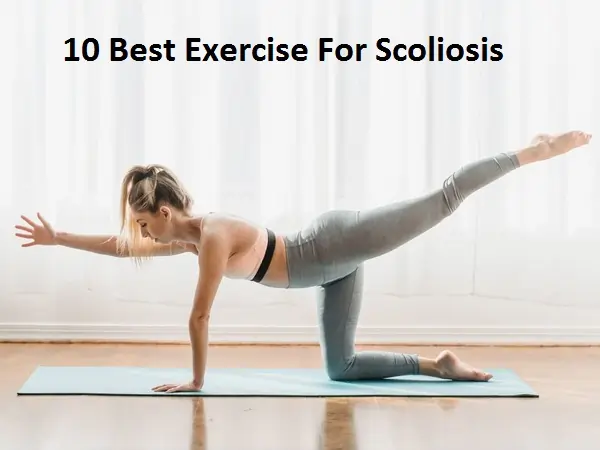
- For example, the complete core chain is strengthened with planks, birddogs, and kettlebell swings.
Increases Flexibility and Mobility
- Functional activities take advantage of natural joint mobility, as opposed to machine-based workouts that restrict your range of motion.
- By doing this, you may avoid stiffness and discomfort by maintaining and increasing your muscle and joint mobility.
- For example, rotational stretches and deep squats increase the flexibility of the hips, knees, and spine.
Increases Endurance in Function
- Functional workouts also train your cardiovascular and muscular endurance since they activate numerous muscles at once.
- You will be able to work out for extended periods of time without becoming tired.
- For example, circuit-style functional training, which combines exercises like push-ups, lunges, and squats, increases strength and endurance.
Improves Posture
- The core, back, and glutes are among the postural muscles that support the spine and are strengthened by functional workouts.
- This fixes muscular imbalances brought on by extended sitting or bad posture.
- The outcome was better spinal alignment, less tension on the neck and back, and a more erect posture.
Reduces the Risk of Injury
- Your body learns to move securely and effectively when you train with natural, full-body motions.
- It prepares muscles, ligaments, and joints to withstand the pressures of everyday living.
- For example, hip hinge workouts such as deadlifts preserve the lower back by teaching appropriate bending technique.
Improves Flexibility in All Motion Planes
- In the sagittal plane, the majority of conventional gym activities simply move in a straight path.
- Through forward, sideways, and rotating motions, functional training prepares the body for a variety of real-world motions.
Promotes Pain Management and Rehabilitation
- Because they strengthen weak regions and restore normal movement patterns, functional exercises are frequently utilized in physiotherapy.
- Through muscle retraining, they can help reduce lower back discomfort, tight joints, and limited mobility.
Improves Sports Performance
- Functional training helps athletes improve their power, agility, and coordination in sport-specific motions (e.g., running, leaping, spinning).
- It helps in effectively producing force while preserving equilibrium and control.
Versatile and Time-Efficient
- Functional exercises frequently target several muscles simultaneously, providing a full-body workout in a shorter amount of time.
- They are perfect for folks with hectic schedules or for at-home exercises because they require little to no equipment.
Promotes Increased Awareness of the Body
- Functional training enhances proprioception, or your awareness of your body’s position and movement, by emphasizing deliberate, controlled movement.
- This awareness aids in avoiding awkward or risky movements that might result in harm.
Improves Life Expectancy and Quality of Life
- In older persons, independence is closely correlated with functional strength.
- Long into old age, your body remains functioning and independent if you can continue to do everyday tasks like walking, bending, and standing up
Functional Exercise
Squat
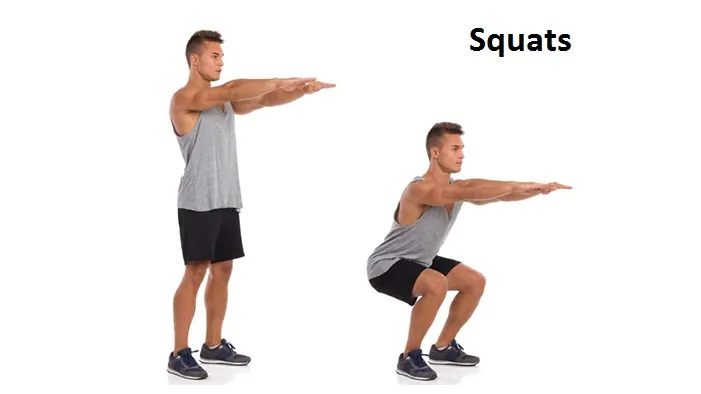
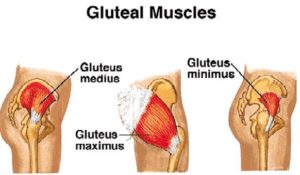
The quadriceps, which straighten the legs, and the gluteus maximus, which pushes the hips forward, are the main muscles used during squats. You should squat below 90 degrees if you’re doing this to grow your butt because the lower you fall, the more your glutes are used.
How to perform a squat:
- With your hands to the side and your feet shoulder-width apart, point forward or slightly outward.
- Squat down slowly until your thighs are horizontal, or somewhat lower if you can do it. As you do so, raise your hands to your face or chest.
- Return slowly and repeat five to seven times.
Jump Squat
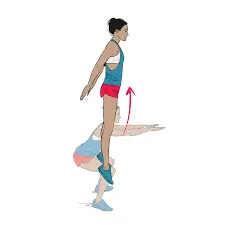
Jump squats target the quadriceps and glutes. In contrast to a weighted squat, hopping explosively increases power and activates the neurological system more intensely without causing as much fatigue in the muscles.
Because of this, jump squats are perfect for a warm-up or a less taxing squat variation on days when you are aware that your recovery is lacking.
The jump squat technique:
- Place your feet shoulder-width apart and keep your hands by your sides.
- Bring your arms in front of your chest and squat down until your thighs are at least horizontal.
- Jump straight up and explode high, swinging your arms down for more force.
Plank

improves posture and spine alignment while strengthening and stabilizing the core.
- Lift onto your forearms and toes after lying face down.
- From head to heels, maintain a straight body alignment.
- Keep your hips from drooping and engage your core.
- Hold: 2–3 rounds × 20–60 seconds.
Push-Up
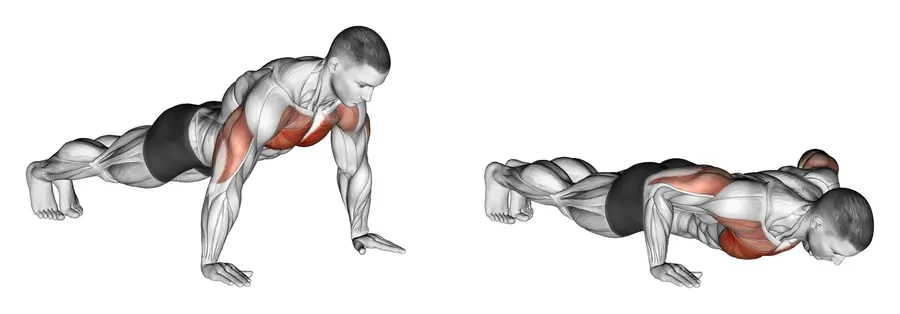
Simulates pushing motions and strengthens the arms, shoulders, chest, and core.
- Place your hands behind your shoulders and begin in the high plank posture.
- From head to heels, maintain a straight posture.
- Drop until your chest almost touches the ground.
- Return to the starting position by pushing up.
- Reps: 2–3 sets × 8–12.
Lunge
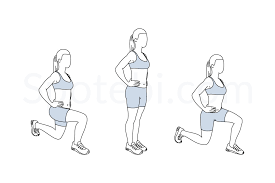
- With the right foot about two to three feet ahead of the left, assume a split stance. Your hands are on your hips, your core is active, your shoulders are back and down, and your torso is straight.
- Lower your body till the back knee is only a few inches above the floor while bending the patient’s knees. Your weight should be evenly distributed between both legs at the bottom of the exercise, with the front thigh parallel to the floor and the rear knee pointing toward the floor.
- Maintaining your weight on the front foot’s heel, push yourself back up to the starting position.
Reverse Lunge
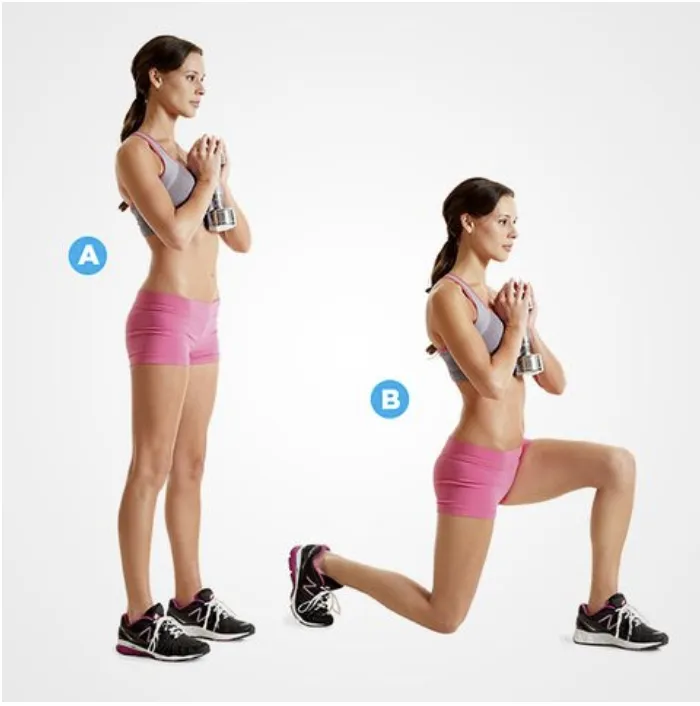
The reverse lunge engages the hamstrings more than other lunge variations, although it works the same muscles overall. Additionally, it’s a really surprising action that makes your brain work in unexpected ways to coordinate your body.
The reverse lunge technique:
- Place your feet four to six inches apart as you stand.
- Bend your left knee and step your right leg out to the side while maintaining a forward-pointing foot.
- With your hands clasped, lower your body and place your left arm lightly on your left knee.
- Return to the starting position gradually.
Summary
Movements used in functional training teach the body how to carry out daily tasks more securely and effortlessly. Through the simultaneous use of several muscles and joints, these exercises concentrate on improving strength, balance, coordination, flexibility, and endurance.
Functional exercises replicate real-life movements, including squatting, lifting, pushing, pulling, and twisting, as opposed to conventional workouts that focus on isolating certain muscles. Squats, lunges, planks, push-ups, and step-ups are typical examples.
Improving general body function, preventing injuries, improving posture, and increasing the efficiency of daily activities are the key objectives.
FAQs
What is a functional exercise?
In order to increase your general strength, balance, and stability for daily chores at home, at work, and during play, functional exercises teach your body to cooperate by simulating commonplace actions like lifting, squatting, and pulling. Functional training combines complex movements and several muscle groups, such as squats or deadlifts, to prepare your body for everyday situations and lower your chance of injury, in contrast to traditional training that isolates muscles.
What is the best functional workout?
Squat
Lunge
Hand-Release Push-Up
Jump Squat
Is it possible to perform functional workouts at home?
Exercises for functional fitness teach your muscles to cooperate so you may carry out everyday duties at work, home, or play. For example, crouching down to pull a weed in the garden is made easier with a squat. The motion of opening a difficult drawer is replicated by a standing row.
Refrences
Fawkes, J. (n.d.). The 30 Best Exercises for Functional Strength and Mobility. https://www.spartan.com/en/blog/best-exercises-for-functional-strength
Cpt, P. W. (2024, June 13). How to do lunges: proper form, variations, and common mistakes. Verywell Fit. https://www.verywellfit.com/how-to-lunge-variations-modifications-and-mistakes-1231320