Buerger’s test
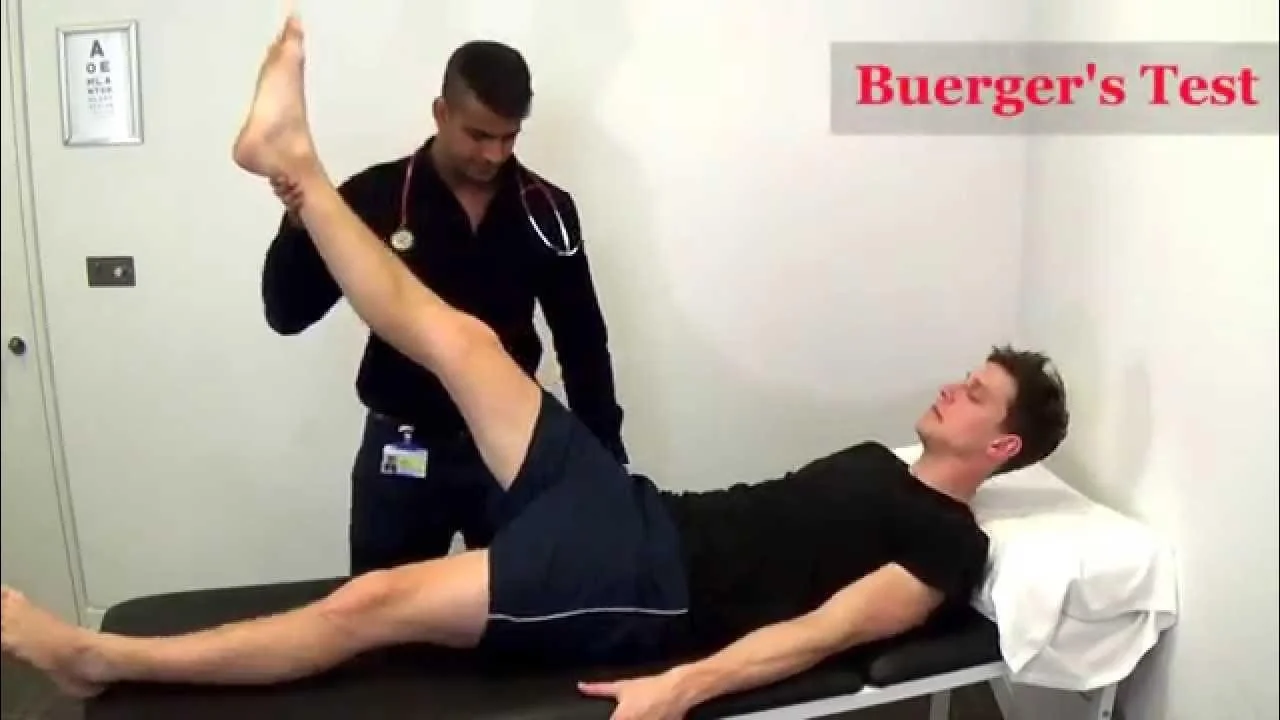
The Buerger test is used to assess arterial sufficiency. It carries Leo Buerger’s name. The angle at which the supine leg must be raised before it fades is called the vascular angle, also known as Buerger’s angle. Even when the limb is elevated 90 degrees, the toes and sole of the foot remain pink in the limb with adequate circulation. The pallor of the ischemic limb may result in elevation to 15 or 30 degrees for 30 to 60 seconds. (This portion of the examination checks for paler skin.) Less than a 20-degree vascular angle indicates severe ischemia.
When the leg is in a sitting position, normal blood flow quickly turns the leg pink, but with peripheral artery disease, the leg changes more slowly and turns pink to red, sometimes called red. at the foot of the sunset. This is because reactive hyperemia causes the arteries to dilate in an attempt to clear the metabolic wastes that have accumulated in reactive hyperemia.
The examination may also be used to identify erythromelalgia.
What is a Buerger’s test?
In fact, the lower limbs, especially the legs, are evaluated for vascular sufficiency using the Buerger’s test, commonly known as the Buerger’s maneuver. Thromboangiitis obliterans (also known as Buerger’s disease) was originally described by a doctor in 1908, and it bears Dr. Leo Buerger’s name.
A rare inflammatory disorder called Buerger’s disease affects the tiny and medium-sized arteries and veins in the limbs, reducing blood flow and occasionally resulting in excruciating pain and tissue destruction.
During Buerger’s test, a measurement called the vascular angle, sometimes known as Buerger’s angle, is taken. It describes the angle at which the leg must be lifted above the level of the torso before it turns pale. In other words, it’s the angle at which the leg’s blood supply is impaired, causing the leg to appear paler as a result of decreased arterial flow.
In people with Buerger’s disease or other vascular diseases affecting the legs, the Buerger’s test and Buerger’s angle are important in determining the degree of arterial insufficiency. Healthcare workers can learn more about the level of arterial impairment or occlusion in the lower extremities by assessing the vascular angle.
On a limb with adequate blood circulation, the toes and sole of the foot remain pink even when the leg is elevated 90 degrees. In an ischemic limb, elevation up to 15 or 30 degrees for 30-60 seconds can cause pallor. (This part of the exam checks for increased pallor) Significant ischemia is indicated by a vascular angle of less than 20 degrees.
In a sitting position, the leg immediately turns pink again due to regular circulation. Peripheral artery disease causes the leg to turn pink more slowly than usual, changing from its typical pink color to reddish-orange ( ruboro ), often called sunset leg. This is due to the dilation of the arteries, the purpose of which is to clean the metabolic waste accumulated in reactive hyperemia. The leg will then change back to its original color. The term “dependency checking” refers to this part of the test.
FAQ
The Buerger’s test is performed to determine if the artery supply to the leg is adequate.
To carry out the Buerger test:
Position of patient is the patient supine and, while standing at the foot of the bed, lift both of the patient’s feet to a 45-degree angle for one to two minutes.
Observe the coloration of the limbs:
Asking the patient to swing their legs over the edge of the bed while they are sitting up:
The Buerger’s test, if positive, indicates more severe ischaemia with distal limb artery involvement and is a helpful addition to standard peripheral vascular examination.
Buerger-Allen Exercise (BAE) is one of the exercise kinds used to encourage Lower Extremity Perfusion (LEP), which in turn promotes the healing of wounds and lessens PNS in people with diabetes mellitus (DM).
Buerger’s disease is often diagnosed based on five variables: a history of smoking, beginning before the age of 50, infrapopliteal artery occlusive disease, upper limb involvement or phlebitis migrans, and the lack of any other atherosclerotic risk factors than smoking.
The Buerger’s test, if positive, indicates more severe ischemia with distal limb artery involvement and is a useful supplement to standard peripheral vascular examination.