Wall Exercises To Improve Rounded Shoulders
Posture, muscular imbalances, and rounded shoulders may all be corrected with some stretching and strengthening exercises. You may do these while sitting, lying down, or standing.
Sitting, exercising, driving, and standing are examples of daily activities that might cause us to round our shoulders.
Reduced range of motion, poor circulation, and neck, head, and lower back pain can all be caused by bad posture caused by rounded shoulders.
Tight neck/shoulder muscles (levator scapulae) and chest muscles (pectoralis major/minor) are the hallmarks of this illness.
Table of Contents
Rounded Shoulders Posture: What Is It?
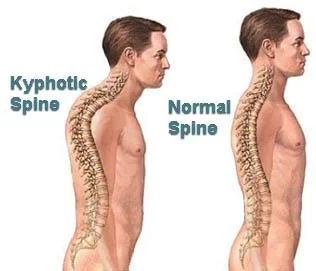
The look of shoulders that are positioned more forward than usual is referred to as “rounded shoulders.” A forward head position and increased upper back slouching, known as Thoracic Kyphosis or Dowager’s Hump, are common characteristics of people with rounded shoulders.
This puts a great deal of strain on the shoulders and neck, which can result in decreased shoulder range of motion, headaches, sleep issues, numbness, and/or loss of function, usually in the upper body.
As you may recall from our earlier essay on posture, most people have a too-flat thoracic spine (the mid-back), whilst the remainder have a more rounded thoracic spine. This article is for you if you weren’t classified as “excessively flat,” and we’ll show you exactly how to correct that terrible hunchback posture!
A typical thoracic spine should have some little rounding, but too much of it might be harmful. Your neck and shoulders are supported by your thoracic spine. The likelihood of experiencing discomfort in nearby joints, particularly the shoulders and neck, rises dramatically if your thoracic spine is immobile.
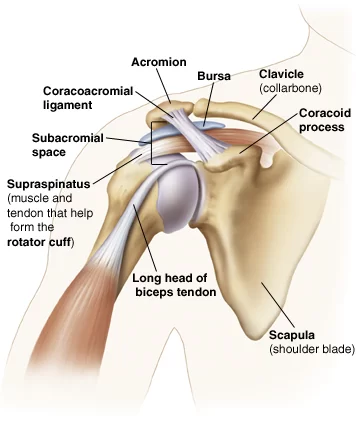
The figure below illustrates how this severe curvature creates the conditions for an extremely forward head position. The muscles that support the head and neck are strained and/or fatigued as a result of trying to sustain an unmanageable posture. Your shoulder blades’ ability to move is also impacted by the thoracic spine’s excessive curvature, which severely compromises the rotator cuff muscles and frequently makes overhead exercises challenging and uncomfortable owing to the impingement that results.
Common Causes Of Rounded Shoulders:
- Using your phone to read or text while keeping your head down.
- Driving with poor posture for long stretches.
- Overly involved overhead
- Sleeping with bad posture.
- Overuse of weights, especially in the chest.
- Shoulder injuries or dysfunctions.
- Riding with bad posture.
- Carrying bulky backpacks
To maintain a neutral posture, there is typically an imbalance between the muscles that should move the shoulders forward and those that should pull them back.
Muscle Imbalance Causes Rounded Shoulders
Muscles that are tight and shortened include:
- Pectoralis major and minor (Chest muscles)
- Latissimus dorsi (Low and mid back)
- Sternocleidomastoid Muscle
- Upper trapezius (Neck and upper back)
- Levator scapulae (which extends from the neck to the shoulder blade)
Muscles that become overstretched and are weak:
- Lower and mid trapezius (mid back)
- Serratus anterior (Side of ribs)
- Rhomboids (Back muscles)
- Rotator Cuff (Muscles around the shoulder blade)
Now let’s look at ways to fix rounded shoulders through exercise.
The Top 7 Rounded Shoulder Exercises
Certain postural exercises can help improve this posture, according to this study.
For best results, we recommend doing these five exercises three to five times a week. All you need is a foam roller and an exercise band (such as a Theraband®) to get started.
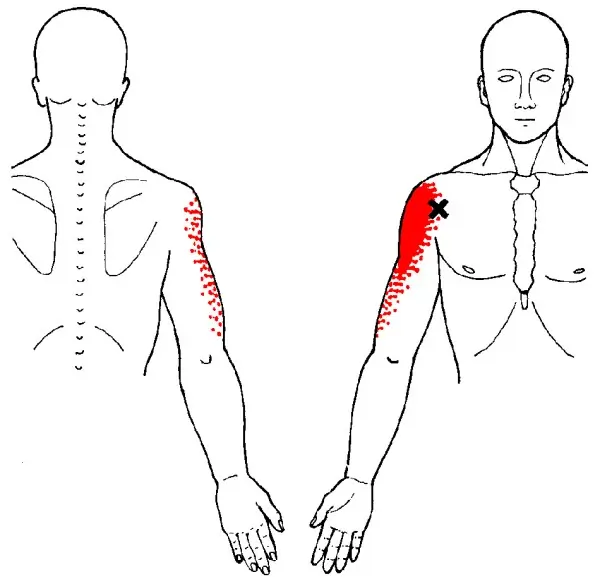
1. Trigger point release for chest muscles
This will loosen the pectoralis major and minor (chest muscles), which are frequently quite stiff in a rounded shoulder position.
How to do it?
- Take hold of the Theracane hook and place the knob in the groove directly below your collarbone.
- To assist in releasing the trigger point, press down on the hook.
- Hold it there for at least 30 seconds once you’ve located a tight spot.
- To train the entire muscle, move the hook to provide pressure at various angles.
- Perform on all sides.
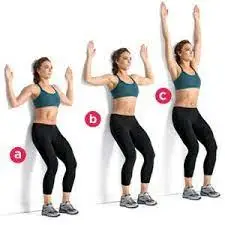
2. Wall Slides
This exercise strengthens the low trapezius and serratus anterior muscles while opening up the shoulders and chest.
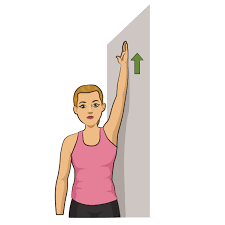
- Stand with your back to the wall and walk your feet out about 12 inches from it, trying to keep your upper back and buttocks in contact with the wall.
- Draw your stomach closer to the wall to avoid having an overly arched low back.
- Try bending your elbows to a 90-degree angle so that your hands are facing up while pressing your forearms on the wall (this may be an uncomfortable posture when you first start performing this exercise).
- Gently move your arms up and down the wall
- Start with a single set of ten reps, then work your way up to three sets of ten reps.
3. Band Pull Apart
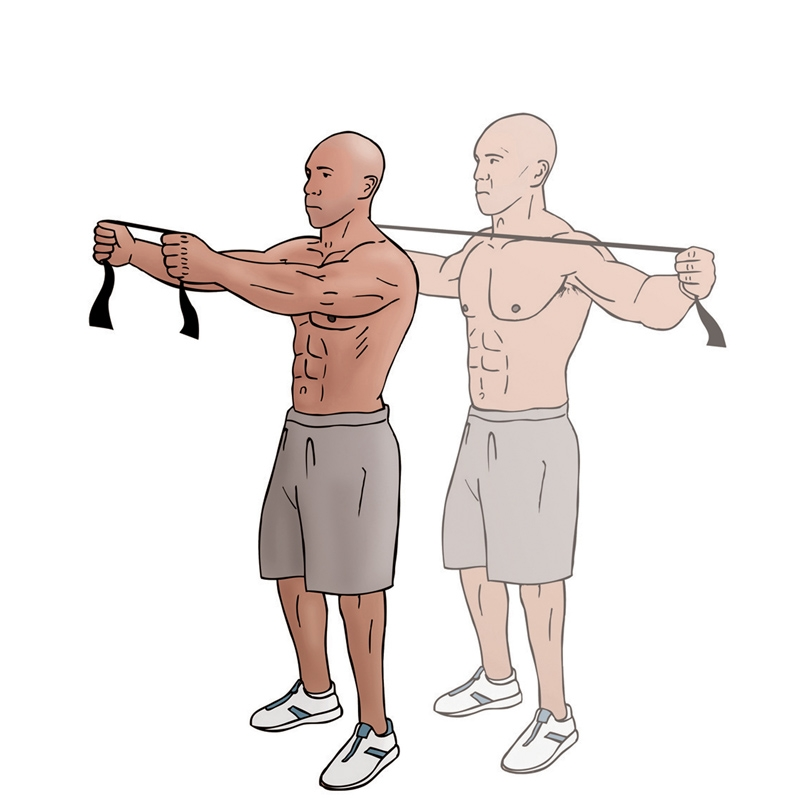
How to Do It:
- Start standing with proper posture.
- Holding a resistance band in both hands, stretch your arms in front of you and straighten your elbows. The amount of resistance you apply will depend on your own strength.
- Slowly extend your arms behind your body while maintaining your elbows locked.
- Go only as far outside as you feel comfortable. Pain in the arms or neck is not acceptable, although mild muscle heat is.
- Repeat 2×10, then progressively increase to 3×10.
- By the time you get to repeat numbers 8, 9, and 10, this should be challenging. If not, raise the resistance of the band.
4. Thoracic Spine Foam Rolling

- Lying on your back with your hands behind your head, place a foam roller under your upper back.
- Roll up and down softly, starting at your mid-back and working your way up to the top of your shoulders.
- Keeping your core firm, roll with your legs.
- Roll gently and slowly; don’t rush.
5. Lateral neck flexion stretch
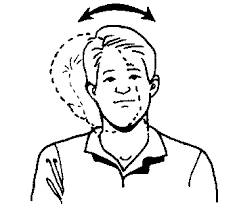
This stretch works the scalene and trapezius muscles, which are involved in breathing and posture across the shoulders and neck.
- With your shoulders down and back straight, either stand or sit erect in a chair.
- To extend the right side of your neck, gently move your left ear toward your left shoulder.
- On the opposite side, repeat.
- Hold for 15 to 30 seconds after completing 1 to 2 sets on each side
6. Chest doorway stretch
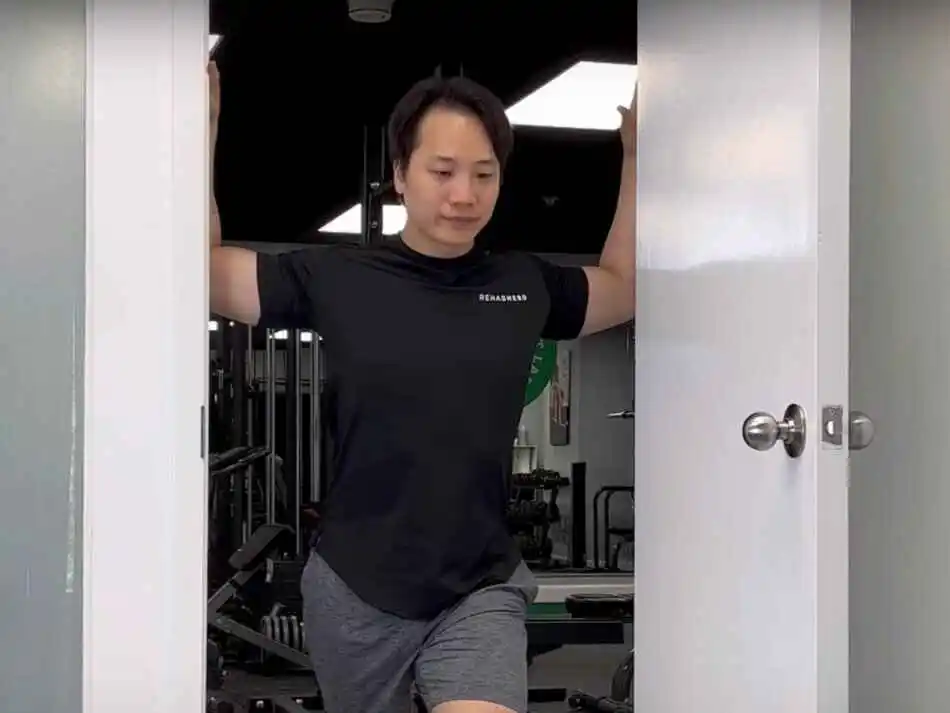
The doorway stretch is a great option for rounded shoulders. This exercise softly stretches the shoulders and expands the chest.
- Place a doorway one to two feet in front of you.
- Raise your arms until your upper arms are parallel to the floor and bend both elbows to a 90-degree angle. Put your forearms on the doorway’s sides.
- Put one foot on the other side of the doorway and take a step forward.
- Gradually transfer your weight to your front foot until your chest begins to expand. Hold on.
- Two or three times a day, perform three sets of 15 to 30 seconds each.
7. Prone I, T, Y
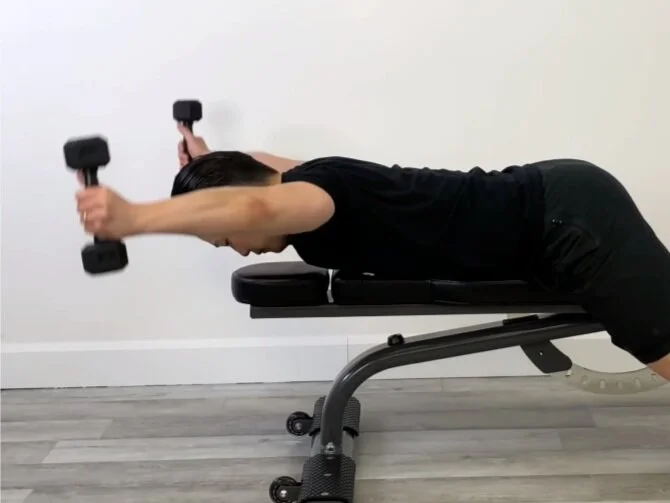
Your shoulders and upper back’s smaller stabilizing muscles may be strengthened with the prone I, T, and Y exercise.
- Lay on your stomach with your hands in a thumbs-up position, your arms straight over your head, and your forehead on the ground.
- Pause, raise your arms as high as you can, then gently lower them again.
- Extend your arms into a “Y” shape
- Then gradually bring them back down.
- Extend your arms into a “T” shape, lift them as high as you can, and then gradually bring them back down.
- Go back to the “I” position and do it again.
- Once or twice a day, perform two sets of ten repetitions.
Can I attempt any other therapies to assist with rounded shoulders?
Stretching and strengthening are the first steps in treating rounded shoulders.
A physical therapist’s soft-tissue mobilization can release tense muscles in the chest area that may result from a hunched-over posture.
Wearing a shoulder posture brace, which maintains the proper alignment of your shoulders and neck, may also be beneficial. A doctor or physical therapist may be able to assist you in selecting the best option for your requirements.
If my shoulders are rounded, should I avoid certain exercises?
The most common cause of hunched or rounded shoulders is a muscle imbalance between the chest and shoulder/upper back region.
Stretching and strengthening should focus on the upper back and chest, not just one, he advised, to address the imbalance. Make sure you are not hunched over and that your spine is straight when doing workouts.
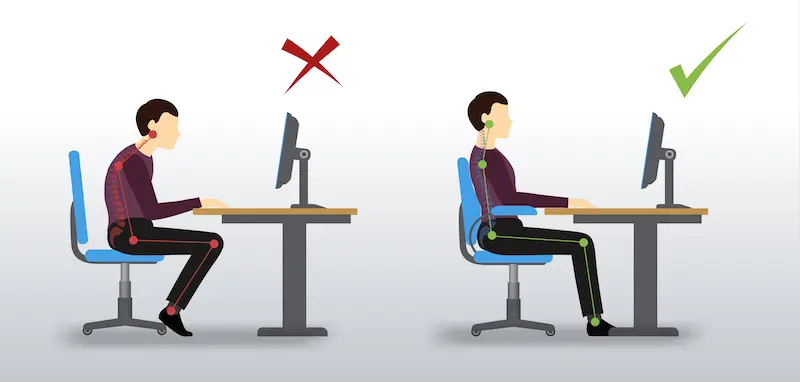
Advice for a desk that is ergonomically sound to prevent rounded shoulders:
- Make sure your thighs are perpendicular to your calves and your knees are bent at a 90-degree angle.
- Use a low-back support cushion to preserve your natural low-back arch.
- Make sure the top third of your computer screen is at eye level.This will allow you to look up rather than down.
- Walk about and stretch your neck and upper back on a regular basis.
- Your rounded shoulders may be a result of spending most of your day at your desk if you have a 9-to-5 office job.
- An ergonomic workspace setup is crucial for correcting rounded shoulders and enhancing posture.
- It will be easier to avoid and correct rounded shoulders if you have better posture when working, so consider how your desk is designed.
Conclusion:
You might not like the way you appear if you have rounded shoulders, or you might have upper back and neck aches. You may now correct your rounded shoulder posture by doing the exercises listed in this article and making changes to your workplace.
FAQs
Is it possible to correct rounded shoulders?
Most of the time, rounded shoulders may be corrected with stretches and strength training that focus on the back, chest, and core. Surgery may be necessary to fix your rounded shoulders and spine if you have really severe kyphosis, but there are many hazards involved.
How much time does it take to eliminate rounded shoulders?
Your lifestyle, general health, and the severity of your rounded shoulders will all affect how long it takes to get rid of them. A timetable tailored to your situation could be provided by a medical expert or physical therapist.
How can rounded shoulders be fixed while you sleep?
It’s unclear which sleeping posture is ideal for those with rounded shoulders. There may be a connection between spine problems and sleep posture, according to some studies, but further investigation is required to pinpoint the precise nature of this interaction.
References:
- McQuilkie, S., DC, & McQuilkie, S., DC. (2024b, November 21). How to fix rounded shoulders posture – 5 Effective exercises. Back Intelligence (Creators of PostureFlow App). https://backintelligence.com/how-to-fix-rounded-shoulders-with-exercises/
- Lindberg, S. (2024, July 19). 6 exercises for rounded shoulders. Healthline. https://www.healthline.com/health/rounded-shoulders-exercises
- Athlete, C. (2024, March 5). 4 exercises to fix rounded shoulders! The Charlotte Athlete. https://thecharlotteathlete.com/4-exercises-to-fix-rounded-shoulders/