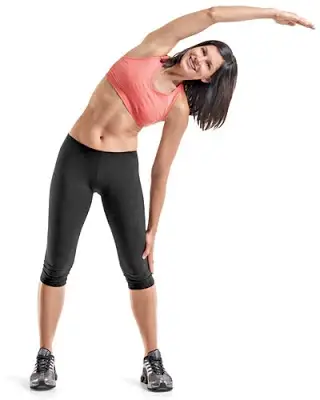
Side Bend Exercise
Table of Contents
Introduction
The Side Bend Exercise is a simple and effective movement that helps improve flexibility and mobility in the spine and waist muscles.
It increases your side-to-side mobility, relieves tension in your chest, hips, and back muscles, and makes you more stable while standing. Besides, it feels great.
This exercise involves bending your upper body sideways until your waist, hips, and back feel somewhat stretched, as the name indicates.
Muscles involved
- Internal and exterior obliques. These muscular groups in your abdomen run down either side of your torso. They help you twist your body as you go about your regular activity.
- Rectus abdominis.The rectus abdominis, sometimes referred to as the “six-pack” muscle, is a long muscle that runs vertically along the front of the abdomen. It gets a great stretch from the standing side bend workout.
- Erector Spinae. This group of muscles runs along the spine and can become tight as a result of daily activities, office jobs, additional strains, and our active lifestyle. This stretch aids in releasing that tension.
- Intercostal muscle. These are little muscles found in the spaces between your ribs. The standing side bend is an excellent method to stretch them, even though they’re not the easiest muscles to target. This is especially true if you take deep breaths during the posture.
- Quadratus Lumborum. This significant lower back muscle connects the bottom ribs, spine, and pelvis. When standing, it is crucial for preserving pelvic stability.
Benefits
Standing side bends increase the strength and flexibility of the muscles on the sides of your waist and back, which makes several everyday tasks simpler and more fun. Additionally, it might enhance your balance and reduce your risk of harm from falls. If you regularly incorporate this technique into your overall movement regimen, you might get the following benefits:
- Muscle tightness, especially after extended sitting or standing.
- Backache. One of the main causes of back pain is the quadratus lumborum muscle. Regularly stretching this muscle can help release tension and improve back mobility, both of which can reduce pain.
- We’ve long maintained that perfect posture doesn’t exist. However, you risk straining your torso if you keep the same posture for a long time. Side bends while standing help release stress.
- Take a seat at your desk. If you must spend most of the day glued to a computer screen, your body will be more resistant to the strain and pain it may cause because there will be less back pain and a stronger emphasis on taking breaks.
- reaching for things, like reaching into an airplane’s overhead compartment or bending over to pick something up off the ground.
- Turning to look behind you or rolling over in bed are examples of twisting actions.
- shifting places. Think about turning to exit the shower or getting out of a chair.
- Your obliques must contract when you are carrying uneven loads to maintain your equilibrium.
- household tasks including sweeping, vacuuming, washing, and putting away dishes.
Side Bend Exercise Video
How to perform the side bend exercise?
- Start by placing your hands at your sides, palms facing your thighs, and standing with your feet comfortably apart.
- As you slowly lower yourself to one side and glide your arm down your leg toward your knee, your shoulder will drop into the side position.
- Your other hand will naturally move up your leg and in the direction of your hip as you bend.
- Hold the stretch while focusing on inhaling and exhaling deeply.
- Go back to where you were.
- Bend to the other side and repeat the stretch.
- Your sides, hips, and lower back may stretch as you finish each repetition.
To facilitate the side bend exercise
Stand with one side facing a wall a few feet away. Your upper arm should be at shoulder height when you place your forearm against the wall. Now, gently press your hip on your forearm and slide it toward the wall. Return to the starting position and repeat on the other side after holding for a few deep breaths.
The seated side bend variation is another option. Every step is the same, with one difference: comfortably sitting in a chair.
To increase the difficulty of the side bend exercise
Extend the other arm straight up by your ear and above your head in the direction you are leaning while sliding one hand down your leg.
A set of dumbbells by your side is another option.
Tips
- Don’t rush the curve or return; alternatively, go with caution and control.
- Avoid bending forward or backward. There should only be side-to-side movement.
- Breathe out as you stand back up to involve your obliques successfully.
- Don’t go over. Go just far enough to experience a stretch rather than a strain.
FAQs
What are the benefits of side bends?
They stretch the muscles in the hips, thighs, and abdomen and improve spine flexibility. Side bends also stretch the intercostal muscles, which are situated between the ribs. These muscles might become short and tight in daily life due to the amount of time spent sitting and slouching.
Which muscles are used in side bends?
The side bend is a simple yet effective exercise to develop the obliques and other muscles along your sides.
Can you reduce the size of your waist by bending to the side?
Work the oblique muscles to tone your waist immediately. However, many people do side bends with a weight in each hand. They swing back and forth to thin the sides. This bending motion is unnecessary and may make your waist appear larger.
Can I do side bends every day?
Yes, we can and do spinal bending, but it is not beneficial to develop core function to constantly bend the body to the side because we don’t separate spinal side bending in routine tasks. The core’s primary function is to control an excessive range of motion, which increases the risk of damage to the spine.
How long should I stay in a side bend?
Use calm breathing to help your body and mind relax as you gradually ease yourself into the stretch, pausing when you feel something. After that, hold the stretch for two to five minutes. Once more, the hips and back require more time than the shoulders or wrists, according to their thicker tissue.
How many times should I perform side bends?
The side bend is a simple yet effective method for strengthening the lateral trunk. The side bend can be done in sets of ten to fifteen repetitions on each side. Use a weight that allows for a full range of motion at a controlled speed.
What does a side bend do?
The side bend is an excellent workout to increase strength, flexibility, and mobility. They strengthen immunity and strength, increase endurance and stamina, and enhance concentration and memory.
References
- Standing side bend. (n.d.). [Video]. Hingehealth. https://www.hingehealth.com/resources/articles/side-bend
- Side Bend – how to video, alternatives & more. (n.d.). https://www.fitnessai.com/exercise/side-bend
- Tomko, J. (2022, August 10). Stop doing side bends. Try these 3 obliques exercises instead. Men’s Health. https://www.menshealth.com/fitness/a40858005/side-bend-exercise-alternatives/