Test for tight retinacular [ collateral ] ligaments

Test for tight retinacular [ collateral ] ligaments

  • The Harness-Zancolli test is another name for this evaluation.
  • The retinacular ligaments’ tightness is evaluated with this technique.
  • When a patient complains about their wrist joint, the therapist will perform this clinical examination.

What is the importance of the Test for tight retinacula [ collateral ] ligaments?

The structures around the proximal interphalangeal joints are examined with this test.

How do you check the test for tight retinacula [ collateral ] ligaments:
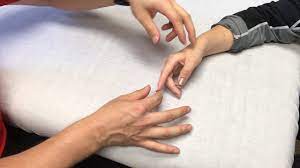
  • The starting position of the exam for the test patient is the seated position.
  • The examiner [therapist] flexes the distal interphalangeal joint while holding the proximal interphalangeal joints in a neutral position.

The test for tight retinacular [collateral] ligaments gives the following results:

  • The proximal interphalangeal capsule or retinacular[collateral] ligaments are tight if the distal interphalangeal joint is rigid.
  • The retinacular ligaments are tight and the capsule is normal if the proximal interphalangeal joint can bend and the distal interphalangeal joints can bend readily.
  • The patient does not make any aggressive movements or stay motionless throughout the exam.

Thumb grind test:

What is the importance of the thumb grind test?

This test is performed to examine the wrist joint’s degenerative joint condition.

How do you check the thumb grind test?

  • The patient is seated during the examination.
  • With the aid of the other hand, the examiner grasps the patient’s thumb just below the metacarpophalangeal joint while holding the patient’s hand.
  • The axial compression and rotation of the metacarpophalangeal joints are then applied by the examiner (therapist).

What is the result of the thumb grind test?

  • If the metacarpophalangeal or metacarpotrapezial joint, which is where the pain is coming from, has degenerative joint disease.
  • Any wrist or hand joint that experiences axial compression while rotating may also show a positive test in the same situations.

Similar Posts

  • Prone instability test

    Introduction The Prone Instability Test (PIT) is a clinical assessment used to evaluate the presence of instability in the lumbar spine. It is primarily used by healthcare professionals, such as physical therapists and chiropractors, to assess patients with low back pain. The Prone Instability test is an orthopedic test used to evaluate radiographic lumbar instability,…

  • | |

    Dermatomes

    Overview The term “dermatome” is a combination of two Greek words: “derma” meaning “skin” & “tome” meaning “cutting” or “thin segment”. Dermatomes are areas of the skin whose sensory distribution is innervated by afferent nerve fibers from the dorsal root of a single spinal nerve root, which is the portion of a peripheral nerve that…

  • External Rotation Recurvatum Test

    Introduction The External Rotation Recurvatum test to measure posterolateral instability of the knee joint is a general assessment of external rotation of the femur that occurs with knee hyperextension and stabilization of the femur. Purpose To document the tibiofemoral joint sagittal plane relationship in patients with posterolateral knee instability and positive external rotation recurvatum test…

  • Elsons Test

    Introduction The Elson test is a physical examination maneuver used to assess for a tear of the central slip of the extensor tendon of the finger. The central slip is a band of tissue that extends the proximal interphalangeal (PIP) joint of the finger. When it is torn, the PIP joint cannot fully extend and…

  • Ege’s Test

    Definition/Description The Ege test is also called the weight-bearing McMurray test because when patients do this test, they have to put weight on their knees. Depending on the meniscus being examined, the patient’s feet are turned outward (medial meniscus) or inward (lateral meniscus). Clinically relevant anatomy The genu articularis consists of several anatomical structures, including…

  • Manual muscle testing of Elbow

    Manual muscle testing of the elbow involves assessing the strength and function of specific muscles around the elbow joint. It is commonly used in physical therapy, rehabilitation, and sports medicine to evaluate muscle strength, detect muscle imbalances, and monitor progress during treatment. Here’s a step-by-step guide for manual muscle testing of the elbow: Elbow Flexion…

Leave a Reply